

7 Current-Induced Dynamics of Chiral Magnetic Structures
153
Note that from a topological point of view, skyrmions and the earlier studied magnetic bubbles are equivalent. Even, given the various systems where such magnetic
whirl-like textures with a winding number of ±1 occur, a clear definition and full
disentanglement might not be possible. Here, we will refer to magnetic bubbles when
the domain wall width of the topological whirl-like structure is small compared to its
the center area and to a skyrmion otherwise. While a strict differentiation between the
two is not possible, the static and dynamic properties of magnetic whirls do depend
on their detailed energy scales, and can be very different. In particular, skyrmions
are typically smaller and more stable such that they are potentially interesting for
future technological applications, see Sect. 7.6.
Roughly speaking, skyrmions occur in systems with competing interactions, of
which some favor the alignment of magnetic moments, and others prefer their twisting. In most systems, however, it is a more complicated interplay that finally stabilizes
the topological magnetic whirls. Experimentally, skyrmions have first been observed
in bulk crystals with broken inversion symmetry as a result of a competition between
a uniform stiffness A, DMI strength D, an applied magnetic field B and strong
thermal fluctuations at temperatures slightly below the critical temperature [29]. By
now several other systems have been identified to host skyrmions, revealing alternative stabilization mechanisms such as spatial confinement and frustrated exchange,
e.g., via RKKY [30, 31]. Moreover, materials have been tailored to exhibit a strong
interfacial DMI to host skyrmions at room temperature [32, 33]. For an overview of
different material systems we refer to [11].
Typically, when discussing magnetic skyrmions, it is assumed that these are whirls
in an out-of-plane polarized background. However, just as domain walls, skyrmions
can be hosted by in-plane polarized backgrounds [34, 35] or even more complex
background phases such as conical backgrounds in 3d [36], or embedded inside a
helical phase [37]. While skyrmions are effectively two-dimensional structures, there
is an ongoing search to find three-dimensional magnetic solitons.
A bit in the middle of two or three-dimensional structures are magnetic bobbers, [38] which, for example, occur in extended films. They look like a skyrmion on
the top surface and then turn into a Bloch point within the material. Chiral bobbers are
metastable states which are stabilized by the interplay of DMI and the boundary condition. The DMI induces a repulsive force between the skyrmion at the surface and
the the Bloch point, wherefore the remaining skyrmion string is not expelled from the
material. Similar surface effects have been known to occur due to demagnetization
effects [39].
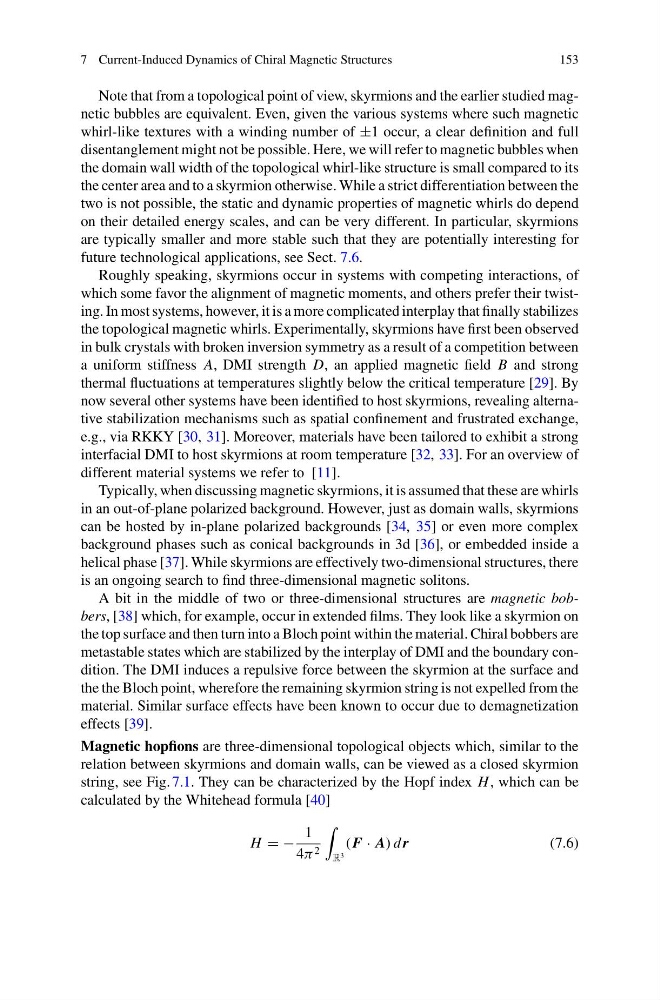
Magnetic hopfions are three-dimensional topological objects which, similar to the
relation between skyrmions and domain walls, can be viewed as a closed skyrmion
string, see Fig. 7.1. They can be characterized by the Hopf index H , which can be
calculated by the Whitehead formula [40]
H = −
1
4π 2
R 3
(F · A) d r
(7.6)
153
Note that from a topological point of view, skyrmions and the earlier studied magnetic bubbles are equivalent. Even, given the various systems where such magnetic
whirl-like textures with a winding number of ±1 occur, a clear definition and full
disentanglement might not be possible. Here, we will refer to magnetic bubbles when
the domain wall width of the topological whirl-like structure is small compared to its
the center area and to a skyrmion otherwise. While a strict differentiation between the
two is not possible, the static and dynamic properties of magnetic whirls do depend
on their detailed energy scales, and can be very different. In particular, skyrmions
are typically smaller and more stable such that they are potentially interesting for
future technological applications, see Sect. 7.6.
Roughly speaking, skyrmions occur in systems with competing interactions, of
which some favor the alignment of magnetic moments, and others prefer their twisting. In most systems, however, it is a more complicated interplay that finally stabilizes
the topological magnetic whirls. Experimentally, skyrmions have first been observed
in bulk crystals with broken inversion symmetry as a result of a competition between
a uniform stiffness A, DMI strength D, an applied magnetic field B and strong
thermal fluctuations at temperatures slightly below the critical temperature [29]. By
now several other systems have been identified to host skyrmions, revealing alternative stabilization mechanisms such as spatial confinement and frustrated exchange,
e.g., via RKKY [30, 31]. Moreover, materials have been tailored to exhibit a strong
interfacial DMI to host skyrmions at room temperature [32, 33]. For an overview of
different material systems we refer to [11].
Typically, when discussing magnetic skyrmions, it is assumed that these are whirls
in an out-of-plane polarized background. However, just as domain walls, skyrmions
can be hosted by in-plane polarized backgrounds [34, 35] or even more complex
background phases such as conical backgrounds in 3d [36], or embedded inside a
helical phase [37]. While skyrmions are effectively two-dimensional structures, there
is an ongoing search to find three-dimensional magnetic solitons.
A bit in the middle of two or three-dimensional structures are magnetic bobbers, [38] which, for example, occur in extended films. They look like a skyrmion on
the top surface and then turn into a Bloch point within the material. Chiral bobbers are
metastable states which are stabilized by the interplay of DMI and the boundary condition. The DMI induces a repulsive force between the skyrmion at the surface and
the the Bloch point, wherefore the remaining skyrmion string is not expelled from the
material. Similar surface effects have been known to occur due to demagnetization
effects [39].
Magnetic hopfions are three-dimensional topological objects which, similar to the
relation between skyrmions and domain walls, can be viewed as a closed skyrmion
string, see Fig. 7.1. They can be characterized by the Hopf index H , which can be
calculated by the Whitehead formula [40]
H = −
1
4π 2
R 3
(F · A) d r
(7.6)