

7 Current-Induced Dynamics of Chiral Magnetic Structures
151
7.2.2 Magnetization Dynamics in the Presence of
Spin-Torques
The interplay of magnetism and currents is very complex and they mutually influence each other. For example, upon traversing a topologically non-trivial magnetic
structure, the electrons pick up a Berry phase [21] which then leads to a topological
Hall effect [12, 22–24] in addition to other Hall contributions such as the anomalous
Hall effect. In this part, we will focus on the effects that an electric current has on
the magnetization.
Within the micromagnetic framework, where the local magnitude of the magnetization is constant, the slow and smooth magnetization dynamics can be described
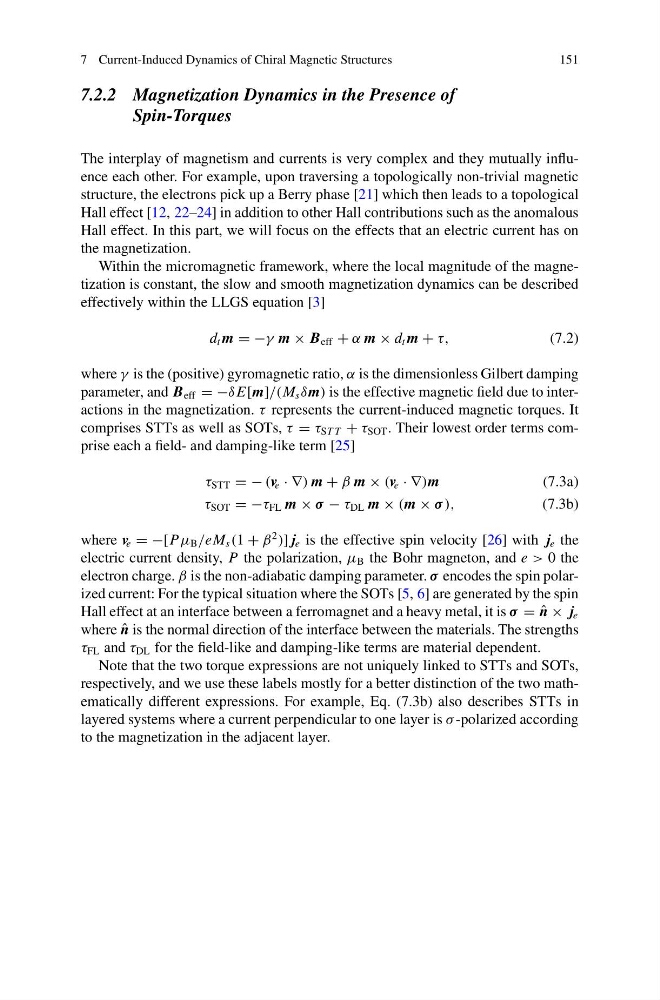
effectively within the LLGS equation [3]
d t m = −γ m × B eff + α m × d t m + τ,
(7.2)
where γ is the (positive) gyromagnetic ratio, α is the dimensionless Gilbert damping
parameter, and B eff = −δ E[m]/(M s δm) is the effective magnetic field due to interactions in the magnetization. τ represents the current-induced magnetic torques. It
comprises STTs as well as SOTs, τ = τ ST T + τ SOT . Their lowest order terms comprise each a field- and damping-like term [25]
τ STT = − (v e · ∇) m + β m × (v e · ∇)m
(7.3a)
τ SOT = −τ FL m × σ − τ DL m × (m × σ ),
(7.3b)
where v e = −[Pμ B /eM s (1 + β
2
)] j e is the effective spin velocity [26] with j e the
electric current density, P the polarization, μ B the Bohr magneton, and e > 0 the
electron charge. β is the non-adiabatic damping parameter. σ encodes the spin polarized current: For the typical situation where the SOTs [5, 6] are generated by the spin
Hall effect at an interface between a ferromagnet and a heavy metal, it is σ = ˆ
n × j e
where ˆ
n is the normal direction of the interface between the materials. The strengths
τ FL and τ DL for the field-like and damping-like terms are material dependent.
Note that the two torque expressions are not uniquely linked to STTs and SOTs,
respectively, and we use these labels mostly for a better distinction of the two mathematically different expressions. For example, Eq. (7.3b) also describes STTs in
layered systems where a current perpendicular to one layer is σ -polarized according
to the magnetization in the adjacent layer.
151
7.2.2 Magnetization Dynamics in the Presence of
Spin-Torques
The interplay of magnetism and currents is very complex and they mutually influence each other. For example, upon traversing a topologically non-trivial magnetic
structure, the electrons pick up a Berry phase [21] which then leads to a topological
Hall effect [12, 22–24] in addition to other Hall contributions such as the anomalous
Hall effect. In this part, we will focus on the effects that an electric current has on
the magnetization.
Within the micromagnetic framework, where the local magnitude of the magnetization is constant, the slow and smooth magnetization dynamics can be described
effectively within the LLGS equation [3]
d t m = −γ m × B eff + α m × d t m + τ,
(7.2)
where γ is the (positive) gyromagnetic ratio, α is the dimensionless Gilbert damping
parameter, and B eff = −δ E[m]/(M s δm) is the effective magnetic field due to interactions in the magnetization. τ represents the current-induced magnetic torques. It
comprises STTs as well as SOTs, τ = τ ST T + τ SOT . Their lowest order terms comprise each a field- and damping-like term [25]
τ STT = − (v e · ∇) m + β m × (v e · ∇)m
(7.3a)
τ SOT = −τ FL m × σ − τ DL m × (m × σ ),
(7.3b)
where v e = −[Pμ B /eM s (1 + β
2
)] j e is the effective spin velocity [26] with j e the
electric current density, P the polarization, μ B the Bohr magneton, and e > 0 the
electron charge. β is the non-adiabatic damping parameter. σ encodes the spin polarized current: For the typical situation where the SOTs [5, 6] are generated by the spin
Hall effect at an interface between a ferromagnet and a heavy metal, it is σ = ˆ
n × j e
where ˆ
n is the normal direction of the interface between the materials. The strengths
τ FL and τ DL for the field-like and damping-like terms are material dependent.
Note that the two torque expressions are not uniquely linked to STTs and SOTs,
respectively, and we use these labels mostly for a better distinction of the two mathematically different expressions. For example, Eq. (7.3b) also describes STTs in
layered systems where a current perpendicular to one layer is σ -polarized according
to the magnetization in the adjacent layer.