

94
K. Huang
4.4.1 Circular Dichroism and Helical Dichroism
In chemistry and biology, many molecules have the same compound of different
atoms but are assembled with different chirality, which can be distinguished by their
circular dichroism (CD) spectroscopy that measures the absorption difference of the
right-handed and left-handed circularly polarized light over a wide range of wavelengths. The fundamental physics is that, the chiral enantiomers have the different
extinction coefficients for right- and left-handed circular-polarization light. The CD
topic has been discussed in many literatures and therefore is ignored here, so that
we can focus the detection of chirality by using another chiral light with orbital
angular momentum as introduced in Sect. 3. The OAM-based chiral detection draws
the increasing attention because the traditional CD spectroscopy has the disadvantages of the weak CD responses at the level of micro-degrees and the broadband
illumination, which imposes the requirement on the optical detectors and the lasers.
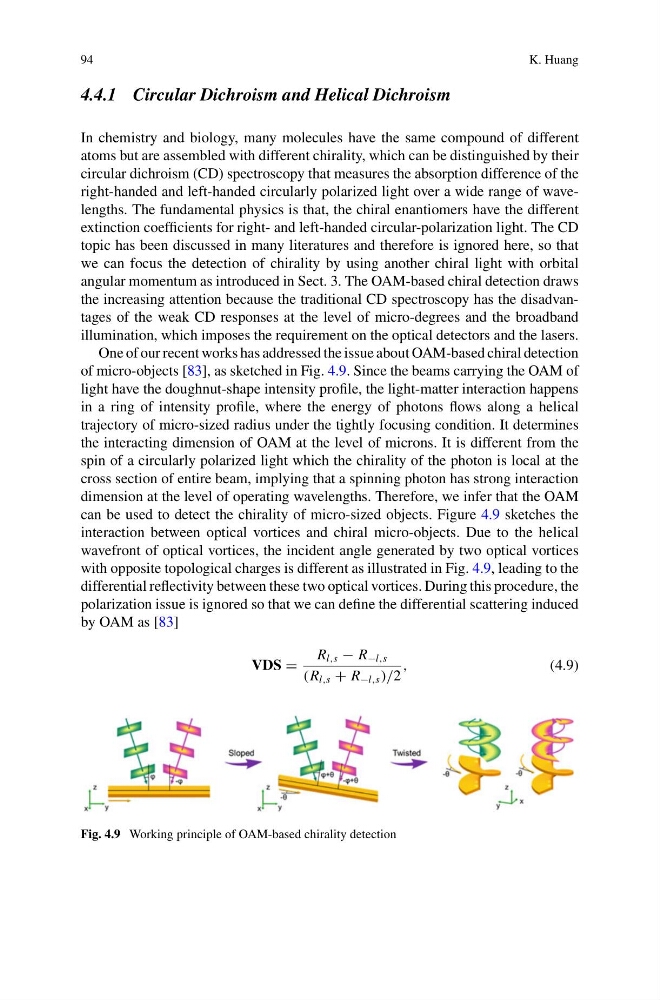
One of our recent works has addressed the issue about OAM-based chiral detection
of micro-objects [83], as sketched in Fig. 4.9. Since the beams carrying the OAM of
light have the doughnut-shape intensity profile, the light-matter interaction happens
in a ring of intensity profile, where the energy of photons flows along a helical
trajectory of micro-sized radius under the tightly focusing condition. It determines
the interacting dimension of OAM at the level of microns. It is different from the
spin of a circularly polarized light which the chirality of the photon is local at the
cross section of entire beam, implying that a spinning photon has strong interaction
dimension at the level of operating wavelengths. Therefore, we infer that the OAM
can be used to detect the chirality of micro-sized objects. Figure 4.9 sketches the
interaction between optical vortices and chiral micro-objects. Due to the helical
wavefront of optical vortices, the incident angle generated by two optical vortices
with opposite topological charges is different as illustrated in Fig. 4.9, leading to the
differential reflectivity between these two optical vortices. During this procedure, the
polarization issue is ignored so that we can define the differential scattering induced
by OAM as [83]
VDS =
R l,s − R −l,s
(R l,s + R −l,s )/2
,
(4.9)
Fig. 4.9 Working principle of OAM-based chirality detection
K. Huang
4.4.1 Circular Dichroism and Helical Dichroism
In chemistry and biology, many molecules have the same compound of different
atoms but are assembled with different chirality, which can be distinguished by their
circular dichroism (CD) spectroscopy that measures the absorption difference of the
right-handed and left-handed circularly polarized light over a wide range of wavelengths. The fundamental physics is that, the chiral enantiomers have the different
extinction coefficients for right- and left-handed circular-polarization light. The CD
topic has been discussed in many literatures and therefore is ignored here, so that
we can focus the detection of chirality by using another chiral light with orbital
angular momentum as introduced in Sect. 3. The OAM-based chiral detection draws
the increasing attention because the traditional CD spectroscopy has the disadvantages of the weak CD responses at the level of micro-degrees and the broadband
illumination, which imposes the requirement on the optical detectors and the lasers.
One of our recent works has addressed the issue about OAM-based chiral detection
of micro-objects [83], as sketched in Fig. 4.9. Since the beams carrying the OAM of
light have the doughnut-shape intensity profile, the light-matter interaction happens
in a ring of intensity profile, where the energy of photons flows along a helical
trajectory of micro-sized radius under the tightly focusing condition. It determines
the interacting dimension of OAM at the level of microns. It is different from the
spin of a circularly polarized light which the chirality of the photon is local at the
cross section of entire beam, implying that a spinning photon has strong interaction
dimension at the level of operating wavelengths. Therefore, we infer that the OAM
can be used to detect the chirality of micro-sized objects. Figure 4.9 sketches the
interaction between optical vortices and chiral micro-objects. Due to the helical
wavefront of optical vortices, the incident angle generated by two optical vortices
with opposite topological charges is different as illustrated in Fig. 4.9, leading to the
differential reflectivity between these two optical vortices. During this procedure, the
polarization issue is ignored so that we can define the differential scattering induced
by OAM as [83]
VDS =
R l,s − R −l,s
(R l,s + R −l,s )/2
,
(4.9)
Fig. 4.9 Working principle of OAM-based chirality detection