

86
K. Huang
4.3 Optical Chiral Metasurfaces
As introduced in Sect. 2., optical metasurfaces contain many types of structures that
are employed to control light with different polarizations. Considering the limitation of the topic about chirality, we constrain ourselves to discuss the chiral metasurfaces that manipulate the circularly polarized light with the geometric phase.
All the chiral metasurfaces follow the same mechanism of realizing the geometric
phase. We start by giving a universal introduction about geometric metasurfaces
containing the birefringent nanostructures that have different responses to two orthogonal components of an incident circularly polarized light. Without the loss of generality, we define the scattering Jones matrix of the non-rotating nanostructure by using
S(ϕ = 0) =
s x 0
0 s y
, where the scattering factors s x and s y stand for the complex
modulation of x- and y-components of the incident polarized light, respectively. The
anti-diagonal elements are fixed to zeros under the assumption that the optical scattering by the nanostructures will not generate a new electric component orthogonal
to the incident one, which is usually valid for rectangle-shape nanostructures. If the
nanostructure has a rotating angle of ϕ with the x-axis, its scattering matrix is
S(ϕ) = R(−ϕ)
s x 0
0 s y
R(ϕ)
(4.7)
where the rotation matrix R(ϕ) =
cos ϕ sin ϕ
− sin ϕ cos ϕ
. When a circularly polarized
beam with the electric field of E
σ
= E•(e x +σ ie y ) is incident on the nanostructure,
the scattering light has the electric field
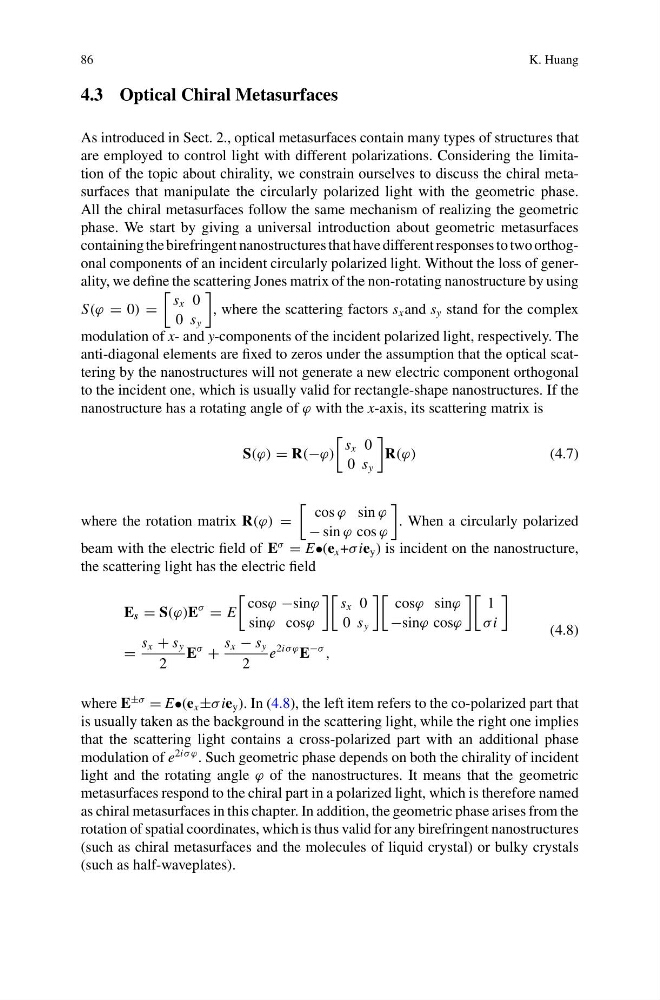
E s = S(ϕ)E
σ
= E
cosϕ −sinϕ
sinϕ cosϕ
s x 0
0 s y
cosϕ sinϕ
−sinϕ cosϕ
1
σ i
=
s x + s y
2
E
σ
+
s x − s y
2
e
2iσ ϕ E
−σ
,
(4.8)
where E
±σ
= E•(e x ±σ ie y ). In (4.8), the left item refers to the co-polarized part that
is usually taken as the background in the scattering light, while the right one implies
that the scattering light contains a cross-polarized part with an additional phase
modulation of e
2iσ ϕ . Such geometric phase depends on both the chirality of incident
light and the rotating angle ϕ of the nanostructures. It means that the geometric
metasurfaces respond to the chiral part in a polarized light, which is therefore named
as chiral metasurfaces in this chapter. In addition, the geometric phase arises from the
rotation of spatial coordinates, which is thus valid for any birefringent nanostructures
(such as chiral metasurfaces and the molecules of liquid crystal) or bulky crystals
(such as half-waveplates).
K. Huang
4.3 Optical Chiral Metasurfaces
As introduced in Sect. 2., optical metasurfaces contain many types of structures that
are employed to control light with different polarizations. Considering the limitation of the topic about chirality, we constrain ourselves to discuss the chiral metasurfaces that manipulate the circularly polarized light with the geometric phase.
All the chiral metasurfaces follow the same mechanism of realizing the geometric
phase. We start by giving a universal introduction about geometric metasurfaces
containing the birefringent nanostructures that have different responses to two orthogonal components of an incident circularly polarized light. Without the loss of generality, we define the scattering Jones matrix of the non-rotating nanostructure by using
S(ϕ = 0) =
s x 0
0 s y
, where the scattering factors s x and s y stand for the complex
modulation of x- and y-components of the incident polarized light, respectively. The
anti-diagonal elements are fixed to zeros under the assumption that the optical scattering by the nanostructures will not generate a new electric component orthogonal
to the incident one, which is usually valid for rectangle-shape nanostructures. If the
nanostructure has a rotating angle of ϕ with the x-axis, its scattering matrix is
S(ϕ) = R(−ϕ)
s x 0
0 s y
R(ϕ)
(4.7)
where the rotation matrix R(ϕ) =
cos ϕ sin ϕ
− sin ϕ cos ϕ
. When a circularly polarized
beam with the electric field of E
σ
= E•(e x +σ ie y ) is incident on the nanostructure,
the scattering light has the electric field
E s = S(ϕ)E
σ
= E
cosϕ −sinϕ
sinϕ cosϕ
s x 0
0 s y
cosϕ sinϕ
−sinϕ cosϕ
1
σ i
=
s x + s y
2
E
σ
+
s x − s y
2
e
2iσ ϕ E
−σ
,
(4.8)
where E
±σ
= E•(e x ±σ ie y ). In (4.8), the left item refers to the co-polarized part that
is usually taken as the background in the scattering light, while the right one implies
that the scattering light contains a cross-polarized part with an additional phase
modulation of e
2iσ ϕ . Such geometric phase depends on both the chirality of incident
light and the rotating angle ϕ of the nanostructures. It means that the geometric
metasurfaces respond to the chiral part in a polarized light, which is therefore named
as chiral metasurfaces in this chapter. In addition, the geometric phase arises from the
rotation of spatial coordinates, which is thus valid for any birefringent nanostructures
(such as chiral metasurfaces and the molecules of liquid crystal) or bulky crystals
(such as half-waveplates).