

63
granulosa cells differentiate into a layer of periantral cells, delimiting the cavity
filled with a fluid, and a cumulus, inside which the egg is still crowned by cells
(corona radiata). At this stage, the cells have acquired sensitivity to the folliclestimulating hormone, secreted by the pituitary and necessary for final maturation
and ovulation. Alternative tests for female fertility include test on isolated follicles
or stabilized cell lines, such as those derived from the Chinese hamster ovary, the
human granulosa, and the cancerous ovarian cells.
The isolated follicles and the cumulus and oocyte complex permit to follow the
maturation of the female gamete and of its environment, to produce the zygote, and
study the artificial fertilization. In mammals, the female gamete matures and is
fertilized inside the body; therefore, its collection for in vitro studies requires more
manipulation than that necessary for the mature sperm. The granulosa cells
surrounding the follicular fluid form the multilayered cumulus–oocyte complex and
play a pivotal role in reproduction. The periantral cells secrete the follicular fluid,
regulate the maturation of follicles, the ovulation, and the formation of corpus
luteum. The cumulus cells regulate instead the maturation of the egg. In addition to
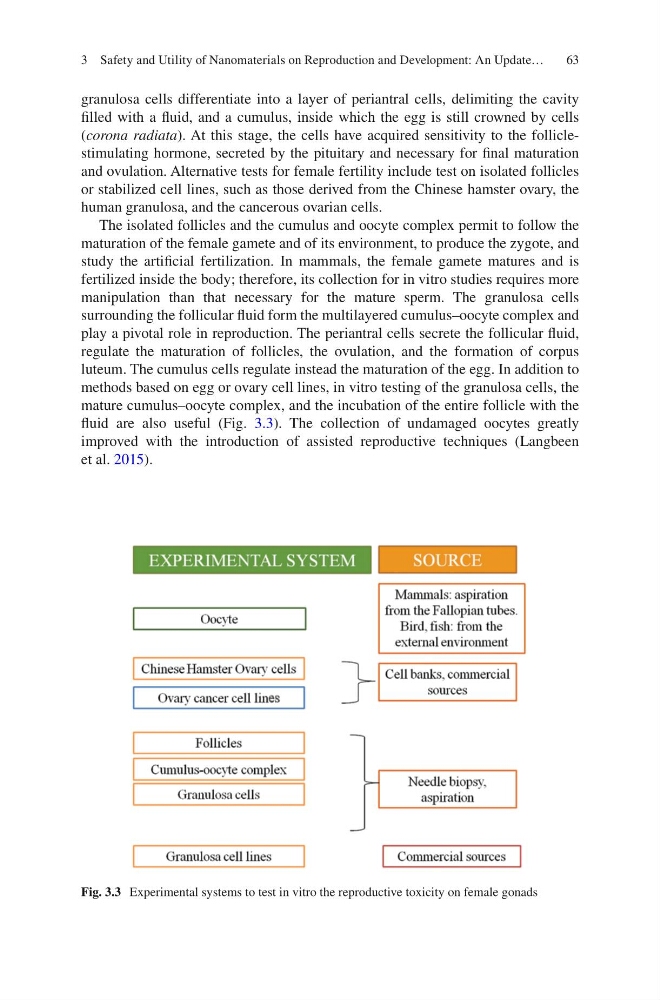
methods based on egg or ovary cell lines, in vitro testing of the granulosa cells, the
mature cumulus–oocyte complex, and the incubation of the entire follicle with the
fluid are also useful (Fig. 3.3). The collection of undamaged oocytes greatly
improved with the introduction of assisted reproductive techniques (Langbeen
et al. 2015).
Fig. 3.3 Experimental systems to test in vitro the reproductive toxicity on female gonads
3 Safety and Utility of Nanomaterials on Reproduction and Development: An Update…
granulosa cells differentiate into a layer of periantral cells, delimiting the cavity
filled with a fluid, and a cumulus, inside which the egg is still crowned by cells
(corona radiata). At this stage, the cells have acquired sensitivity to the folliclestimulating hormone, secreted by the pituitary and necessary for final maturation
and ovulation. Alternative tests for female fertility include test on isolated follicles
or stabilized cell lines, such as those derived from the Chinese hamster ovary, the
human granulosa, and the cancerous ovarian cells.
The isolated follicles and the cumulus and oocyte complex permit to follow the
maturation of the female gamete and of its environment, to produce the zygote, and
study the artificial fertilization. In mammals, the female gamete matures and is
fertilized inside the body; therefore, its collection for in vitro studies requires more
manipulation than that necessary for the mature sperm. The granulosa cells
surrounding the follicular fluid form the multilayered cumulus–oocyte complex and
play a pivotal role in reproduction. The periantral cells secrete the follicular fluid,
regulate the maturation of follicles, the ovulation, and the formation of corpus
luteum. The cumulus cells regulate instead the maturation of the egg. In addition to
methods based on egg or ovary cell lines, in vitro testing of the granulosa cells, the
mature cumulus–oocyte complex, and the incubation of the entire follicle with the
fluid are also useful (Fig. 3.3). The collection of undamaged oocytes greatly
improved with the introduction of assisted reproductive techniques (Langbeen
et al. 2015).
Fig. 3.3 Experimental systems to test in vitro the reproductive toxicity on female gonads
3 Safety and Utility of Nanomaterials on Reproduction and Development: An Update…