

295
11.5 Physicochemical Properties of Engineered
Nanomaterials and Their Toxicity
The indispensable application of the ENPs in different sectors including pharmaceuticals results in their dissemination into the environment. In fact, the very similar
properties that direct toward the scientific and technical benefits of nanotechnology
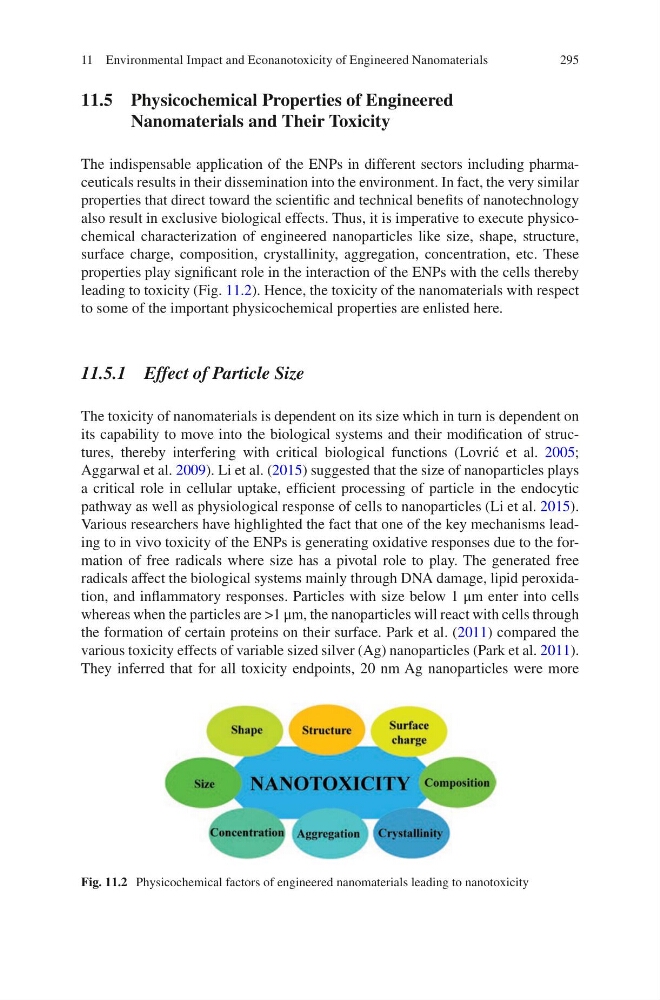
also result in exclusive biological effects. Thus, it is imperative to execute physicochemical characterization of engineered nanoparticles like size, shape, structure,
surface charge, composition, crystallinity, aggregation, concentration, etc. These
properties play significant role in the interaction of the ENPs with the cells thereby
leading to toxicity (Fig. 11.2). Hence, the toxicity of the nanomaterials with respect
to some of the important physicochemical properties are enlisted here.
11.5.1 Effect of Particle Size
The toxicity of nanomaterials is dependent on its size which in turn is dependent on
its capability to move into the biological systems and their modification of structures, thereby interfering with critical biological functions (Lovrić et al. 2005;
Aggarwal et al. 2009). Li et al. (2015) suggested that the size of nanoparticles plays
a critical role in cellular uptake, efficient processing of particle in the endocytic
pathway as well as physiological response of cells to nanoparticles (Li et al. 2015).
Various researchers have highlighted the fact that one of the key mechanisms leading to in vivo toxicity of the ENPs is generating oxidative responses due to the formation of free radicals where size has a pivotal role to play. The generated free
radicals affect the biological systems mainly through DNA damage, lipid peroxidation, and inflammatory responses. Particles with size below 1 μm enter into cells
whereas when the particles are >1 μm, the nanoparticles will react with cells through
the formation of certain proteins on their surface. Park et al. (2011) compared the
various toxicity effects of variable sized silver (Ag) nanoparticles (Park et al. 2011).
They inferred that for all toxicity endpoints, 20 nm Ag nanoparticles were more
Fig. 11.2 Physicochemical factors of engineered nanomaterials leading to nanotoxicity
11 Environmental Impact and Econanotoxicity of Engineered Nanomaterials
11.5 Physicochemical Properties of Engineered
Nanomaterials and Their Toxicity
The indispensable application of the ENPs in different sectors including pharmaceuticals results in their dissemination into the environment. In fact, the very similar
properties that direct toward the scientific and technical benefits of nanotechnology
also result in exclusive biological effects. Thus, it is imperative to execute physicochemical characterization of engineered nanoparticles like size, shape, structure,
surface charge, composition, crystallinity, aggregation, concentration, etc. These
properties play significant role in the interaction of the ENPs with the cells thereby
leading to toxicity (Fig. 11.2). Hence, the toxicity of the nanomaterials with respect
to some of the important physicochemical properties are enlisted here.
11.5.1 Effect of Particle Size
The toxicity of nanomaterials is dependent on its size which in turn is dependent on
its capability to move into the biological systems and their modification of structures, thereby interfering with critical biological functions (Lovrić et al. 2005;
Aggarwal et al. 2009). Li et al. (2015) suggested that the size of nanoparticles plays
a critical role in cellular uptake, efficient processing of particle in the endocytic
pathway as well as physiological response of cells to nanoparticles (Li et al. 2015).
Various researchers have highlighted the fact that one of the key mechanisms leading to in vivo toxicity of the ENPs is generating oxidative responses due to the formation of free radicals where size has a pivotal role to play. The generated free
radicals affect the biological systems mainly through DNA damage, lipid peroxidation, and inflammatory responses. Particles with size below 1 μm enter into cells
whereas when the particles are >1 μm, the nanoparticles will react with cells through
the formation of certain proteins on their surface. Park et al. (2011) compared the
various toxicity effects of variable sized silver (Ag) nanoparticles (Park et al. 2011).
They inferred that for all toxicity endpoints, 20 nm Ag nanoparticles were more
Fig. 11.2 Physicochemical factors of engineered nanomaterials leading to nanotoxicity
11 Environmental Impact and Econanotoxicity of Engineered Nanomaterials