

291
aggregation of the synthesized nanoparticles during mechanical milling; they comprise a film or coat throughout the NPs to prevent aggregation (Borm et al. 2006).
However, the unique qualities of the ENPs result in new chemical reactions, thereby
making the prediction of its environmental impact and fate more difficult which in
turn calls for significant multidisciplinary advances to know about their impacts
(Wiesner et al. 2006; Handy et al. 2008).
11.3 Different Classes of Engineered Nanoparticles
As discussed previously, the NPs relevant in the environment can be categorized
into natural and engineered nanoparticles. The ENPs are further categorized into
various classes, including (i) carbonaceous nanomaterials (fullerene compounds,
nanotubes, nanowires, etc.), (ii) metal oxides [bismuth trioxide (Bi 2 O 3 ), chromium
dioxide (CrO 2 ), cerium dioxide (CeO 2 ), molybdenum trioxide (MoO 3 ), titanium
dioxide (TiO 2 ), zinc oxide (ZnO)], and binary oxides, (iii) semiconductor materials
[quantum dots (QDs)], (iv) zero-valent metals [ferric (Fe
3+
) or ferrous, dissolution
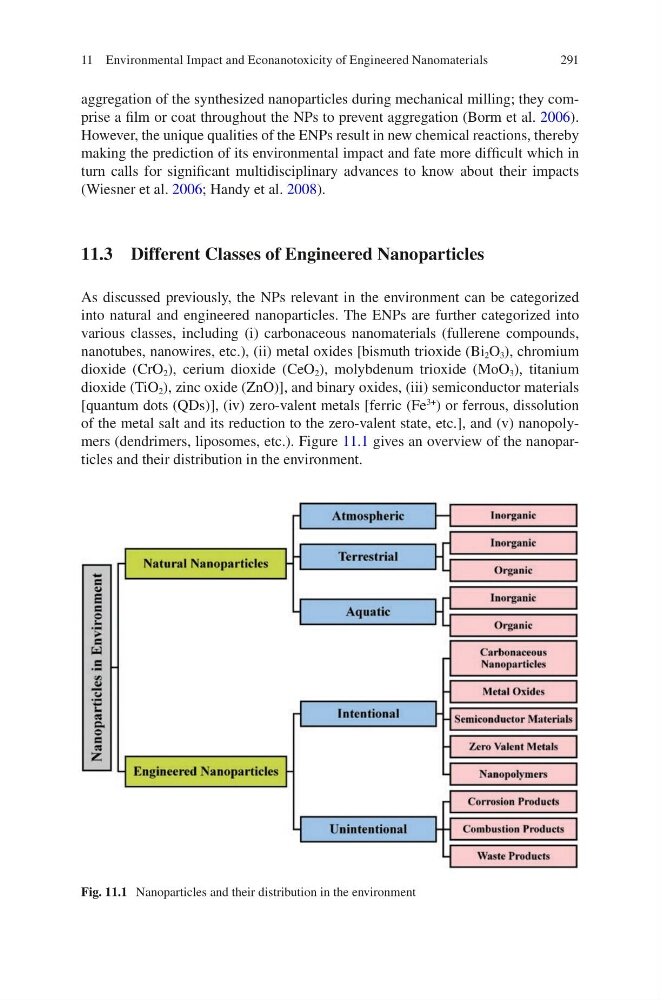
of the metal salt and its reduction to the zero-valent state, etc.], and (v) nanopolymers (dendrimers, liposomes, etc.). Figure 11.1 gives an overview of the nanoparticles and their distribution in the environment.
Fig. 11.1 Nanoparticles and their distribution in the environment
11 Environmental Impact and Econanotoxicity of Engineered Nanomaterials
aggregation of the synthesized nanoparticles during mechanical milling; they comprise a film or coat throughout the NPs to prevent aggregation (Borm et al. 2006).
However, the unique qualities of the ENPs result in new chemical reactions, thereby
making the prediction of its environmental impact and fate more difficult which in
turn calls for significant multidisciplinary advances to know about their impacts
(Wiesner et al. 2006; Handy et al. 2008).
11.3 Different Classes of Engineered Nanoparticles
As discussed previously, the NPs relevant in the environment can be categorized
into natural and engineered nanoparticles. The ENPs are further categorized into
various classes, including (i) carbonaceous nanomaterials (fullerene compounds,
nanotubes, nanowires, etc.), (ii) metal oxides [bismuth trioxide (Bi 2 O 3 ), chromium
dioxide (CrO 2 ), cerium dioxide (CeO 2 ), molybdenum trioxide (MoO 3 ), titanium
dioxide (TiO 2 ), zinc oxide (ZnO)], and binary oxides, (iii) semiconductor materials
[quantum dots (QDs)], (iv) zero-valent metals [ferric (Fe
3+
) or ferrous, dissolution
of the metal salt and its reduction to the zero-valent state, etc.], and (v) nanopolymers (dendrimers, liposomes, etc.). Figure 11.1 gives an overview of the nanoparticles and their distribution in the environment.
Fig. 11.1 Nanoparticles and their distribution in the environment
11 Environmental Impact and Econanotoxicity of Engineered Nanomaterials