

267
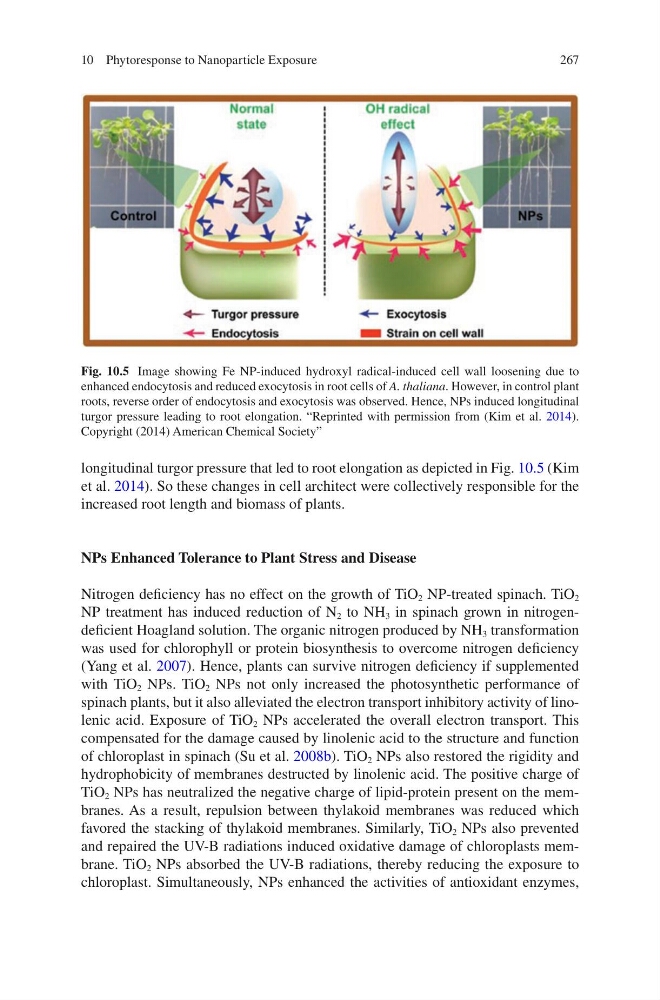
longitudinal turgor pressure that led to root elongation as depicted in Fig. 10.5 (Kim
et al. 2014). So these changes in cell architect were collectively responsible for the
increased root length and biomass of plants.
NPs Enhanced Tolerance to Plant Stress and Disease
Nitrogen deficiency has no effect on the growth of TiO 2 NP-treated spinach. TiO 2
NP treatment has induced reduction of N 2 to NH 3 in spinach grown in nitrogendeficient Hoagland solution. The organic nitrogen produced by NH 3 transformation
was used for chlorophyll or protein biosynthesis to overcome nitrogen deficiency
(Yang et al. 2007). Hence, plants can survive nitrogen deficiency if supplemented
with TiO 2 NPs. TiO 2 NPs not only increased the photosynthetic performance of
spinach plants, but it also alleviated the electron transport inhibitory activity of linolenic acid. Exposure of TiO 2 NPs accelerated the overall electron transport. This
compensated for the damage caused by linolenic acid to the structure and function
of chloroplast in spinach (Su et al. 2008b). TiO 2 NPs also restored the rigidity and
hydrophobicity of membranes destructed by linolenic acid. The positive charge of
TiO 2 NPs has neutralized the negative charge of lipid-protein present on the membranes. As a result, repulsion between thylakoid membranes was reduced which
favored the stacking of thylakoid membranes. Similarly, TiO 2 NPs also prevented
and repaired the UV-B radiations induced oxidative damage of chloroplasts membrane. TiO 2 NPs absorbed the UV-B radiations, thereby reducing the exposure to
chloroplast. Simultaneously, NPs enhanced the activities of antioxidant enzymes,
Fig. 10.5 Image showing Fe NP-induced hydroxyl radical-induced cell wall loosening due to
enhanced endocytosis and reduced exocytosis in root cells of A. thaliana. However, in control plant
roots, reverse order of endocytosis and exocytosis was observed. Hence, NPs induced longitudinal
turgor pressure leading to root elongation. “Reprinted with permission from (Kim et al. 2014).
Copyright (2014) American Chemical Society”
10 Phytoresponse to Nanoparticle Exposure
longitudinal turgor pressure that led to root elongation as depicted in Fig. 10.5 (Kim
et al. 2014). So these changes in cell architect were collectively responsible for the
increased root length and biomass of plants.
NPs Enhanced Tolerance to Plant Stress and Disease
Nitrogen deficiency has no effect on the growth of TiO 2 NP-treated spinach. TiO 2
NP treatment has induced reduction of N 2 to NH 3 in spinach grown in nitrogendeficient Hoagland solution. The organic nitrogen produced by NH 3 transformation
was used for chlorophyll or protein biosynthesis to overcome nitrogen deficiency
(Yang et al. 2007). Hence, plants can survive nitrogen deficiency if supplemented
with TiO 2 NPs. TiO 2 NPs not only increased the photosynthetic performance of
spinach plants, but it also alleviated the electron transport inhibitory activity of linolenic acid. Exposure of TiO 2 NPs accelerated the overall electron transport. This
compensated for the damage caused by linolenic acid to the structure and function
of chloroplast in spinach (Su et al. 2008b). TiO 2 NPs also restored the rigidity and
hydrophobicity of membranes destructed by linolenic acid. The positive charge of
TiO 2 NPs has neutralized the negative charge of lipid-protein present on the membranes. As a result, repulsion between thylakoid membranes was reduced which
favored the stacking of thylakoid membranes. Similarly, TiO 2 NPs also prevented
and repaired the UV-B radiations induced oxidative damage of chloroplasts membrane. TiO 2 NPs absorbed the UV-B radiations, thereby reducing the exposure to
chloroplast. Simultaneously, NPs enhanced the activities of antioxidant enzymes,
Fig. 10.5 Image showing Fe NP-induced hydroxyl radical-induced cell wall loosening due to
enhanced endocytosis and reduced exocytosis in root cells of A. thaliana. However, in control plant
roots, reverse order of endocytosis and exocytosis was observed. Hence, NPs induced longitudinal
turgor pressure leading to root elongation. “Reprinted with permission from (Kim et al. 2014).
Copyright (2014) American Chemical Society”
10 Phytoresponse to Nanoparticle Exposure