

253
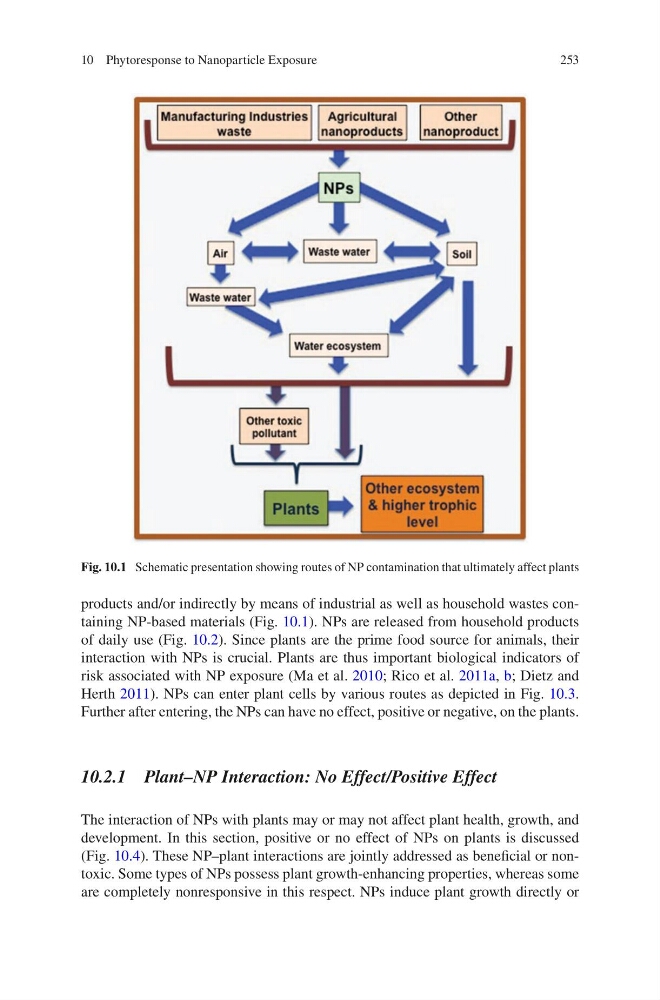
products and/or indirectly by means of industrial as well as household wastes containing NP-based materials (Fig. 10.1). NPs are released from household products
of daily use (Fig. 10.2). Since plants are the prime food source for animals, their
interaction with NPs is crucial. Plants are thus important biological indicators of
risk associated with NP exposure (Ma et al. 2010; Rico et al. 2011a, b; Dietz and
Herth 2011). NPs can enter plant cells by various routes as depicted in Fig. 10.3.
Further after entering, the NPs can have no effect, positive or negative, on the plants.
10.2.1 Plant–NP Interaction: No Effect/Positive Effect
The interaction of NPs with plants may or may not affect plant health, growth, and
development. In this section, positive or no effect of NPs on plants is discussed
(Fig. 10.4). These NP–plant interactions are jointly addressed as beneficial or nontoxic. Some types of NPs possess plant growth-enhancing properties, whereas some
are completely nonresponsive in this respect. NPs induce plant growth directly or
Fig. 10.1 Schematic presentation showing routes of NP contamination that ultimately affect plants
10 Phytoresponse to Nanoparticle Exposure
products and/or indirectly by means of industrial as well as household wastes containing NP-based materials (Fig. 10.1). NPs are released from household products
of daily use (Fig. 10.2). Since plants are the prime food source for animals, their
interaction with NPs is crucial. Plants are thus important biological indicators of
risk associated with NP exposure (Ma et al. 2010; Rico et al. 2011a, b; Dietz and
Herth 2011). NPs can enter plant cells by various routes as depicted in Fig. 10.3.
Further after entering, the NPs can have no effect, positive or negative, on the plants.
10.2.1 Plant–NP Interaction: No Effect/Positive Effect
The interaction of NPs with plants may or may not affect plant health, growth, and
development. In this section, positive or no effect of NPs on plants is discussed
(Fig. 10.4). These NP–plant interactions are jointly addressed as beneficial or nontoxic. Some types of NPs possess plant growth-enhancing properties, whereas some
are completely nonresponsive in this respect. NPs induce plant growth directly or
Fig. 10.1 Schematic presentation showing routes of NP contamination that ultimately affect plants
10 Phytoresponse to Nanoparticle Exposure