

205
Donaldson et al. (2004) to establish a new subarea in the toxicology field with focus
on the knowledge of NMs-induced toxicity. Thus, nanotoxicology is defined as the
“study of adverse effects of NMs on living organisms and ecosystems, including the
prevention and amelioration of such adverse effects” (Cattaneo et al. 2010).
Hazard characterization and toxicity testing of NMs are carried out using in vitro
and in vivo assays, for the establishment of dose–response relationships, also considering different degrees of exposure. NMs toxicological characterization must be
considered on the primary stages of new material development with the purpose to
predict the biological response obtained with the manipulation of several parameters. The unique properties of NMs and their higher reactivity, which differ from
conventional sized materials, may reflect on toxicity (Patel and Shah 2017). In fact,
several physicochemical parameters, such as chemical composition, size and surface area, surface functionalization and charge, shape, and dissolution profiles
(Seitz et al. 2014; Mendes et al. 2014; Huang et al. 2011; Gonzalez et al. 2014), are
responsible for biological effects, thus a casuistic approach for studying their impact
on human health is required.
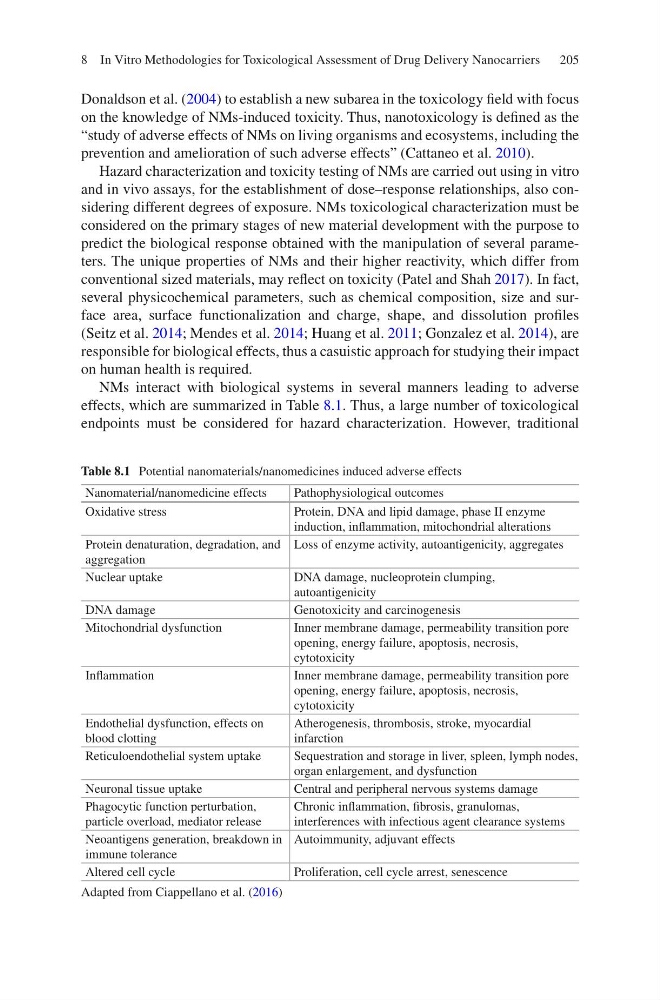
NMs interact with biological systems in several manners leading to adverse
effects, which are summarized in Table 8.1. Thus, a large number of toxicological
endpoints must be considered for hazard characterization. However, traditional
Table 8.1 Potential nanomaterials/nanomedicines induced adverse effects
Nanomaterial/nanomedicine effects
Pathophysiological outcomes
Oxidative stress
Protein, DNA and lipid damage, phase II enzyme
induction, inflammation, mitochondrial alterations
Protein denaturation, degradation, and
aggregation
Loss of enzyme activity, autoantigenicity, aggregates
Nuclear uptake
DNA damage, nucleoprotein clumping,
autoantigenicity
DNA damage
Genotoxicity and carcinogenesis
Mitochondrial dysfunction
Inner membrane damage, permeability transition pore
opening, energy failure, apoptosis, necrosis,
cytotoxicity
Inflammation
Inner membrane damage, permeability transition pore
opening, energy failure, apoptosis, necrosis,
cytotoxicity
Endothelial dysfunction, effects on
blood clotting
Atherogenesis, thrombosis, stroke, myocardial
infarction
Reticuloendothelial system uptake
Sequestration and storage in liver, spleen, lymph nodes,
organ enlargement, and dysfunction
Neuronal tissue uptake
Central and peripheral nervous systems damage
Phagocytic function perturbation,
particle overload, mediator release
Chronic inflammation, fibrosis, granulomas,
interferences with infectious agent clearance systems
Neoantigens generation, breakdown in
immune tolerance
Autoimmunity, adjuvant effects
Altered cell cycle
Proliferation, cell cycle arrest, senescence
Adapted from Ciappellano et al. (2016)
8 In Vitro Methodologies for Toxicological Assessment of Drug Delivery Nanocarriers
Donaldson et al. (2004) to establish a new subarea in the toxicology field with focus
on the knowledge of NMs-induced toxicity. Thus, nanotoxicology is defined as the
“study of adverse effects of NMs on living organisms and ecosystems, including the
prevention and amelioration of such adverse effects” (Cattaneo et al. 2010).
Hazard characterization and toxicity testing of NMs are carried out using in vitro
and in vivo assays, for the establishment of dose–response relationships, also considering different degrees of exposure. NMs toxicological characterization must be
considered on the primary stages of new material development with the purpose to
predict the biological response obtained with the manipulation of several parameters. The unique properties of NMs and their higher reactivity, which differ from
conventional sized materials, may reflect on toxicity (Patel and Shah 2017). In fact,
several physicochemical parameters, such as chemical composition, size and surface area, surface functionalization and charge, shape, and dissolution profiles
(Seitz et al. 2014; Mendes et al. 2014; Huang et al. 2011; Gonzalez et al. 2014), are
responsible for biological effects, thus a casuistic approach for studying their impact
on human health is required.
NMs interact with biological systems in several manners leading to adverse
effects, which are summarized in Table 8.1. Thus, a large number of toxicological
endpoints must be considered for hazard characterization. However, traditional
Table 8.1 Potential nanomaterials/nanomedicines induced adverse effects
Nanomaterial/nanomedicine effects
Pathophysiological outcomes
Oxidative stress
Protein, DNA and lipid damage, phase II enzyme
induction, inflammation, mitochondrial alterations
Protein denaturation, degradation, and
aggregation
Loss of enzyme activity, autoantigenicity, aggregates
Nuclear uptake
DNA damage, nucleoprotein clumping,
autoantigenicity
DNA damage
Genotoxicity and carcinogenesis
Mitochondrial dysfunction
Inner membrane damage, permeability transition pore
opening, energy failure, apoptosis, necrosis,
cytotoxicity
Inflammation
Inner membrane damage, permeability transition pore
opening, energy failure, apoptosis, necrosis,
cytotoxicity
Endothelial dysfunction, effects on
blood clotting
Atherogenesis, thrombosis, stroke, myocardial
infarction
Reticuloendothelial system uptake
Sequestration and storage in liver, spleen, lymph nodes,
organ enlargement, and dysfunction
Neuronal tissue uptake
Central and peripheral nervous systems damage
Phagocytic function perturbation,
particle overload, mediator release
Chronic inflammation, fibrosis, granulomas,
interferences with infectious agent clearance systems
Neoantigens generation, breakdown in
immune tolerance
Autoimmunity, adjuvant effects
Altered cell cycle
Proliferation, cell cycle arrest, senescence
Adapted from Ciappellano et al. (2016)
8 In Vitro Methodologies for Toxicological Assessment of Drug Delivery Nanocarriers