

178
graphene-based materials including graphene oxide and reduced graphene oxide,
concerns have been raised about the nanotoxicological effects that they can cause in
the environment, reaching all trophic levels, from aquatic through terrestrial ecosystems (Ou et al. 2016; Guo et al. 2017; He et al. 2017; Zhang et al. 2017; Zhao et al.
2017; Garacci et al. 2017; Katsumiti et al. 2017).
Graphene can be obtained from crystalline graphite by different chemical routes
(Ou et al. 2016). According to Paulchamy et al. (2015), the structure and properties
of graphene oxide are dependent on the type of synthesis method and also on the
degree of oxidation process. The types of graphene and their derivatives may include
monolayer graphene, graphene (2–5 layers), multilayer graphene (2–10 layers),
graphite nanoplates, graphene oxide, reduced graphene oxide, graphene nanosheets,
graphene quantum dots, among others (Geim 2009; Park et al. 2009; Seabra et al.
2014; Guo and Mei 2014; Facure et al. 2020).
The syntheses methods for graphene oxide and reduced graphene oxide will be
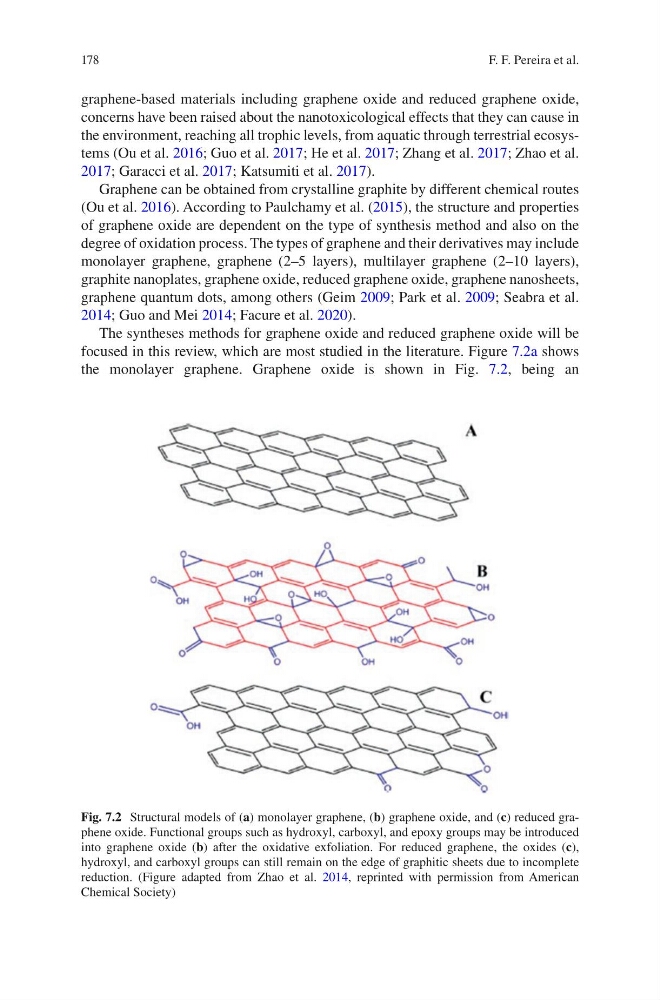
focused in this review, which are most studied in the literature. Figure 7.2a shows
the monolayer graphene. Graphene oxide is shown in Fig. 7.2, being an
Fig. 7.2 Structural models of (a) monolayer graphene, (b) graphene oxide, and (c) reduced graphene oxide. Functional groups such as hydroxyl, carboxyl, and epoxy groups may be introduced
into graphene oxide (b) after the oxidative exfoliation. For reduced graphene, the oxides (c),
hydroxyl, and carboxyl groups can still remain on the edge of graphitic sheets due to incomplete
reduction. (Figure adapted from Zhao et al. 2014, reprinted with permission from American
Chemical Society)
F. F. Pereira et al.
graphene-based materials including graphene oxide and reduced graphene oxide,
concerns have been raised about the nanotoxicological effects that they can cause in
the environment, reaching all trophic levels, from aquatic through terrestrial ecosystems (Ou et al. 2016; Guo et al. 2017; He et al. 2017; Zhang et al. 2017; Zhao et al.
2017; Garacci et al. 2017; Katsumiti et al. 2017).
Graphene can be obtained from crystalline graphite by different chemical routes
(Ou et al. 2016). According to Paulchamy et al. (2015), the structure and properties
of graphene oxide are dependent on the type of synthesis method and also on the
degree of oxidation process. The types of graphene and their derivatives may include
monolayer graphene, graphene (2–5 layers), multilayer graphene (2–10 layers),
graphite nanoplates, graphene oxide, reduced graphene oxide, graphene nanosheets,
graphene quantum dots, among others (Geim 2009; Park et al. 2009; Seabra et al.
2014; Guo and Mei 2014; Facure et al. 2020).
The syntheses methods for graphene oxide and reduced graphene oxide will be
focused in this review, which are most studied in the literature. Figure 7.2a shows
the monolayer graphene. Graphene oxide is shown in Fig. 7.2, being an
Fig. 7.2 Structural models of (a) monolayer graphene, (b) graphene oxide, and (c) reduced graphene oxide. Functional groups such as hydroxyl, carboxyl, and epoxy groups may be introduced
into graphene oxide (b) after the oxidative exfoliation. For reduced graphene, the oxides (c),
hydroxyl, and carboxyl groups can still remain on the edge of graphitic sheets due to incomplete
reduction. (Figure adapted from Zhao et al. 2014, reprinted with permission from American
Chemical Society)
F. F. Pereira et al.