

134
and Behranvand 2016). Especially, it is widely used in medicine due to their specific
physical and chemical properties which alter the normal biological activity, as compared to bulk materials. The main use of polymer-based nanoparticle is in drug
delivery, although they are also used in bioimaging and biosensing assays.
Cytotoxicity and degradation by-products are major problems and it needs to be
further investigated in order to improve the biocompatibility of polymeric nanoparticles. Regarding this, many polymeric core-shell nanoparticles are being explored
in various clinical phase trials, meaning that they have so far surpassed the cellular
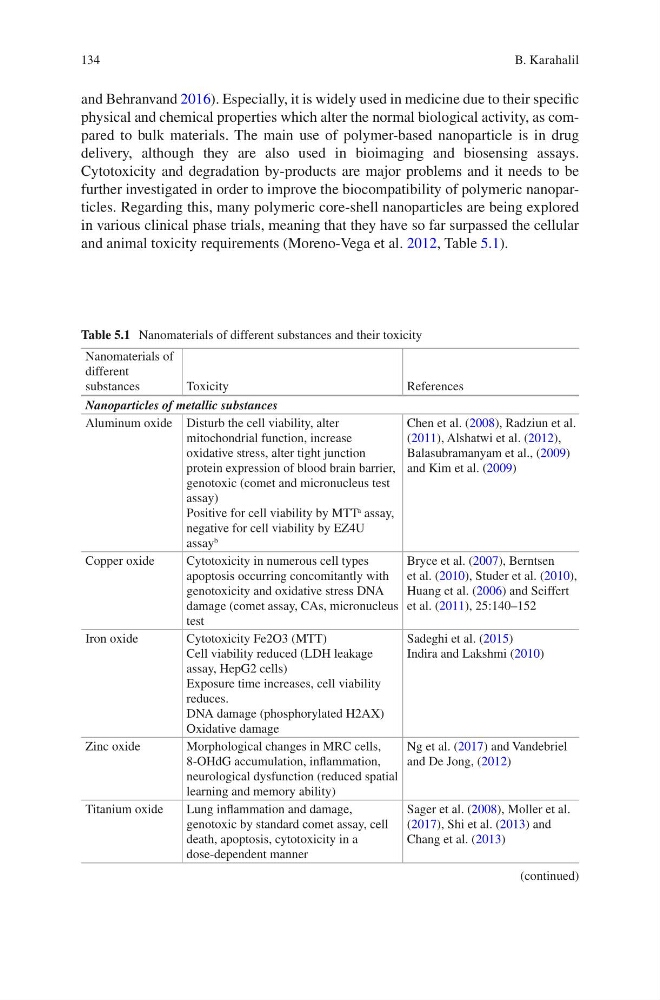
and animal toxicity requirements (Moreno-Vega et al. 2012, Table 5.1).
Table 5.1 Nanomaterials of different substances and their toxicity
Nanomaterials of
different
substances
Toxicity
References
Nanoparticles of metallic substances
Aluminum oxide Disturb the cell viability, alter
mitochondrial function, increase
oxidative stress, alter tight junction
protein expression of blood brain barrier,
genotoxic (comet and micronucleus test
assay)
Positive for cell viability by MTT
a assay,
negative for cell viability by EZ4U
assay
b
Chen et al. (2008), Radziun et al.
(2011), Alshatwi et al. (2012),
Balasubramanyam et al., (2009)
and Kim et al. (2009)
Copper oxide
Cytotoxicity in numerous cell types
apoptosis occurring concomitantly with
genotoxicity and oxidative stress DNA
damage (comet assay, CAs, micronucleus
test
Bryce et al. (2007), Berntsen
et al. (2010), Studer et al. (2010),
Huang et al. (2006) and Seiffert
et al. (2011), 25:140–152
Iron oxide
Cytotoxicity Fe2O3 (MTT)
Cell viability reduced (LDH leakage
assay, HepG2 cells)
Exposure time increases, cell viability
reduces.
DNA damage (phosphorylated H2AX)
Oxidative damage
Sadeghi et al. (2015)
Indira and Lakshmi (2010)
Zinc oxide
Morphological changes in MRC cells,
8-OHdG accumulation, inflammation,
neurological dysfunction (reduced spatial
learning and memory ability)
Ng et al. (2017) and Vandebriel
and De Jong, (2012)
Titanium oxide
Lung inflammation and damage,
genotoxic by standard comet assay, cell
death, apoptosis, cytotoxicity in a
dose-dependent manner
Sager et al. (2008), Moller et al.
(2017), Shi et al. (2013) and
Chang et al. (2013)
(continued)
B. Karahalil
and Behranvand 2016). Especially, it is widely used in medicine due to their specific
physical and chemical properties which alter the normal biological activity, as compared to bulk materials. The main use of polymer-based nanoparticle is in drug
delivery, although they are also used in bioimaging and biosensing assays.
Cytotoxicity and degradation by-products are major problems and it needs to be
further investigated in order to improve the biocompatibility of polymeric nanoparticles. Regarding this, many polymeric core-shell nanoparticles are being explored
in various clinical phase trials, meaning that they have so far surpassed the cellular
and animal toxicity requirements (Moreno-Vega et al. 2012, Table 5.1).
Table 5.1 Nanomaterials of different substances and their toxicity
Nanomaterials of
different
substances
Toxicity
References
Nanoparticles of metallic substances
Aluminum oxide Disturb the cell viability, alter
mitochondrial function, increase
oxidative stress, alter tight junction
protein expression of blood brain barrier,
genotoxic (comet and micronucleus test
assay)
Positive for cell viability by MTT
a assay,
negative for cell viability by EZ4U
assay
b
Chen et al. (2008), Radziun et al.
(2011), Alshatwi et al. (2012),
Balasubramanyam et al., (2009)
and Kim et al. (2009)
Copper oxide
Cytotoxicity in numerous cell types
apoptosis occurring concomitantly with
genotoxicity and oxidative stress DNA
damage (comet assay, CAs, micronucleus
test
Bryce et al. (2007), Berntsen
et al. (2010), Studer et al. (2010),
Huang et al. (2006) and Seiffert
et al. (2011), 25:140–152
Iron oxide
Cytotoxicity Fe2O3 (MTT)
Cell viability reduced (LDH leakage
assay, HepG2 cells)
Exposure time increases, cell viability
reduces.
DNA damage (phosphorylated H2AX)
Oxidative damage
Sadeghi et al. (2015)
Indira and Lakshmi (2010)
Zinc oxide
Morphological changes in MRC cells,
8-OHdG accumulation, inflammation,
neurological dysfunction (reduced spatial
learning and memory ability)
Ng et al. (2017) and Vandebriel
and De Jong, (2012)
Titanium oxide
Lung inflammation and damage,
genotoxic by standard comet assay, cell
death, apoptosis, cytotoxicity in a
dose-dependent manner
Sager et al. (2008), Moller et al.
(2017), Shi et al. (2013) and
Chang et al. (2013)
(continued)
B. Karahalil