

108
phosphatase, and ammonia oxidation in soil are directly linked with soil microbial
communities. Nanoparticles interaction with these microbial communities interfere
with the production of enzymes in soil and impact their optimized production.
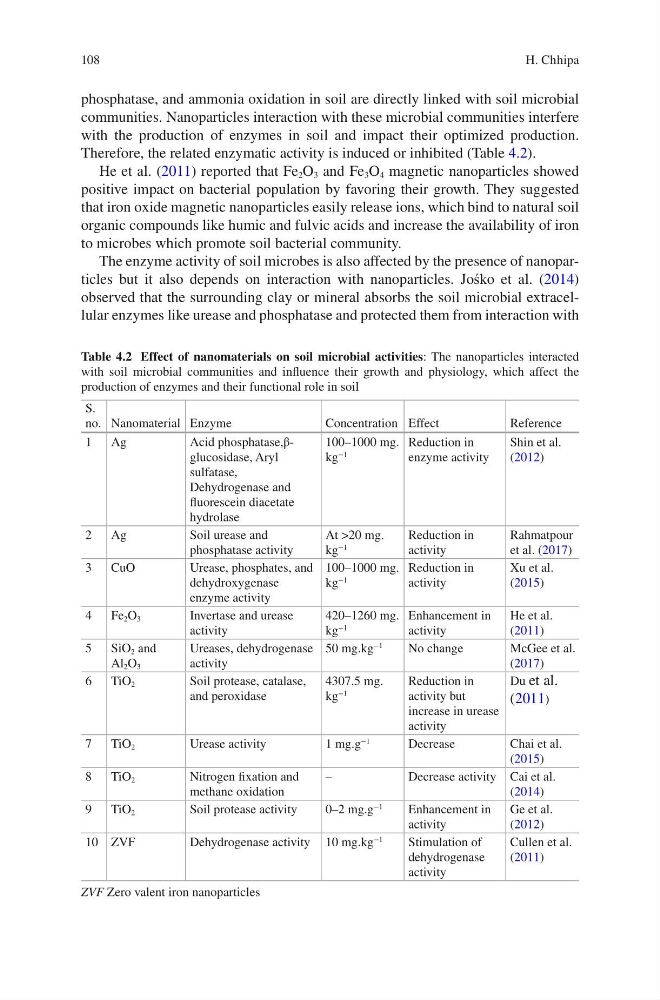
Therefore, the related enzymatic activity is induced or inhibited (Table 4.2).
He et al. (2011) reported that Fe 2 O 3 and Fe 3 O 4 magnetic nanoparticles showed
positive impact on bacterial population by favoring their growth. They suggested
that iron oxide magnetic nanoparticles easily release ions, which bind to natural soil
organic compounds like humic and fulvic acids and increase the availability of iron
to microbes which promote soil bacterial community.
The enzyme activity of soil microbes is also affected by the presence of nanoparticles but it also depends on interaction with nanoparticles. Jośko et al. (2014)
observed that the surrounding clay or mineral absorbs the soil microbial extracellular enzymes like urease and phosphatase and protected them from interaction with
Table 4.2 Effect of nanomaterials on soil microbial activities: The nanoparticles interacted
with soil microbial communities and influence their growth and physiology, which affect the
production of enzymes and their functional role in soil
S.
no. Nanomaterial Enzyme
Concentration Effect
Reference
1
Ag
Acid phosphatase,βglucosidase, Aryl
sulfatase,
Dehydrogenase and
fluorescein diacetate
hydrolase
100–1000 mg.
kg
−1
Reduction in
enzyme activity
Shin et al.
(2012)
2
Ag
Soil urease and
phosphatase activity
At >20 mg.
kg
−1
Reduction in
activity
Rahmatpour
et al. (2017)
3
CuO
Urease, phosphates, and
dehydroxygenase
enzyme activity
100–1000 mg.
kg
−1
Reduction in
activity
Xu et al.
(2015)
4
Fe 2 O 3
Invertase and urease
activity
420–1260 mg.
kg
−1
Enhancement in
activity
He et al.
(2011)
5
SiO 2 and
Al 2 O 3
Ureases, dehydrogenase
activity
50 mg.kg
−1
No change
McGee et al.
(2017)
6
TiO 2
Soil protease, catalase,
and peroxidase
4307.5 mg.
kg
−1
Reduction in
activity but
increase in urease
activity
Du et al.
(2011)
7
TiO 2
Urease activity
1 mg.g
−1
Decrease
Chai et al.
(2015)
8
TiO 2
Nitrogen fixation and
methane oxidation
–
Decrease activity Cai et al.
(2014)
9
TiO 2
Soil protease activity
0–2 mg.g
−1
Enhancement in
activity
Ge et al.
(2012)
10 ZVF
Dehydrogenase activity 10 mg.kg
−1
Stimulation of
dehydrogenase
activity
Cullen et al.
(2011)
ZVF Zero valent iron nanoparticles
H. Chhipa
phosphatase, and ammonia oxidation in soil are directly linked with soil microbial
communities. Nanoparticles interaction with these microbial communities interfere
with the production of enzymes in soil and impact their optimized production.
Therefore, the related enzymatic activity is induced or inhibited (Table 4.2).
He et al. (2011) reported that Fe 2 O 3 and Fe 3 O 4 magnetic nanoparticles showed
positive impact on bacterial population by favoring their growth. They suggested
that iron oxide magnetic nanoparticles easily release ions, which bind to natural soil
organic compounds like humic and fulvic acids and increase the availability of iron
to microbes which promote soil bacterial community.
The enzyme activity of soil microbes is also affected by the presence of nanoparticles but it also depends on interaction with nanoparticles. Jośko et al. (2014)
observed that the surrounding clay or mineral absorbs the soil microbial extracellular enzymes like urease and phosphatase and protected them from interaction with
Table 4.2 Effect of nanomaterials on soil microbial activities: The nanoparticles interacted
with soil microbial communities and influence their growth and physiology, which affect the
production of enzymes and their functional role in soil
S.
no. Nanomaterial Enzyme
Concentration Effect
Reference
1
Ag
Acid phosphatase,βglucosidase, Aryl
sulfatase,
Dehydrogenase and
fluorescein diacetate
hydrolase
100–1000 mg.
kg
−1
Reduction in
enzyme activity
Shin et al.
(2012)
2
Ag
Soil urease and
phosphatase activity
At >20 mg.
kg
−1
Reduction in
activity
Rahmatpour
et al. (2017)
3
CuO
Urease, phosphates, and
dehydroxygenase
enzyme activity
100–1000 mg.
kg
−1
Reduction in
activity
Xu et al.
(2015)
4
Fe 2 O 3
Invertase and urease
activity
420–1260 mg.
kg
−1
Enhancement in
activity
He et al.
(2011)
5
SiO 2 and
Al 2 O 3
Ureases, dehydrogenase
activity
50 mg.kg
−1
No change
McGee et al.
(2017)
6
TiO 2
Soil protease, catalase,
and peroxidase
4307.5 mg.
kg
−1
Reduction in
activity but
increase in urease
activity
Du et al.
(2011)
7
TiO 2
Urease activity
1 mg.g
−1
Decrease
Chai et al.
(2015)
8
TiO 2
Nitrogen fixation and
methane oxidation
–
Decrease activity Cai et al.
(2014)
9
TiO 2
Soil protease activity
0–2 mg.g
−1
Enhancement in
activity
Ge et al.
(2012)
10 ZVF
Dehydrogenase activity 10 mg.kg
−1
Stimulation of
dehydrogenase
activity
Cullen et al.
(2011)
ZVF Zero valent iron nanoparticles
H. Chhipa