

5 Analyzing the Problem of a Spherical Cavity Expansion …
81
S(ξ ) = −
T 0
μ
− 2
ε
3
(2μ − 1)ξ
+
ε
6
(μ − 2)ξ 4
+
T 0
μ
+ 2
ε
3
(2μ − 1)
−
ε
6
(μ − 2)
+ ε
3
− ε
6
ξ
−2μ
(5.41a)
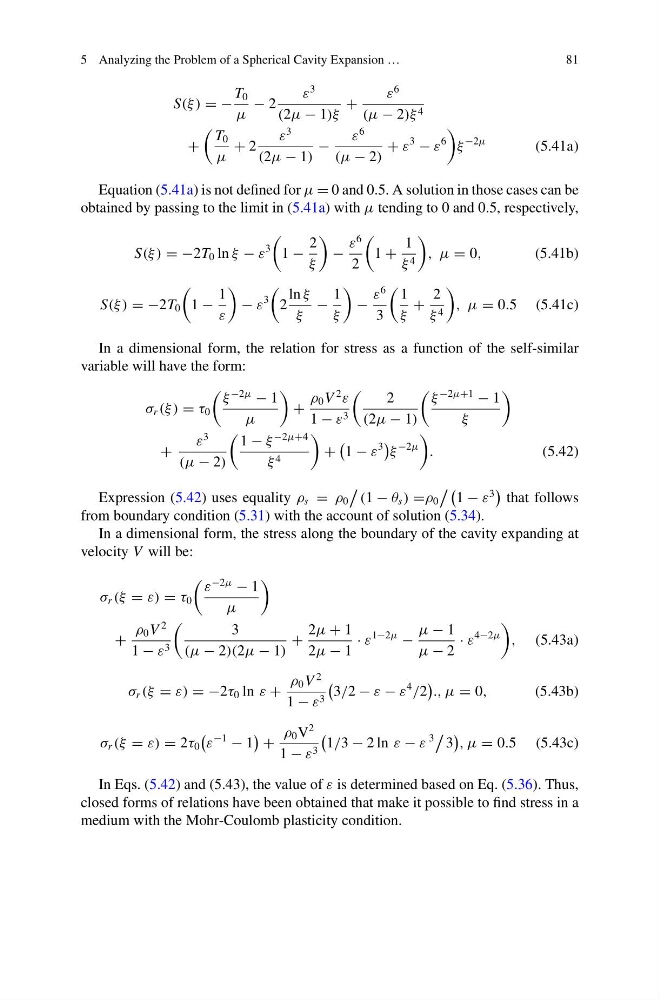
Equation (5.41a) is not defined for μ = 0 and 0.5. A solution in those cases can be
obtained by passing to the limit in (5.41a) with μ tending to 0 and 0.5, respectively,
S(ξ ) = −2T 0 ln ξ − ε
3
1 −
2
ξ
−
ε
6
2
1 +
1
ξ 4
, μ = 0,
(5.41b)
S(ξ ) = −2T 0
1 −
1
ε
− ε
3
2
ln ξ
ξ
−
1
ξ
−
ε
6
3
1
ξ
+
2
ξ 4
, μ = 0.5 (5.41c)
In a dimensional form, the relation for stress as a function of the self-similar
variable will have the form:
σ r (ξ ) = τ 0
ξ
−2μ
− 1
μ
+
ρ 0 V
2
ε
1 − ε 3
2
(2μ − 1)
ξ
−2μ+1
− 1
ξ
+
ε
3
(μ − 2)
1 − ξ
−2μ+4
ξ 4
+
1 − ε
3
ξ
−2μ
.
(5.42)
Expression (5.42) uses equality ρ s = ρ 0
(1 − θ s ) =ρ 0
1 − ε
3
that follows
from boundary condition (5.31) with the account of solution (5.34).
In a dimensional form, the stress along the boundary of the cavity expanding at
velocity V will be:
σ r (ξ = ε) = τ 0
ε
−2μ
− 1
μ
+
ρ 0 V
2
1 − ε 3
3
(μ − 2)(2μ − 1)
+
2μ + 1
2μ − 1
· ε
1−2μ
−
μ − 1
μ − 2
· ε
4−2μ
, (5.43a)
σ r (ξ = ε) = −2τ 0 ln ε +
ρ 0 V
2
1 − ε 3
3/2 − ε − ε
4
/2
., μ = 0,
(5.43b)
σ r (ξ = ε) = 2τ 0
ε
−1
− 1
+
ρ 0 V
2
1 − ε 3
1/3 − 2 ln ε − ε
3
3
, μ = 0.5 (5.43c)
In Eqs. (5.42) and (5.43), the value of ε is determined based on Eq. (5.36). Thus,
closed forms of relations have been obtained that make it possible to find stress in a
medium with the Mohr-Coulomb plasticity condition.
81
S(ξ ) = −
T 0
μ
− 2
ε
3
(2μ − 1)ξ
+
ε
6
(μ − 2)ξ 4
+
T 0
μ
+ 2
ε
3
(2μ − 1)
−
ε
6
(μ − 2)
+ ε
3
− ε
6
ξ
−2μ
(5.41a)
Equation (5.41a) is not defined for μ = 0 and 0.5. A solution in those cases can be
obtained by passing to the limit in (5.41a) with μ tending to 0 and 0.5, respectively,
S(ξ ) = −2T 0 ln ξ − ε
3
1 −
2
ξ
−
ε
6
2
1 +
1
ξ 4
, μ = 0,
(5.41b)
S(ξ ) = −2T 0
1 −
1
ε
− ε
3
2
ln ξ
ξ
−
1
ξ
−
ε
6
3
1
ξ
+
2
ξ 4
, μ = 0.5 (5.41c)
In a dimensional form, the relation for stress as a function of the self-similar
variable will have the form:
σ r (ξ ) = τ 0
ξ
−2μ
− 1
μ
+
ρ 0 V
2
ε
1 − ε 3
2
(2μ − 1)
ξ
−2μ+1
− 1
ξ
+
ε
3
(μ − 2)
1 − ξ
−2μ+4
ξ 4
+
1 − ε
3
ξ
−2μ
.
(5.42)
Expression (5.42) uses equality ρ s = ρ 0
(1 − θ s ) =ρ 0
1 − ε
3
that follows
from boundary condition (5.31) with the account of solution (5.34).
In a dimensional form, the stress along the boundary of the cavity expanding at
velocity V will be:
σ r (ξ = ε) = τ 0
ε
−2μ
− 1
μ
+
ρ 0 V
2
1 − ε 3
3
(μ − 2)(2μ − 1)
+
2μ + 1
2μ − 1
· ε
1−2μ
−
μ − 1
μ − 2
· ε
4−2μ
, (5.43a)
σ r (ξ = ε) = −2τ 0 ln ε +
ρ 0 V
2
1 − ε 3
3/2 − ε − ε
4
/2
., μ = 0,
(5.43b)
σ r (ξ = ε) = 2τ 0
ε
−1
− 1
+
ρ 0 V
2
1 − ε 3
1/3 − 2 ln ε − ε
3
3
, μ = 0.5 (5.43c)
In Eqs. (5.42) and (5.43), the value of ε is determined based on Eq. (5.36). Thus,
closed forms of relations have been obtained that make it possible to find stress in a
medium with the Mohr-Coulomb plasticity condition.