

5 Analyzing the Problem of a Spherical Cavity Expansion …
79
(c) density ρ s behind the shockwave front is assumed constant, i.e., incompressibility is assumed behind the shockwave front, the value of ρ s depends on the
cavity expansion velocity;
(d) plastic wave front propagation velocity c is equal to the propagation velocity of
the plane shockwave front, determined by Hugoniot’s linear adiabat (5.28), i.e.,
it is assumed that U s ≡ c.
Such assumptions appear to be justified for soft soils characterized by low
cohesion and high porosity (Bragov et al. 2018).
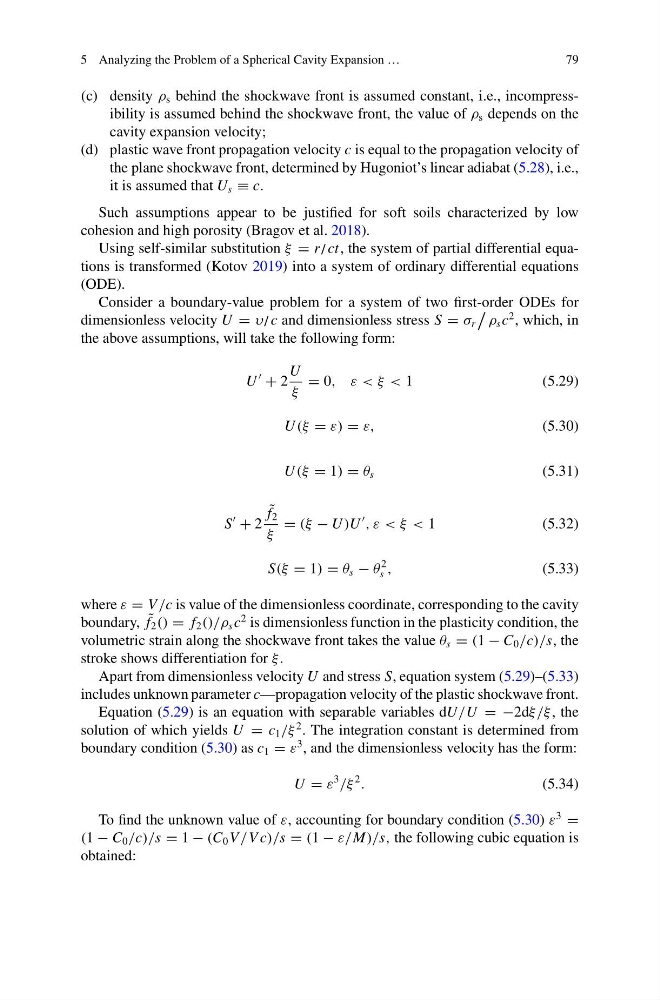
Using self-similar substitution ξ = r / ct, the system of partial differential equations is transformed (Kotov 2019) into a system of ordinary differential equations
(ODE).
Consider a boundary-value problem for a system of two first-order ODEs for
dimensionless velocity U = υ/ c and dimensionless stress S = σ r
ρ s c
2 , which, in
the above assumptions, will take the following form:
U
+ 2
U
ξ
= 0, ε < ξ < 1
(5.29)
U (ξ = ε) = ε,
(5.30)
U (ξ = 1) = θ s
(5.31)
S
+ 2
˜
f 2
ξ
= (ξ − U )U
, ε < ξ < 1
(5.32)
S(ξ = 1) = θ s − θ
2
s ,
(5.33)
where ε = V /c is value of the dimensionless coordinate, corresponding to the cavity
boundary, ˜
f 2 () = f 2 ()/ρ s c
2 is dimensionless function in the plasticity condition, the
volumetric strain along the shockwave front takes the value θ s = (1 − C 0 /c)/s, the
stroke shows differentiation for ξ .
Apart from dimensionless velocity U and stress S, equation system (5.29)–(5.33)
includes unknown parameter c—propagation velocity of the plastic shockwave front.
Equation (5.29) is an equation with separable variables dU/U = −2dξ/ξ , the
solution of which yields U = c 1 /ξ
2 . The integration constant is determined from
boundary condition (5.30) as c 1 = ε
3 , and the dimensionless velocity has the form:
U = ε
3
/ξ
2
.
(5.34)
To find the unknown value of ε, accounting for boundary condition (5.30) ε
3
=
(1 − C 0 /c)/s = 1 − (C 0 V /V c)/s = (1 − ε/M)/s, the following cubic equation is
obtained:
79
(c) density ρ s behind the shockwave front is assumed constant, i.e., incompressibility is assumed behind the shockwave front, the value of ρ s depends on the
cavity expansion velocity;
(d) plastic wave front propagation velocity c is equal to the propagation velocity of
the plane shockwave front, determined by Hugoniot’s linear adiabat (5.28), i.e.,
it is assumed that U s ≡ c.
Such assumptions appear to be justified for soft soils characterized by low
cohesion and high porosity (Bragov et al. 2018).
Using self-similar substitution ξ = r / ct, the system of partial differential equations is transformed (Kotov 2019) into a system of ordinary differential equations
(ODE).
Consider a boundary-value problem for a system of two first-order ODEs for
dimensionless velocity U = υ/ c and dimensionless stress S = σ r
ρ s c
2 , which, in
the above assumptions, will take the following form:
U
+ 2
U
ξ
= 0, ε < ξ < 1
(5.29)
U (ξ = ε) = ε,
(5.30)
U (ξ = 1) = θ s
(5.31)
S
+ 2
˜
f 2
ξ
= (ξ − U )U
, ε < ξ < 1
(5.32)
S(ξ = 1) = θ s − θ
2
s ,
(5.33)
where ε = V /c is value of the dimensionless coordinate, corresponding to the cavity
boundary, ˜
f 2 () = f 2 ()/ρ s c
2 is dimensionless function in the plasticity condition, the
volumetric strain along the shockwave front takes the value θ s = (1 − C 0 /c)/s, the
stroke shows differentiation for ξ .
Apart from dimensionless velocity U and stress S, equation system (5.29)–(5.33)
includes unknown parameter c—propagation velocity of the plastic shockwave front.
Equation (5.29) is an equation with separable variables dU/U = −2dξ/ξ , the
solution of which yields U = c 1 /ξ
2 . The integration constant is determined from
boundary condition (5.30) as c 1 = ε
3 , and the dimensionless velocity has the form:
U = ε
3
/ξ
2
.
(5.34)
To find the unknown value of ε, accounting for boundary condition (5.30) ε
3
=
(1 − C 0 /c)/s = 1 − (C 0 V /V c)/s = (1 − ε/M)/s, the following cubic equation is
obtained: