

58
A. V. Demareva et al.
consist of a metal matrix and pores in an amount of up to 80–90%. The technological expansion requires the expansion of the porous materials range and the production promising methods development. Preference is given to simple and economical
technologies that allow to regulate the total porosity, pore diameter, and its configuration. Recently, the engineers’ attention attracted metal hollow spheres (MHS)
filler—porous material obtained by joining homogeneous metal hollow spheres
(Ramchandra et al. 2003; Ruan et al. 2006; Caty et al. 2009; Liu et al. 2012). This
multifunctional material is characterized by a nonlinear deformation diagram, and it
significantly absorbs impact energy and has good prospects for use in high-impact
structures, in particular, in containers for dangerous cargo transportation.
More information about porous materials one can find in (dell’Isola and Batra
1997; dell’Isola et al. 2000, 2009; Madeo et al. 2013; Sciarra et al. 2007). Generalized continua (Abali et al. 2017; Alibert et al. 2003; Auffray et al. 2013; dell’Isola
et al. 2012, 2015, 2017) found its application in developing new micsrostructured
metamaterials (Barchiesi et al., 2018; Del Vescovo and Giorgio 2014). An example
of mechanical metamaterials is pantographic structure (dell’Isola et al. 2019; Placidi
et al. 2016; Giorgio 2016).
In general, the choice of a porous material as a damper should be based on theoretical and experimental studies of its stress state under the corresponding loading.
Currently, elasto-plastic buckling even of separated spherical shell is studied insufficiently. Therefore, direct calculations of the MHS filler dynamics with a detailed
account of its structure are justified only in its compact fragments (representative
volumes) deformation study. This determines the relevance of the development and
justification of the mathematical model and the method of numerical stress–strain
state study.
Below is a mathematical model and method for solving the deformation of structures with MHS filler problem. The results of its usage for the analysis of damping
properties of individual spherical shells and for shells set are presented.
4.2 Constitutive System of Equations and Problem Solution
Method
The motion of the structure is described from the standpoint of continuum mechanics
using the current Lagrangian formulation (Bathe 1996). The equation of motion is
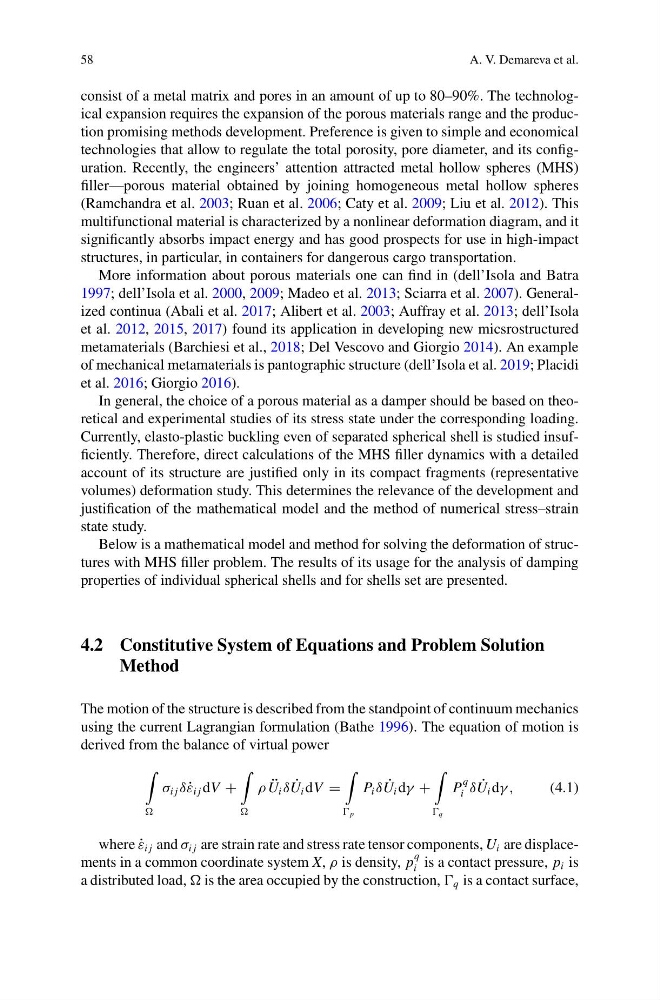
derived from the balance of virtual power
σ i j δ ˙
ε i j dV +
ρ ¨
U i δ ˙
U i dV =
p
P i δ ˙
U i dγ +
q
P
q
i δ ˙
U i dγ ,
(4.1)
where ˙
ε i j and σ i j are strain rate and stress rate tensor components, U i are displacements in a common coordinate system X, ρ is density, p
q
i is a contact pressure, p i is
a distributed load, is the area occupied by the construction, q is a contact surface,
A. V. Demareva et al.
consist of a metal matrix and pores in an amount of up to 80–90%. The technological expansion requires the expansion of the porous materials range and the production promising methods development. Preference is given to simple and economical
technologies that allow to regulate the total porosity, pore diameter, and its configuration. Recently, the engineers’ attention attracted metal hollow spheres (MHS)
filler—porous material obtained by joining homogeneous metal hollow spheres
(Ramchandra et al. 2003; Ruan et al. 2006; Caty et al. 2009; Liu et al. 2012). This
multifunctional material is characterized by a nonlinear deformation diagram, and it
significantly absorbs impact energy and has good prospects for use in high-impact
structures, in particular, in containers for dangerous cargo transportation.
More information about porous materials one can find in (dell’Isola and Batra
1997; dell’Isola et al. 2000, 2009; Madeo et al. 2013; Sciarra et al. 2007). Generalized continua (Abali et al. 2017; Alibert et al. 2003; Auffray et al. 2013; dell’Isola
et al. 2012, 2015, 2017) found its application in developing new micsrostructured
metamaterials (Barchiesi et al., 2018; Del Vescovo and Giorgio 2014). An example
of mechanical metamaterials is pantographic structure (dell’Isola et al. 2019; Placidi
et al. 2016; Giorgio 2016).
In general, the choice of a porous material as a damper should be based on theoretical and experimental studies of its stress state under the corresponding loading.
Currently, elasto-plastic buckling even of separated spherical shell is studied insufficiently. Therefore, direct calculations of the MHS filler dynamics with a detailed
account of its structure are justified only in its compact fragments (representative
volumes) deformation study. This determines the relevance of the development and
justification of the mathematical model and the method of numerical stress–strain
state study.
Below is a mathematical model and method for solving the deformation of structures with MHS filler problem. The results of its usage for the analysis of damping
properties of individual spherical shells and for shells set are presented.
4.2 Constitutive System of Equations and Problem Solution
Method
The motion of the structure is described from the standpoint of continuum mechanics
using the current Lagrangian formulation (Bathe 1996). The equation of motion is
derived from the balance of virtual power
σ i j δ ˙
ε i j dV +
ρ ¨
U i δ ˙
U i dV =
p
P i δ ˙
U i dγ +
q
P
q
i δ ˙
U i dγ ,
(4.1)
where ˙
ε i j and σ i j are strain rate and stress rate tensor components, U i are displacements in a common coordinate system X, ρ is density, p
q
i is a contact pressure, p i is
a distributed load, is the area occupied by the construction, q is a contact surface,