

52
D. Dudin and I. Keller
D
−
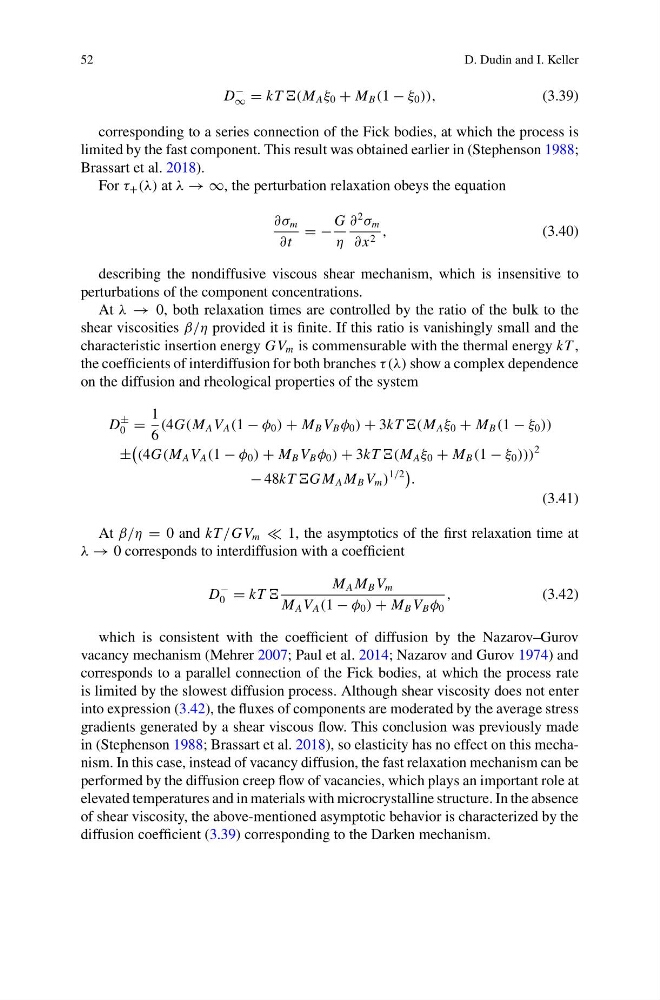
∞ = kT (M A ξ 0 + M B (1 − ξ 0 )),
(3.39)
corresponding to a series connection of the Fick bodies, at which the process is
limited by the fast component. This result was obtained earlier in (Stephenson 1988;
Brassart et al. 2018).
For τ + (λ) at λ → ∞, the perturbation relaxation obeys the equation
∂σ m
∂t
= −
G
η
∂
2
σ m
∂ x 2 ,
(3.40)
describing the nondiffusive viscous shear mechanism, which is insensitive to
perturbations of the component concentrations.
At λ → 0, both relaxation times are controlled by the ratio of the bulk to the
shear viscosities β/η provided it is finite. If this ratio is vanishingly small and the
characteristic insertion energy GV m is commensurable with the thermal energy kT ,
the coefficients of interdiffusion for both branches τ (λ) show a complex dependence
on the diffusion and rheological properties of the system
D
±
0 =
1
6
(4G(M A V A (1 − φ 0 ) + M B V B φ 0 ) + 3kT (M A ξ 0 + M B (1 − ξ 0 ))
±
(4G(M A V A (1 − φ 0 ) + M B V B φ 0 ) + 3kT (M A ξ 0 + M B (1 − ξ 0 )))
2
− 48kT G M A M B V m )
1/2
.
(3.41)
At β/η = 0 and kT /GV m 1, the asymptotics of the first relaxation time at
λ → 0 corresponds to interdiffusion with a coefficient
D
−
0 = kT
M A M B V m
M A V A (1 − φ 0 ) + M B V B φ 0
,
(3.42)
which is consistent with the coefficient of diffusion by the Nazarov–Gurov
vacancy mechanism (Mehrer 2007; Paul et al. 2014; Nazarov and Gurov 1974) and
corresponds to a parallel connection of the Fick bodies, at which the process rate
is limited by the slowest diffusion process. Although shear viscosity does not enter
into expression (3.42), the fluxes of components are moderated by the average stress
gradients generated by a shear viscous flow. This conclusion was previously made
in (Stephenson 1988; Brassart et al. 2018), so elasticity has no effect on this mechanism. In this case, instead of vacancy diffusion, the fast relaxation mechanism can be
performed by the diffusion creep flow of vacancies, which plays an important role at
elevated temperatures and in materials with microcrystalline structure. In the absence
of shear viscosity, the above-mentioned asymptotic behavior is characterized by the
diffusion coefficient (3.39) corresponding to the Darken mechanism.
D. Dudin and I. Keller
D
−
∞ = kT (M A ξ 0 + M B (1 − ξ 0 )),
(3.39)
corresponding to a series connection of the Fick bodies, at which the process is
limited by the fast component. This result was obtained earlier in (Stephenson 1988;
Brassart et al. 2018).
For τ + (λ) at λ → ∞, the perturbation relaxation obeys the equation
∂σ m
∂t
= −
G
η
∂
2
σ m
∂ x 2 ,
(3.40)
describing the nondiffusive viscous shear mechanism, which is insensitive to
perturbations of the component concentrations.
At λ → 0, both relaxation times are controlled by the ratio of the bulk to the
shear viscosities β/η provided it is finite. If this ratio is vanishingly small and the
characteristic insertion energy GV m is commensurable with the thermal energy kT ,
the coefficients of interdiffusion for both branches τ (λ) show a complex dependence
on the diffusion and rheological properties of the system
D
±
0 =
1
6
(4G(M A V A (1 − φ 0 ) + M B V B φ 0 ) + 3kT (M A ξ 0 + M B (1 − ξ 0 ))
±
(4G(M A V A (1 − φ 0 ) + M B V B φ 0 ) + 3kT (M A ξ 0 + M B (1 − ξ 0 )))
2
− 48kT G M A M B V m )
1/2
.
(3.41)
At β/η = 0 and kT /GV m 1, the asymptotics of the first relaxation time at
λ → 0 corresponds to interdiffusion with a coefficient
D
−
0 = kT
M A M B V m
M A V A (1 − φ 0 ) + M B V B φ 0
,
(3.42)
which is consistent with the coefficient of diffusion by the Nazarov–Gurov
vacancy mechanism (Mehrer 2007; Paul et al. 2014; Nazarov and Gurov 1974) and
corresponds to a parallel connection of the Fick bodies, at which the process rate
is limited by the slowest diffusion process. Although shear viscosity does not enter
into expression (3.42), the fluxes of components are moderated by the average stress
gradients generated by a shear viscous flow. This conclusion was previously made
in (Stephenson 1988; Brassart et al. 2018), so elasticity has no effect on this mechanism. In this case, instead of vacancy diffusion, the fast relaxation mechanism can be
performed by the diffusion creep flow of vacancies, which plays an important role at
elevated temperatures and in materials with microcrystalline structure. In the absence
of shear viscosity, the above-mentioned asymptotic behavior is characterized by the
diffusion coefficient (3.39) corresponding to the Darken mechanism.