

50
D. Dudin and I. Keller
= φ 0 (1 − φ 0 )
M A V A
1 +
3β A (1 − φ 0 )
4η
−M B V B
1 +
3β B φ 0
4η
∂
2
σ m
∂ x 2
+ φ 0 (1 − φ 0 )(M A V A β A (1 − φ 0 ) − M B V B β B φ 0 )
3
4G
∂
3
σ m
∂t∂ x 2 ,
(3.35)
3
4G
∂σ m
∂t
−
M A V A β A (1 − φ 0 )
2
+ M B V B β B φ
2
0
3
4G
∂
3
σ m
∂t∂ x 2 +
3
4η
∂
2
σ m
∂ x 2
−
− (M A V A (1 − φ 0 ) + M B V B φ 0 )
∂
2
σ m
∂ x 2 +
3σ m
4η
= kT V m
M A
V B
−
M B
V A
∂
2
φ
∂ x 2
+ (M A V A β A (1 − φ 0 ) − M B V B β B φ 0 )
∂
3
φ
∂t∂ x 2 ,
(3.36)
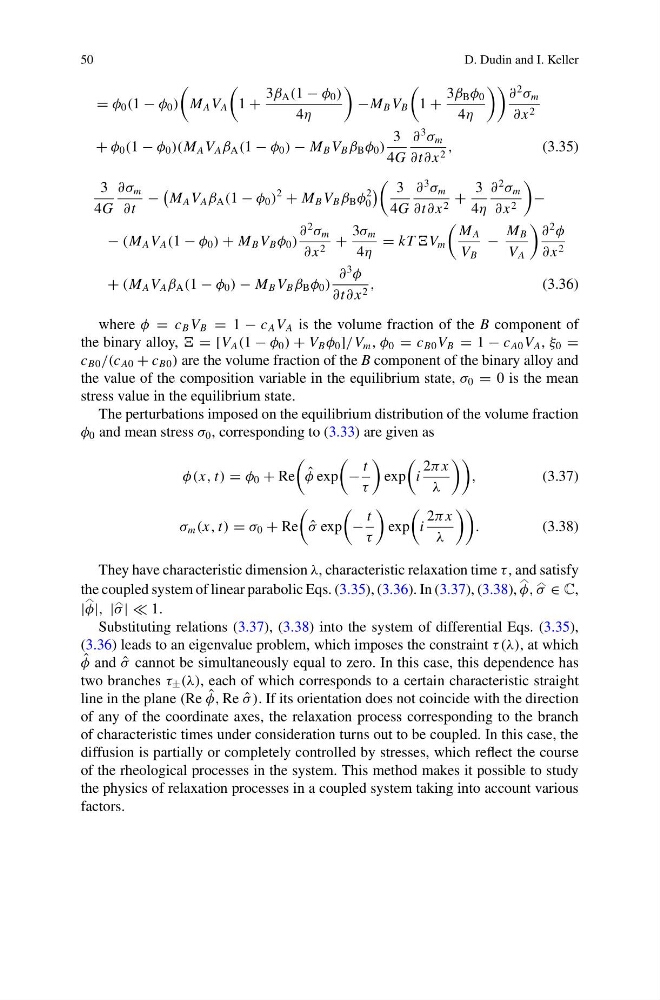
where φ = c B V B = 1 − c A V A is the volume fraction of the B component of
the binary alloy, = [V A (1 − φ 0 ) + V B φ 0 ]/V m , φ 0 = c B0 V B = 1 − c A0 V A , ξ 0 =
c B0 /(c A0 + c B0 ) are the volume fraction of the B component of the binary alloy and
the value of the composition variable in the equilibrium state, σ 0 = 0 is the mean
stress value in the equilibrium state.
The perturbations imposed on the equilibrium distribution of the volume fraction
φ 0 and mean stress σ 0 , corresponding to (3.33) are given as
φ(x, t) = φ 0 + Re
ˆ
φ exp
−
t
τ
exp
i
2π x
λ
,
(3.37)
σ m (x, t) = σ 0 + Re
ˆ
σ exp
−
t
τ
exp
i
2π x
λ
.
(3.38)
They have characteristic dimension λ, characteristic relaxation time τ , and satisfy
the coupled system of linear parabolic Eqs. (3.35), (3.36). In (3.37), (3.38), φ
, σ
∈ C,
|φ
|, |σ
| | 1.
Substituting relations (3.37), (3.38) into the system of differential Eqs. (3.35),
(3.36) leads to an eigenvalue problem, which imposes the constraint τ (λ), at which
ˆ
φ and ˆ
σ cannot be simultaneously equal to zero. In this case, this dependence has
two branches τ ± (λ), each of which corresponds to a certain characteristic straight
line in the plane (Re ˆ
φ, Re ˆ
σ ). If its orientation does not coincide with the direction
of any of the coordinate axes, the relaxation process corresponding to the branch
of characteristic times under consideration turns out to be coupled. In this case, the
diffusion is partially or completely controlled by stresses, which reflect the course
of the rheological processes in the system. This method makes it possible to study
the physics of relaxation processes in a coupled system taking into account various
factors.
D. Dudin and I. Keller
= φ 0 (1 − φ 0 )
M A V A
1 +
3β A (1 − φ 0 )
4η
−M B V B
1 +
3β B φ 0
4η
∂
2
σ m
∂ x 2
+ φ 0 (1 − φ 0 )(M A V A β A (1 − φ 0 ) − M B V B β B φ 0 )
3
4G
∂
3
σ m
∂t∂ x 2 ,
(3.35)
3
4G
∂σ m
∂t
−
M A V A β A (1 − φ 0 )
2
+ M B V B β B φ
2
0
3
4G
∂
3
σ m
∂t∂ x 2 +
3
4η
∂
2
σ m
∂ x 2
−
− (M A V A (1 − φ 0 ) + M B V B φ 0 )
∂
2
σ m
∂ x 2 +
3σ m
4η
= kT V m
M A
V B
−
M B
V A
∂
2
φ
∂ x 2
+ (M A V A β A (1 − φ 0 ) − M B V B β B φ 0 )
∂
3
φ
∂t∂ x 2 ,
(3.36)
where φ = c B V B = 1 − c A V A is the volume fraction of the B component of
the binary alloy, = [V A (1 − φ 0 ) + V B φ 0 ]/V m , φ 0 = c B0 V B = 1 − c A0 V A , ξ 0 =
c B0 /(c A0 + c B0 ) are the volume fraction of the B component of the binary alloy and
the value of the composition variable in the equilibrium state, σ 0 = 0 is the mean
stress value in the equilibrium state.
The perturbations imposed on the equilibrium distribution of the volume fraction
φ 0 and mean stress σ 0 , corresponding to (3.33) are given as
φ(x, t) = φ 0 + Re
ˆ
φ exp
−
t
τ
exp
i
2π x
λ
,
(3.37)
σ m (x, t) = σ 0 + Re
ˆ
σ exp
−
t
τ
exp
i
2π x
λ
.
(3.38)
They have characteristic dimension λ, characteristic relaxation time τ , and satisfy
the coupled system of linear parabolic Eqs. (3.35), (3.36). In (3.37), (3.38), φ
, σ
∈ C,
|φ
|, |σ
| | 1.
Substituting relations (3.37), (3.38) into the system of differential Eqs. (3.35),
(3.36) leads to an eigenvalue problem, which imposes the constraint τ (λ), at which
ˆ
φ and ˆ
σ cannot be simultaneously equal to zero. In this case, this dependence has
two branches τ ± (λ), each of which corresponds to a certain characteristic straight
line in the plane (Re ˆ
φ, Re ˆ
σ ). If its orientation does not coincide with the direction
of any of the coordinate axes, the relaxation process corresponding to the branch
of characteristic times under consideration turns out to be coupled. In this case, the
diffusion is partially or completely controlled by stresses, which reflect the course
of the rheological processes in the system. This method makes it possible to study
the physics of relaxation processes in a coupled system taking into account various
factors.