

32
A. M. Antonov et al.
Based on the studies performed, it can be concluded that a source moving at
a constant subsonic speed along the border of the gradient-elastic half-space will
generate surface elastic waves. Such waves, in contrast to the classical Rayleigh
surface waves, have a dispersion. The displacement amplitudes change depending
on the magnitude of the load of the moving source, as well as its speed, and increase
without limit as the source speed approaches the shear wave velocity.
2.4.2 The Supersonic Case
We next proceed to the consideration of the case when the velocity of the source of
disturbances D exceeds the velocities of the shear longitudinal waves—the supersonic
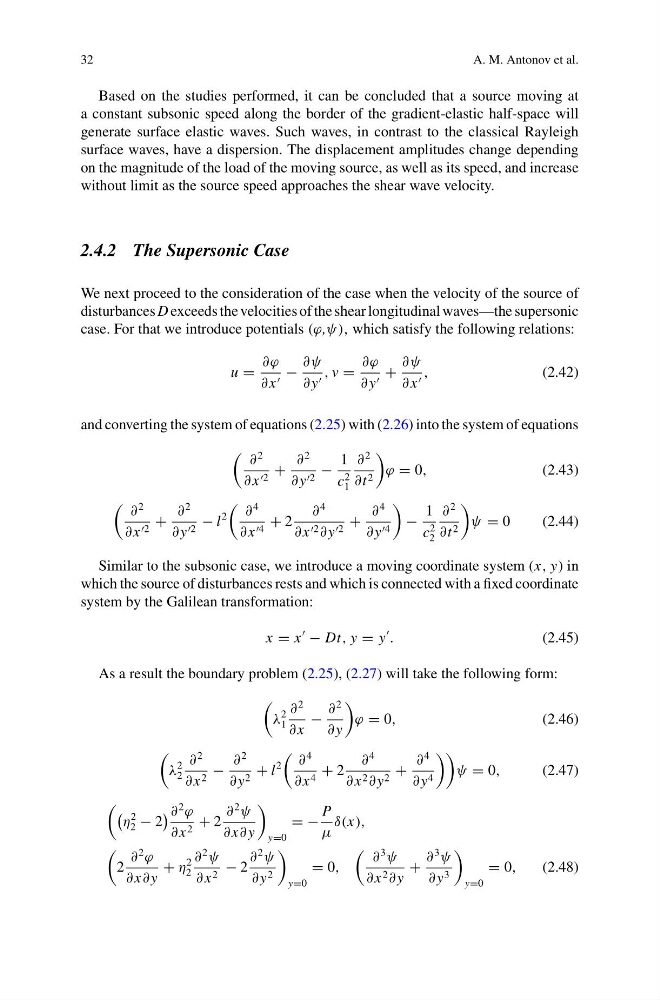
case. For that we introduce potentials (ϕ,ψ), which satisfy the following relations:
u =
∂ϕ
∂ x −
∂ψ
∂ y , v =
∂ϕ
∂ y +
∂ψ
∂ x ,
(2.42)
and converting the system of equations (2.25) with (2.26) into the system of equations
∂
2
∂ x 2 +
∂
2
∂ y 2 −
1
c
2
1
∂
2
∂t 2
ϕ = 0,
(2.43)
∂
2
∂ x 2 +
∂
2
∂ y 2 − l
2
∂
4
∂ x 4 + 2
∂
4
∂ x 2 ∂ y 2 +
∂
4
∂ y 4
−
1
c
2
2
∂
2
∂t 2
ψ = 0
(2.44)
Similar to the subsonic case, we introduce a moving coordinate system (x, y) in
which the source of disturbances rests and which is connected with a fixed coordinate
system by the Galilean transformation:
x = x
− Dt, y = y
.
(2.45)
As a result the boundary problem (2.25), (2.27) will take the following form:
λ
2
1
∂
2
∂ x
−
∂
2
∂ y
ϕ = 0,
(2.46)
λ
2
2
∂
2
∂ x 2 −
∂
2
∂ y 2 + l
2
∂
4
∂ x 4 + 2
∂
4
∂ x 2 ∂ y 2 +
∂
4
∂ y 4
ψ = 0,
(2.47)
η
2
2 − 2
∂
2
ϕ
∂ x 2 + 2
∂
2
ψ
∂ x∂ y
y=0
= −
P
μ
δ(x),
2
∂
2
ϕ
∂ x∂ y
+ η
2
2
∂
2
ψ
∂ x 2 − 2
∂
2
ψ
∂ y 2
y=0
= 0,
∂
3
ψ
∂ x 2 ∂ y
+
∂
3
ψ
∂ y 3
y=0
= 0,
(2.48)
A. M. Antonov et al.
Based on the studies performed, it can be concluded that a source moving at
a constant subsonic speed along the border of the gradient-elastic half-space will
generate surface elastic waves. Such waves, in contrast to the classical Rayleigh
surface waves, have a dispersion. The displacement amplitudes change depending
on the magnitude of the load of the moving source, as well as its speed, and increase
without limit as the source speed approaches the shear wave velocity.
2.4.2 The Supersonic Case
We next proceed to the consideration of the case when the velocity of the source of
disturbances D exceeds the velocities of the shear longitudinal waves—the supersonic
case. For that we introduce potentials (ϕ,ψ), which satisfy the following relations:
u =
∂ϕ
∂ x −
∂ψ
∂ y , v =
∂ϕ
∂ y +
∂ψ
∂ x ,
(2.42)
and converting the system of equations (2.25) with (2.26) into the system of equations
∂
2
∂ x 2 +
∂
2
∂ y 2 −
1
c
2
1
∂
2
∂t 2
ϕ = 0,
(2.43)
∂
2
∂ x 2 +
∂
2
∂ y 2 − l
2
∂
4
∂ x 4 + 2
∂
4
∂ x 2 ∂ y 2 +
∂
4
∂ y 4
−
1
c
2
2
∂
2
∂t 2
ψ = 0
(2.44)
Similar to the subsonic case, we introduce a moving coordinate system (x, y) in
which the source of disturbances rests and which is connected with a fixed coordinate
system by the Galilean transformation:
x = x
− Dt, y = y
.
(2.45)
As a result the boundary problem (2.25), (2.27) will take the following form:
λ
2
1
∂
2
∂ x
−
∂
2
∂ y
ϕ = 0,
(2.46)
λ
2
2
∂
2
∂ x 2 −
∂
2
∂ y 2 + l
2
∂
4
∂ x 4 + 2
∂
4
∂ x 2 ∂ y 2 +
∂
4
∂ y 4
ψ = 0,
(2.47)
η
2
2 − 2
∂
2
ϕ
∂ x 2 + 2
∂
2
ψ
∂ x∂ y
y=0
= −
P
μ
δ(x),
2
∂
2
ϕ
∂ x∂ y
+ η
2
2
∂
2
ψ
∂ x 2 − 2
∂
2
ψ
∂ y 2
y=0
= 0,
∂
3
ψ
∂ x 2 ∂ y
+
∂
3
ψ
∂ y 3
y=0
= 0,
(2.48)