

18 A Plausible Description of Continuum …
365
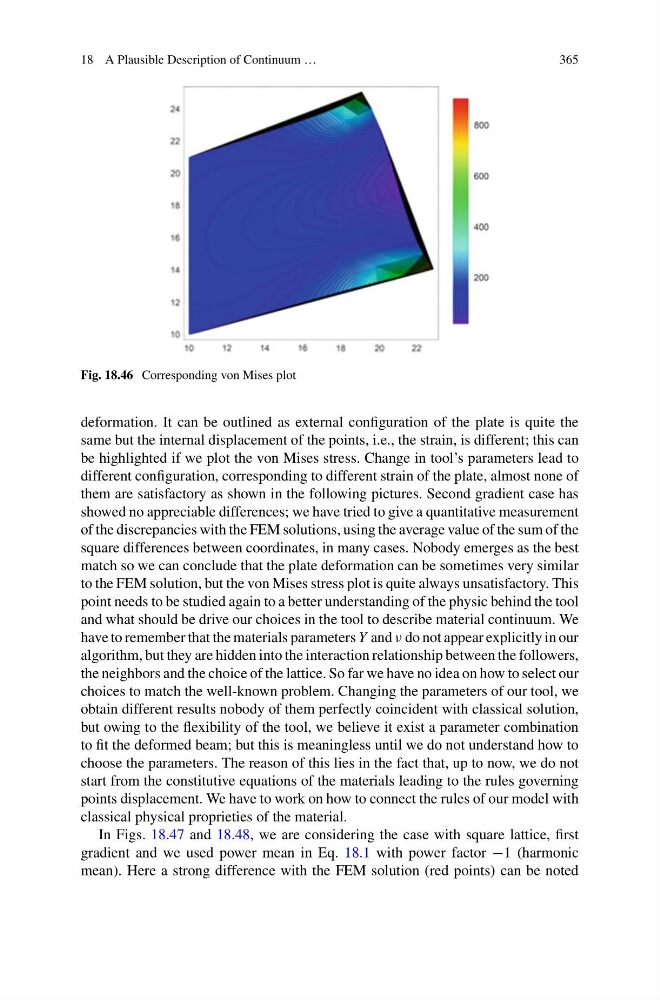
Fig. 18.46 Corresponding von Mises plot
deformation. It can be outlined as external configuration of the plate is quite the
same but the internal displacement of the points, i.e., the strain, is different; this can
be highlighted if we plot the von Mises stress. Change in tool’s parameters lead to
different configuration, corresponding to different strain of the plate, almost none of
them are satisfactory as shown in the following pictures. Second gradient case has
showed no appreciable differences; we have tried to give a quantitative measurement
of the discrepancies with the FEM solutions, using the average value of the sum of the
square differences between coordinates, in many cases. Nobody emerges as the best
match so we can conclude that the plate deformation can be sometimes very similar
to the FEM solution, but the von Mises stress plot is quite always unsatisfactory. This
point needs to be studied again to a better understanding of the physic behind the tool
and what should be drive our choices in the tool to describe material continuum. We
have to remember that the materials parameters Y and ν do not appear explicitly in our
algorithm, but they are hidden into the interaction relationship between the followers,
the neighbors and the choice of the lattice. So far we have no idea on how to select our
choices to match the well-known problem. Changing the parameters of our tool, we
obtain different results nobody of them perfectly coincident with classical solution,
but owing to the flexibility of the tool, we believe it exist a parameter combination
to fit the deformed beam; but this is meaningless until we do not understand how to
choose the parameters. The reason of this lies in the fact that, up to now, we do not
start from the constitutive equations of the materials leading to the rules governing
points displacement. We have to work on how to connect the rules of our model with
classical physical proprieties of the material.
In Figs. 18.47 and 18.48, we are considering the case with square lattice, first
gradient and we used power mean in Eq. 18.1 with power factor −1 (harmonic
mean). Here a strong difference with the FEM solution (red points) can be noted
365
Fig. 18.46 Corresponding von Mises plot
deformation. It can be outlined as external configuration of the plate is quite the
same but the internal displacement of the points, i.e., the strain, is different; this can
be highlighted if we plot the von Mises stress. Change in tool’s parameters lead to
different configuration, corresponding to different strain of the plate, almost none of
them are satisfactory as shown in the following pictures. Second gradient case has
showed no appreciable differences; we have tried to give a quantitative measurement
of the discrepancies with the FEM solutions, using the average value of the sum of the
square differences between coordinates, in many cases. Nobody emerges as the best
match so we can conclude that the plate deformation can be sometimes very similar
to the FEM solution, but the von Mises stress plot is quite always unsatisfactory. This
point needs to be studied again to a better understanding of the physic behind the tool
and what should be drive our choices in the tool to describe material continuum. We
have to remember that the materials parameters Y and ν do not appear explicitly in our
algorithm, but they are hidden into the interaction relationship between the followers,
the neighbors and the choice of the lattice. So far we have no idea on how to select our
choices to match the well-known problem. Changing the parameters of our tool, we
obtain different results nobody of them perfectly coincident with classical solution,
but owing to the flexibility of the tool, we believe it exist a parameter combination
to fit the deformed beam; but this is meaningless until we do not understand how to
choose the parameters. The reason of this lies in the fact that, up to now, we do not
start from the constitutive equations of the materials leading to the rules governing
points displacement. We have to work on how to connect the rules of our model with
classical physical proprieties of the material.
In Figs. 18.47 and 18.48, we are considering the case with square lattice, first
gradient and we used power mean in Eq. 18.1 with power factor −1 (harmonic
mean). Here a strong difference with the FEM solution (red points) can be noted