

18 A Plausible Description of Continuum …
357
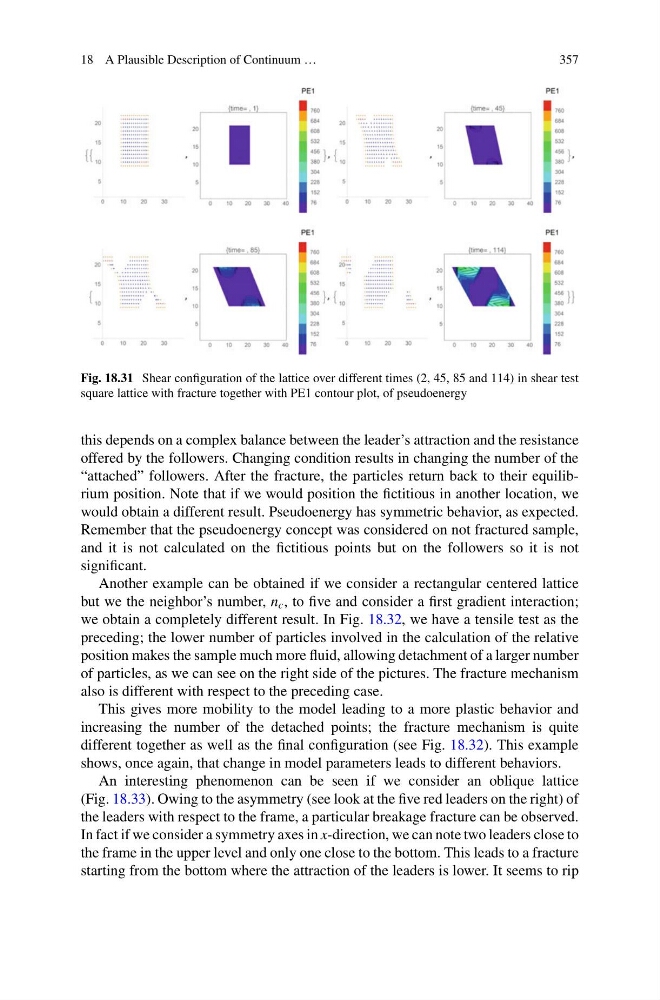
Fig. 18.31 Shear configuration of the lattice over different times (2, 45, 85 and 114) in shear test
square lattice with fracture together with PE1 contour plot, of pseudoenergy
this depends on a complex balance between the leader’s attraction and the resistance
offered by the followers. Changing condition results in changing the number of the
“attached” followers. After the fracture, the particles return back to their equilibrium position. Note that if we would position the fictitious in another location, we
would obtain a different result. Pseudoenergy has symmetric behavior, as expected.
Remember that the pseudoenergy concept was considered on not fractured sample,
and it is not calculated on the fictitious points but on the followers so it is not
significant.
Another example can be obtained if we consider a rectangular centered lattice
but we the neighbor’s number, n c , to five and consider a first gradient interaction;
we obtain a completely different result. In Fig. 18.32, we have a tensile test as the
preceding; the lower number of particles involved in the calculation of the relative
position makes the sample much more fluid, allowing detachment of a larger number
of particles, as we can see on the right side of the pictures. The fracture mechanism
also is different with respect to the preceding case.
This gives more mobility to the model leading to a more plastic behavior and
increasing the number of the detached points; the fracture mechanism is quite
different together as well as the final configuration (see Fig. 18.32). This example
shows, once again, that change in model parameters leads to different behaviors.
An interesting phenomenon can be seen if we consider an oblique lattice
(Fig. 18.33). Owing to the asymmetry (see look at the five red leaders on the right) of
the leaders with respect to the frame, a particular breakage fracture can be observed.
In fact if we consider a symmetry axes in x-direction, we can note two leaders close to
the frame in the upper level and only one close to the bottom. This leads to a fracture
starting from the bottom where the attraction of the leaders is lower. It seems to rip
357
Fig. 18.31 Shear configuration of the lattice over different times (2, 45, 85 and 114) in shear test
square lattice with fracture together with PE1 contour plot, of pseudoenergy
this depends on a complex balance between the leader’s attraction and the resistance
offered by the followers. Changing condition results in changing the number of the
“attached” followers. After the fracture, the particles return back to their equilibrium position. Note that if we would position the fictitious in another location, we
would obtain a different result. Pseudoenergy has symmetric behavior, as expected.
Remember that the pseudoenergy concept was considered on not fractured sample,
and it is not calculated on the fictitious points but on the followers so it is not
significant.
Another example can be obtained if we consider a rectangular centered lattice
but we the neighbor’s number, n c , to five and consider a first gradient interaction;
we obtain a completely different result. In Fig. 18.32, we have a tensile test as the
preceding; the lower number of particles involved in the calculation of the relative
position makes the sample much more fluid, allowing detachment of a larger number
of particles, as we can see on the right side of the pictures. The fracture mechanism
also is different with respect to the preceding case.
This gives more mobility to the model leading to a more plastic behavior and
increasing the number of the detached points; the fracture mechanism is quite
different together as well as the final configuration (see Fig. 18.32). This example
shows, once again, that change in model parameters leads to different behaviors.
An interesting phenomenon can be seen if we consider an oblique lattice
(Fig. 18.33). Owing to the asymmetry (see look at the five red leaders on the right) of
the leaders with respect to the frame, a particular breakage fracture can be observed.
In fact if we consider a symmetry axes in x-direction, we can note two leaders close to
the frame in the upper level and only one close to the bottom. This leads to a fracture
starting from the bottom where the attraction of the leaders is lower. It seems to rip