

340
R. dell’Erba
Practically, you have to decide constraints of the lattice and the interaction rules
between the followers, in order to describe the correct behavior of the constitutive
equations of the materials.
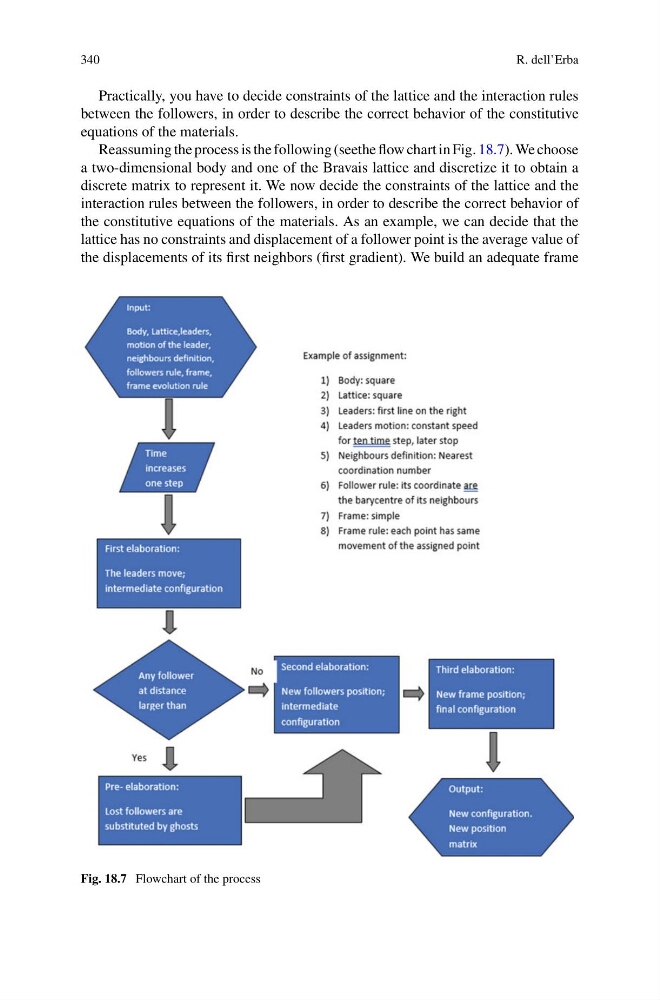
Reassuming the process is the following (seethe flow chart in Fig. 18.7). We choose
a two-dimensional body and one of the Bravais lattice and discretize it to obtain a
discrete matrix to represent it. We now decide the constraints of the lattice and the
interaction rules between the followers, in order to describe the correct behavior of
the constitutive equations of the materials. As an example, we can decide that the
lattice has no constraints and displacement of a follower point is the average value of
the displacements of its first neighbors (first gradient). We build an adequate frame
Fig. 18.7 Flowchart of the process
R. dell’Erba
Practically, you have to decide constraints of the lattice and the interaction rules
between the followers, in order to describe the correct behavior of the constitutive
equations of the materials.
Reassuming the process is the following (seethe flow chart in Fig. 18.7). We choose
a two-dimensional body and one of the Bravais lattice and discretize it to obtain a
discrete matrix to represent it. We now decide the constraints of the lattice and the
interaction rules between the followers, in order to describe the correct behavior of
the constitutive equations of the materials. As an example, we can decide that the
lattice has no constraints and displacement of a follower point is the average value of
the displacements of its first neighbors (first gradient). We build an adequate frame
Fig. 18.7 Flowchart of the process