

2 Excitation of the Waves with a Focused Source …
19
2.2 The Basic Equations of Gradient Theory of Elasticity
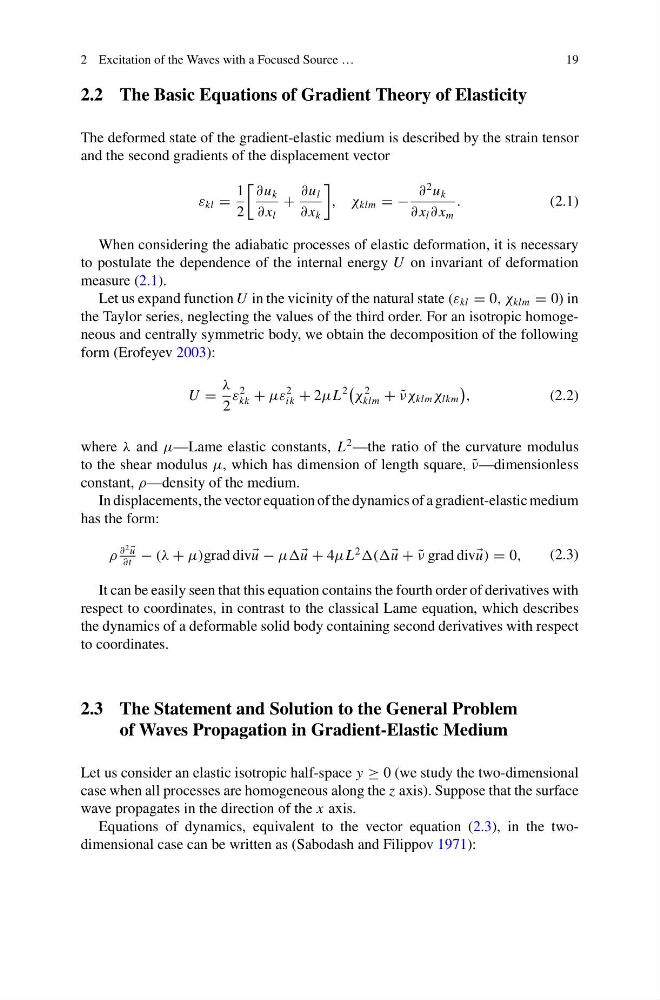
The deformed state of the gradient-elastic medium is described by the strain tensor
and the second gradients of the displacement vector
ε kl =
1
2
∂u k
∂ x l
+
∂u l
∂ x k
, χ klm = −
∂
2 u k
∂ x l ∂ x m
.
(2.1)
When considering the adiabatic processes of elastic deformation, it is necessary
to postulate the dependence of the internal energy U on invariant of deformation
measure (2.1).
Let us expand function U in the vicinity of the natural state (ε kl = 0, χ klm = 0) in
the Taylor series, neglecting the values of the third order. For an isotropic homogeneous and centrally symmetric body, we obtain the decomposition of the following
form (Erofeyev 2003):
U =
λ
2
ε
2
kk + με
2
ik + 2μL
2
χ
2
klm + ˜
νχ klm χ lkm
,
(2.2)
where λ and μ—Lame elastic constants, L
2 —the ratio of the curvature modulus
to the shear modulus μ, which has dimension of length square, ˜
ν—dimensionless
constant, ρ—density of the medium.
In displacements, the vector equation of the dynamics of a gradient-elastic medium
has the form:
ρ
∂
2
u
∂t
− (λ + μ)grad div u − μμ u + 4μL
2
( u + ˜
ν grad div u) = 0,
(2.3)
It can be easily seen that this equation contains the fourth order of derivatives with
respect to coordinates, in contrast to the classical Lame equation, which describes
the dynamics of a deformable solid body containing second derivatives with respect
to coordinates.
2.3 The Statement and Solution to the General Problem
of Waves Propagation in Gradient-Elastic Medium
Let us consider an elastic isotropic half-space y ≥ 0 (we study the two-dimensional
case when all processes are homogeneous along the z axis). Suppose that the surface
wave propagates in the direction of the x axis.
Equations of dynamics, equivalent to the vector equation (2.3), in the twodimensional case can be written as (Sabodash and Filippov 1971):
19
2.2 The Basic Equations of Gradient Theory of Elasticity
The deformed state of the gradient-elastic medium is described by the strain tensor
and the second gradients of the displacement vector
ε kl =
1
2
∂u k
∂ x l
+
∂u l
∂ x k
, χ klm = −
∂
2 u k
∂ x l ∂ x m
.
(2.1)
When considering the adiabatic processes of elastic deformation, it is necessary
to postulate the dependence of the internal energy U on invariant of deformation
measure (2.1).
Let us expand function U in the vicinity of the natural state (ε kl = 0, χ klm = 0) in
the Taylor series, neglecting the values of the third order. For an isotropic homogeneous and centrally symmetric body, we obtain the decomposition of the following
form (Erofeyev 2003):
U =
λ
2
ε
2
kk + με
2
ik + 2μL
2
χ
2
klm + ˜
νχ klm χ lkm
,
(2.2)
where λ and μ—Lame elastic constants, L
2 —the ratio of the curvature modulus
to the shear modulus μ, which has dimension of length square, ˜
ν—dimensionless
constant, ρ—density of the medium.
In displacements, the vector equation of the dynamics of a gradient-elastic medium
has the form:
ρ
∂
2
u
∂t
− (λ + μ)grad div u − μμ u + 4μL
2
( u + ˜
ν grad div u) = 0,
(2.3)
It can be easily seen that this equation contains the fourth order of derivatives with
respect to coordinates, in contrast to the classical Lame equation, which describes
the dynamics of a deformable solid body containing second derivatives with respect
to coordinates.
2.3 The Statement and Solution to the General Problem
of Waves Propagation in Gradient-Elastic Medium
Let us consider an elastic isotropic half-space y ≥ 0 (we study the two-dimensional
case when all processes are homogeneous along the z axis). Suppose that the surface
wave propagates in the direction of the x axis.
Equations of dynamics, equivalent to the vector equation (2.3), in the twodimensional case can be written as (Sabodash and Filippov 1971):