

17 Microplane Modeling for Inelastic Responses …
311
Although transformation-induced strain is the only part of inelastic response in
the utilized 1-D microplane laws, it can be shown that the resultant 3-D constitutive
equations predicts inelastic strain due to martensite variants reorientation as well
(Mehrabi and Kadkhodaei 2013). Reorientation of martensite variants is an important
phenomenon under nonproportional loadings, which causes deviation from normality
rule in constitutive modeling of SMAs, and the presented formulation takes it into
account although no expression is explicitly attributed to this kind of strain. However,
one can introduce separate terms for reorientation-induced strains in microplane
modeling of shape memory alloys (Zhou et al. 2019).
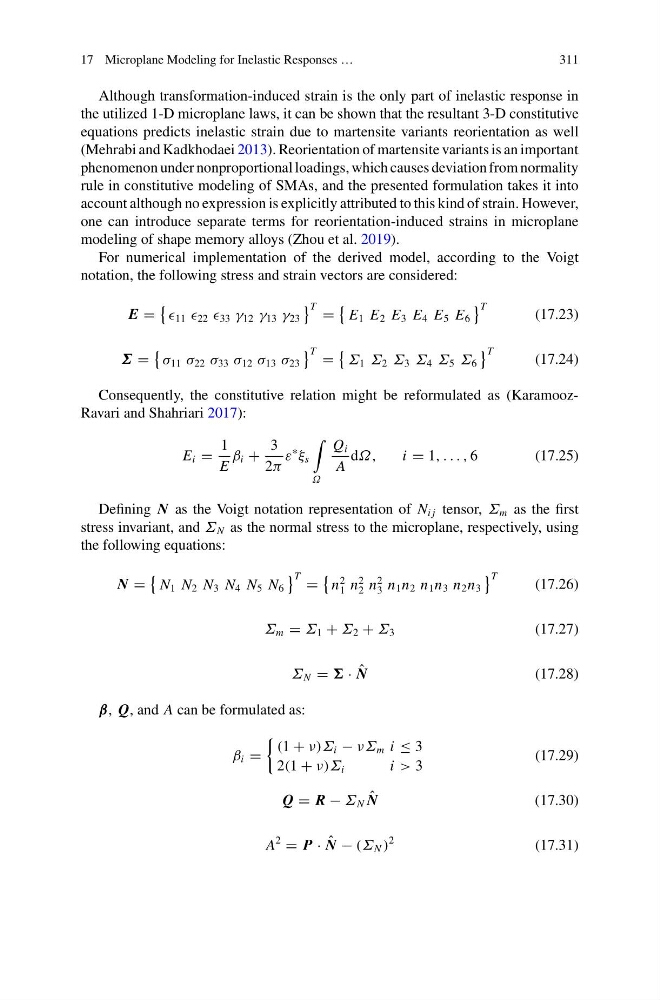
For numerical implementation of the derived model, according to the Voigt
notation, the following stress and strain vectors are considered:
E =
11 22 33 γ 12 γ 13 γ 23
T =
E 1 E 2 E 3 E 4 E 5 E 6
T
(17.23)
Σ =
σ 11 σ 22 σ 33 σ 12 σ 13 σ 23
T =
Σ 1 Σ 2 Σ 3 Σ 4 Σ 5 Σ 6
T
(17.24)
Consequently, the constitutive relation might be reformulated as (KaramoozRavari and Shahriari 2017):
E i =
1
E
β i +
3
2π
ε
∗
ξ s
Ω
Q i
A
dΩ,
i = 1, . . . , 6
(17.25)
Defining N as the Voigt notation representation of N i j tensor, Σ m as the first
stress invariant, and Σ N as the normal stress to the microplane, respectively, using
the following equations:
N =
N 1 N 2 N 3 N 4 N 5 N 6
T =
n
2
1 n
2
2 n
2
3 n 1 n 2 n 1 n 3 n 2 n 3
T
(17.26)
Σ m = Σ 1 + Σ 2 + Σ 3
(17.27)
Σ N = · ˆ
N
(17.28)
β, Q, and A can be formulated as:
β i =
(1 + ν)Σ i − νΣ m i ≤ 3
2(1 + ν)Σ i
i > 3
(17.29)
Q = R − Σ N ˆ
N
(17.30)
A
2
= P · ˆ
N − (Σ N )
2
(17.31)
311
Although transformation-induced strain is the only part of inelastic response in
the utilized 1-D microplane laws, it can be shown that the resultant 3-D constitutive
equations predicts inelastic strain due to martensite variants reorientation as well
(Mehrabi and Kadkhodaei 2013). Reorientation of martensite variants is an important
phenomenon under nonproportional loadings, which causes deviation from normality
rule in constitutive modeling of SMAs, and the presented formulation takes it into
account although no expression is explicitly attributed to this kind of strain. However,
one can introduce separate terms for reorientation-induced strains in microplane
modeling of shape memory alloys (Zhou et al. 2019).
For numerical implementation of the derived model, according to the Voigt
notation, the following stress and strain vectors are considered:
E =
11 22 33 γ 12 γ 13 γ 23
T =
E 1 E 2 E 3 E 4 E 5 E 6
T
(17.23)
Σ =
σ 11 σ 22 σ 33 σ 12 σ 13 σ 23
T =
Σ 1 Σ 2 Σ 3 Σ 4 Σ 5 Σ 6
T
(17.24)
Consequently, the constitutive relation might be reformulated as (KaramoozRavari and Shahriari 2017):
E i =
1
E
β i +
3
2π
ε
∗
ξ s
Ω
Q i
A
dΩ,
i = 1, . . . , 6
(17.25)
Defining N as the Voigt notation representation of N i j tensor, Σ m as the first
stress invariant, and Σ N as the normal stress to the microplane, respectively, using
the following equations:
N =
N 1 N 2 N 3 N 4 N 5 N 6
T =
n
2
1 n
2
2 n
2
3 n 1 n 2 n 1 n 3 n 2 n 3
T
(17.26)
Σ m = Σ 1 + Σ 2 + Σ 3
(17.27)
Σ N = · ˆ
N
(17.28)
β, Q, and A can be formulated as:
β i =
(1 + ν)Σ i − νΣ m i ≤ 3
2(1 + ν)Σ i
i > 3
(17.29)
Q = R − Σ N ˆ
N
(17.30)
A
2
= P · ˆ
N − (Σ N )
2
(17.31)