

17 Microplane Modeling for Inelastic Responses …
309
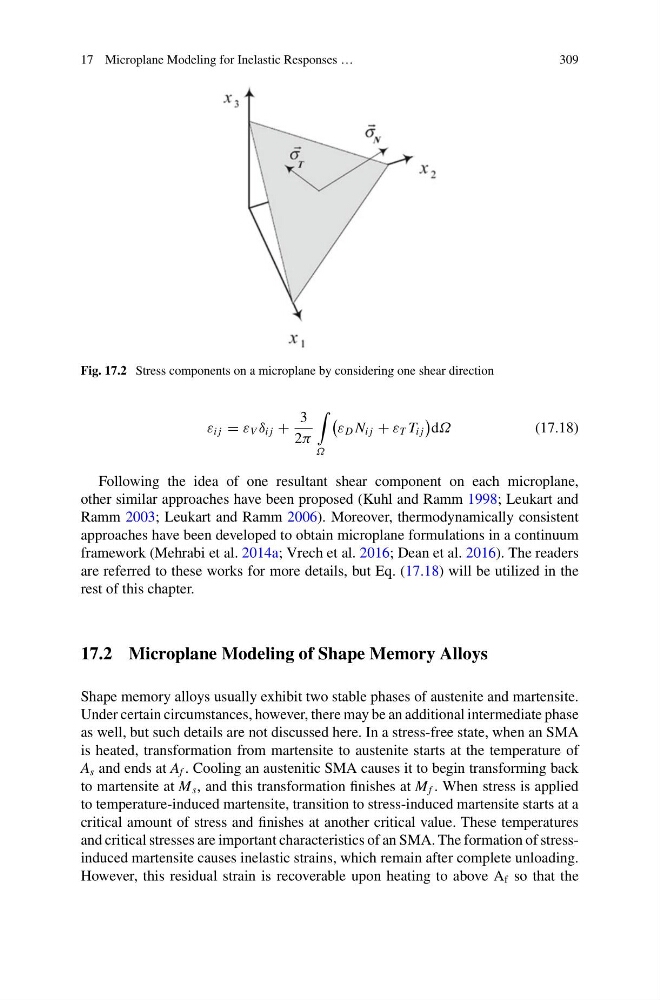
Fig. 17.2 Stress components on a microplane by considering one shear direction
ε i j = ε V δ i j +
3
2π
Ω
ε D N i j + ε T T i j
dΩ
(17.18)
Following the idea of one resultant shear component on each microplane,
other similar approaches have been proposed (Kuhl and Ramm 1998; Leukart and
Ramm 2003; Leukart and Ramm 2006). Moreover, thermodynamically consistent
approaches have been developed to obtain microplane formulations in a continuum
framework (Mehrabi et al. 2014a; Vrech et al. 2016; Dean et al. 2016). The readers
are referred to these works for more details, but Eq. (17.18) will be utilized in the
rest of this chapter.
17.2 Microplane Modeling of Shape Memory Alloys
Shape memory alloys usually exhibit two stable phases of austenite and martensite.
Under certain circumstances, however, there may be an additional intermediate phase
as well, but such details are not discussed here. In a stress-free state, when an SMA
is heated, transformation from martensite to austenite starts at the temperature of
A s and ends at A f . Cooling an austenitic SMA causes it to begin transforming back
to martensite at M s , and this transformation finishes at M f . When stress is applied
to temperature-induced martensite, transition to stress-induced martensite starts at a
critical amount of stress and finishes at another critical value. These temperatures
and critical stresses are important characteristics of an SMA. The formation of stressinduced martensite causes inelastic strains, which remain after complete unloading.
However, this residual strain is recoverable upon heating to above A f so that the
309
Fig. 17.2 Stress components on a microplane by considering one shear direction
ε i j = ε V δ i j +
3
2π
Ω
ε D N i j + ε T T i j
dΩ
(17.18)
Following the idea of one resultant shear component on each microplane,
other similar approaches have been proposed (Kuhl and Ramm 1998; Leukart and
Ramm 2003; Leukart and Ramm 2006). Moreover, thermodynamically consistent
approaches have been developed to obtain microplane formulations in a continuum
framework (Mehrabi et al. 2014a; Vrech et al. 2016; Dean et al. 2016). The readers
are referred to these works for more details, but Eq. (17.18) will be utilized in the
rest of this chapter.
17.2 Microplane Modeling of Shape Memory Alloys
Shape memory alloys usually exhibit two stable phases of austenite and martensite.
Under certain circumstances, however, there may be an additional intermediate phase
as well, but such details are not discussed here. In a stress-free state, when an SMA
is heated, transformation from martensite to austenite starts at the temperature of
A s and ends at A f . Cooling an austenitic SMA causes it to begin transforming back
to martensite at M s , and this transformation finishes at M f . When stress is applied
to temperature-induced martensite, transition to stress-induced martensite starts at a
critical amount of stress and finishes at another critical value. These temperatures
and critical stresses are important characteristics of an SMA. The formation of stressinduced martensite causes inelastic strains, which remain after complete unloading.
However, this residual strain is recoverable upon heating to above A f so that the