

304
M. R. Karamooz-Ravari et al.
17.1 An Introduction to the Basics of Microplane Modeling
The so-called microplane modeling approach originated from the work of Taylor
(1938) who achieved constitutive equations of polycrystalline metals by developing
relations between stress and strain vectors on generic planes of arbitrary orientations
in a material point so that the macroscopic stress or strain tensors were determined
as a resultant of all these vectors. This concept was later modified by others and
was commonly known as “slip theory of plasticity”. As slip is not the source of
inelastic response for all types of materials, Bažant (1984) introduced the neutral
term “microplane theory” which can be used for general inelastic behaviors. In this
approach, 1-D constitutive laws for each stress vector and its associated strain vector
are sufficient to generate a macroscopic 3-D model by considering either one of two
main formulations in microplane theory named “static constraint” and “kinematic
constraint”. In static constraint formulation, it is assumed that the stress vector acting
on each microplane is the projection of the macroscopic stress tensor. In kinematic
constraint formulation, the strain vector on any microplane is considered as the
projection of the macroscopic strain tensor. Moreover, there are some particular cases,
called “double constraint” formulation, where both static and kinematic constraints
co-exist.
Microplane theory with static constraint inspired by the works of Bažant et al.
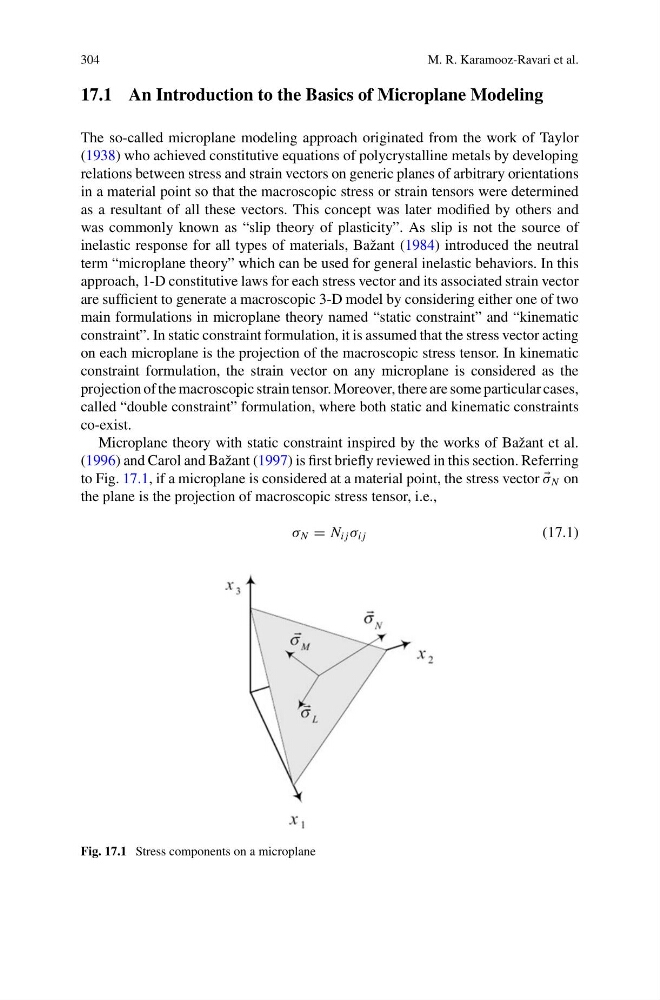
(1996) and Carol and Bažant (1997) is first briefly reviewed in this section. Referring
to Fig. 17.1, if a microplane is considered at a material point, the stress vector
σ N on
the plane is the projection of macroscopic stress tensor, i.e.,
σ N = N i j σ i j
(17.1)
Fig. 17.1 Stress components on a microplane
M. R. Karamooz-Ravari et al.
17.1 An Introduction to the Basics of Microplane Modeling
The so-called microplane modeling approach originated from the work of Taylor
(1938) who achieved constitutive equations of polycrystalline metals by developing
relations between stress and strain vectors on generic planes of arbitrary orientations
in a material point so that the macroscopic stress or strain tensors were determined
as a resultant of all these vectors. This concept was later modified by others and
was commonly known as “slip theory of plasticity”. As slip is not the source of
inelastic response for all types of materials, Bažant (1984) introduced the neutral
term “microplane theory” which can be used for general inelastic behaviors. In this
approach, 1-D constitutive laws for each stress vector and its associated strain vector
are sufficient to generate a macroscopic 3-D model by considering either one of two
main formulations in microplane theory named “static constraint” and “kinematic
constraint”. In static constraint formulation, it is assumed that the stress vector acting
on each microplane is the projection of the macroscopic stress tensor. In kinematic
constraint formulation, the strain vector on any microplane is considered as the
projection of the macroscopic strain tensor. Moreover, there are some particular cases,
called “double constraint” formulation, where both static and kinematic constraints
co-exist.
Microplane theory with static constraint inspired by the works of Bažant et al.
(1996) and Carol and Bažant (1997) is first briefly reviewed in this section. Referring
to Fig. 17.1, if a microplane is considered at a material point, the stress vector
σ N on
the plane is the projection of macroscopic stress tensor, i.e.,
σ N = N i j σ i j
(17.1)
Fig. 17.1 Stress components on a microplane