

15 Homogenization-Based Mechanical Behavior Modeling of Composites …
273
Appendix
The form of the elementary operators t
e for isotropic elasticity. (from Franciosi
and Lormand 2004; Franciosi 2005), to be retrieved in (Spagnuolo et al. 2020).
Each t
e
(ω) = t
e
(θ ,ϕ) elementary operator in the GO t
V
(r) or mGO t V of V is
an axisymmetric operator, defined in reference to the parallel planes of ω normal
direction in some reference medium frame. For general elasticity anisotropy, considering the (0, 0)-oriented t
e
(0, 0) elementary operator for (θ ,ϕ) = (0, 0), the only
nonzero terms correspond to ω = (0, 0, 1) what only involves the C m3 p3 elastic
moduli of the infinite medium, for C expressed in the operator axes frame as
C(0, 0). In this frame, the nonzero terms of the t
e
(0, 0) operator are the t
e
p3 j3 (0,0)
terms which make a symmetric 3 × 3 matrix, t say, such that t
e
p3 j3 = t pj . For
elastic isotropy, since in all frames C 3333 = λ + 2 μ = 2 μ (1 − ν)/(1 − 2 ν)
and C 1313 = C 2323 = μ, the C frame identification is made useless. It remains
t 11 = 1/C 1313 , t 22 = 1/C 2323 , t 33 = 1/C 3333 and t ((2,3),(2,3)) = t ((3,1),(3,1)) =
1/4 μ = B/4, t 3333 = (1/μ)(1 − 0.5/(1 − ν)) = B + A, ∀(θ ,ϕ) ≡ ω. One
arrives at t
e
pq jn (ω) = A τ
A
pq jn (ω) + B τ
B
pq jn (ω) with τ
A
pqjn (ω) = ω j ω p ω n ω q and
τ
B
pq jn (ω) =
δ j p ω n ω q
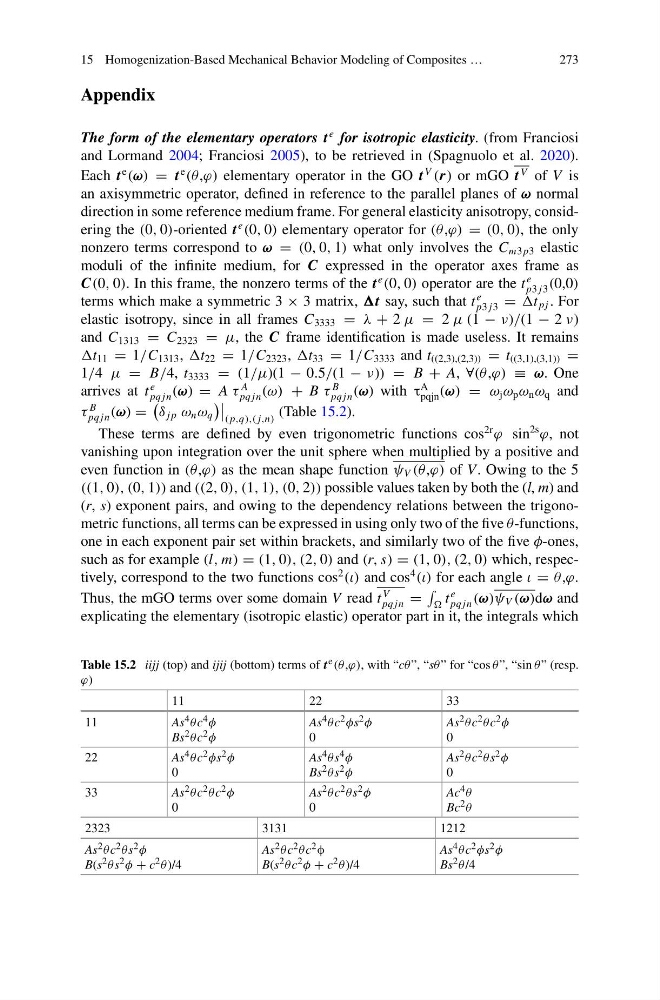
( p,q),( j,n) (Table 15.2).
These terms are defined by even trigonometric functions cos
2r
ϕ sin
2s
ϕ, not
vanishing upon integration over the unit sphere when multiplied by a positive and
even function in (θ ,ϕ) as the mean shape function ψ V (θ ,ϕ) of V. Owing to the 5
((1, 0), (0, 1)) and ((2, 0), (1, 1), (0, 2)) possible values taken by both the (l, m) and
(r, s) exponent pairs, and owing to the dependency relations between the trigonometric functions, all terms can be expressed in using only two of the five θ-functions,
one in each exponent pair set within brackets, and similarly two of the five φ-ones,
such as for example (l, m) = (1, 0), (2, 0) and (r, s) = (1, 0), (2, 0) which, respectively, correspond to the two functions cos
2
(ι) and cos
4
(ι) for each angle ι = θ ,ϕ.
Thus, the mGO terms over some domain V read t
V
pq jn =
t
e
pq jn (ω)ψ V (ω)dω and
explicating the elementary (isotropic elastic) operator part in it, the integrals which
Table 15.2 iijj (top) and ijij (bottom) terms of t e (θ,ϕ), with “cθ”, “sθ” for “cos θ”, “sin θ” (resp.
ϕ)
11
22
33
11
As 4 θc 4 φ
Bs 2 θc 2 φ
As 4 θc 2 φs 2 φ
0
As 2 θc 2 θc 2 φ
0
22
As 4 θc 2 φs 2 φ
0
As 4 θs 4 φ
Bs 2 θs 2 φ
As 2 θc 2 θs 2 φ
0
33
As 2 θc 2 θc 2 φ
0
As 2 θc 2 θs 2 φ
0
Ac 4 θ
Bc 2 θ
2323
3131
1212
As 2 θc 2 θs 2 φ
B(s 2 θs 2 φ + c 2 θ)/4
As 2 θc 2 θc 2 φ
B(s 2 θc 2 φ + c 2 θ)/4
As 4 θc 2 φs 2 φ
Bs 2 θ/4
273
Appendix
The form of the elementary operators t
e for isotropic elasticity. (from Franciosi
and Lormand 2004; Franciosi 2005), to be retrieved in (Spagnuolo et al. 2020).
Each t
e
(ω) = t
e
(θ ,ϕ) elementary operator in the GO t
V
(r) or mGO t V of V is
an axisymmetric operator, defined in reference to the parallel planes of ω normal
direction in some reference medium frame. For general elasticity anisotropy, considering the (0, 0)-oriented t
e
(0, 0) elementary operator for (θ ,ϕ) = (0, 0), the only
nonzero terms correspond to ω = (0, 0, 1) what only involves the C m3 p3 elastic
moduli of the infinite medium, for C expressed in the operator axes frame as
C(0, 0). In this frame, the nonzero terms of the t
e
(0, 0) operator are the t
e
p3 j3 (0,0)
terms which make a symmetric 3 × 3 matrix, t say, such that t
e
p3 j3 = t pj . For
elastic isotropy, since in all frames C 3333 = λ + 2 μ = 2 μ (1 − ν)/(1 − 2 ν)
and C 1313 = C 2323 = μ, the C frame identification is made useless. It remains
t 11 = 1/C 1313 , t 22 = 1/C 2323 , t 33 = 1/C 3333 and t ((2,3),(2,3)) = t ((3,1),(3,1)) =
1/4 μ = B/4, t 3333 = (1/μ)(1 − 0.5/(1 − ν)) = B + A, ∀(θ ,ϕ) ≡ ω. One
arrives at t
e
pq jn (ω) = A τ
A
pq jn (ω) + B τ
B
pq jn (ω) with τ
A
pqjn (ω) = ω j ω p ω n ω q and
τ
B
pq jn (ω) =
δ j p ω n ω q
( p,q),( j,n) (Table 15.2).
These terms are defined by even trigonometric functions cos
2r
ϕ sin
2s
ϕ, not
vanishing upon integration over the unit sphere when multiplied by a positive and
even function in (θ ,ϕ) as the mean shape function ψ V (θ ,ϕ) of V. Owing to the 5
((1, 0), (0, 1)) and ((2, 0), (1, 1), (0, 2)) possible values taken by both the (l, m) and
(r, s) exponent pairs, and owing to the dependency relations between the trigonometric functions, all terms can be expressed in using only two of the five θ-functions,
one in each exponent pair set within brackets, and similarly two of the five φ-ones,
such as for example (l, m) = (1, 0), (2, 0) and (r, s) = (1, 0), (2, 0) which, respectively, correspond to the two functions cos
2
(ι) and cos
4
(ι) for each angle ι = θ ,ϕ.
Thus, the mGO terms over some domain V read t
V
pq jn =
t
e
pq jn (ω)ψ V (ω)dω and
explicating the elementary (isotropic elastic) operator part in it, the integrals which
Table 15.2 iijj (top) and ijij (bottom) terms of t e (θ,ϕ), with “cθ”, “sθ” for “cos θ”, “sin θ” (resp.
ϕ)
11
22
33
11
As 4 θc 4 φ
Bs 2 θc 2 φ
As 4 θc 2 φs 2 φ
0
As 2 θc 2 θc 2 φ
0
22
As 4 θc 2 φs 2 φ
0
As 4 θs 4 φ
Bs 2 θs 2 φ
As 2 θc 2 θs 2 φ
0
33
As 2 θc 2 θc 2 φ
0
As 2 θc 2 θs 2 φ
0
Ac 4 θ
Bc 2 θ
2323
3131
1212
As 2 θc 2 θs 2 φ
B(s 2 θs 2 φ + c 2 θ)/4
As 2 θc 2 θc 2 φ
B(s 2 θc 2 φ + c 2 θ)/4
As 4 θc 2 φs 2 φ
Bs 2 θ/4