

258
P. Franciosi and M. Spagnuolo
square beams (Franciosi et al. 2015; Franciosi 2018; Spagnuolo et al. 2020) did
not have so nice ones. Yet, these cases are among those having an interaction part
nicely expressed from a linear combination of interior mGOs of the same type,
noticing that intermediates empty spaces between elements are also finite cylinders or
rectangular beams, say have same shape as the aligned elements. This was formalized
as a specific “decomposition method” in (Franciosi 2018), a consequence from the
geometric nature of the RT-IRT method. The interior mGOs for finite cylinders and
for rectangular beams were explicated in (Franciosi 2014; 2018), respectively. An
approximate, more manageable form was provided in (Spagnuolo et al. 2020) for
square beams. In particular, it is easily retrieved that the mGO of a compact set of
coaxial finite cylinders of same radius (resp. of aligned rectangular beams of same
height) equal the (uniform) GO of an infinite cylinder (respectively of a laminate
layer), confirming the known “blindness to connectedness” of the mGOs, as related
they are to the covariance function, between parts in contact in any partition of a
compact domain (Santalo 1976; Serra 1982). The difference between a compact
set of elements and a connected identical one is in their different behaviors under
loading: While the former will lose its “integrity” and dissociates, the latter will not.
These are examples where missing physical interconnections have to be represented
by mathematical (here mechanical) conditions.
Regarding, for the axial alignments of spheres (and spheroids), possibilities of
describing more general interconnections between such aligned elements (either
when at contact or not), an arbitrary modification of the alignment mGO was proposed
(Franciosi 2010) in just averaging it with the GO of a uniform infinite cylinder of
same orientation. This was obviously a simple way to stiffen the alignment in the axial
direction “as if” an axial connection was present between them but without much
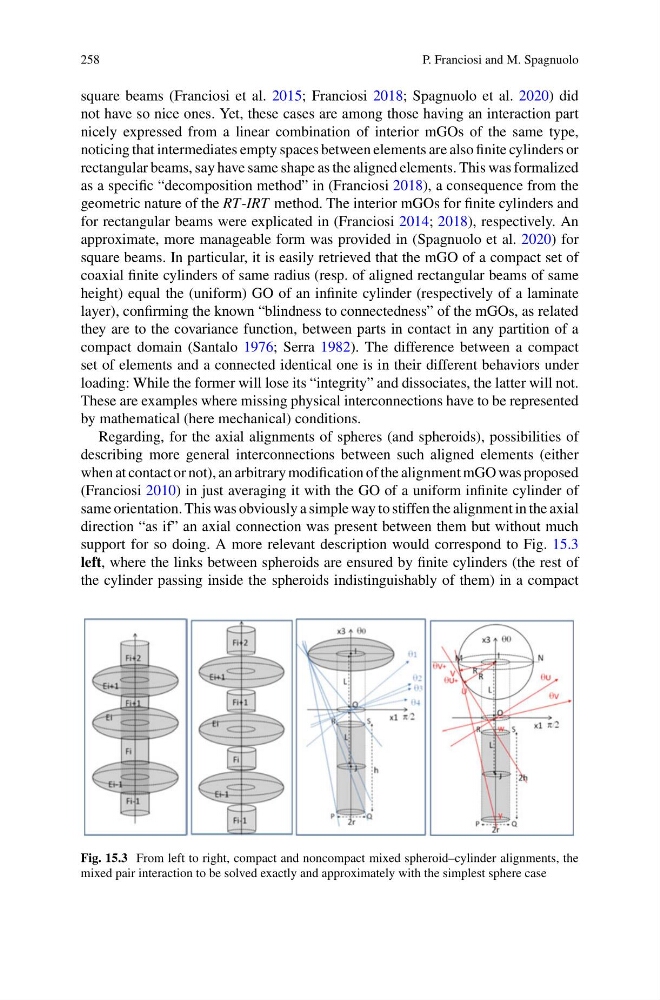
support for so doing. A more relevant description would correspond to Fig. 15.3
left, where the links between spheroids are ensured by finite cylinders (the rest of
the cylinder passing inside the spheroids indistinguishably of them) in a compact
Fig. 15.3 From left to right, compact and noncompact mixed spheroid–cylinder alignments, the
mixed pair interaction to be solved exactly and approximately with the simplest sphere case
P. Franciosi and M. Spagnuolo
square beams (Franciosi et al. 2015; Franciosi 2018; Spagnuolo et al. 2020) did
not have so nice ones. Yet, these cases are among those having an interaction part
nicely expressed from a linear combination of interior mGOs of the same type,
noticing that intermediates empty spaces between elements are also finite cylinders or
rectangular beams, say have same shape as the aligned elements. This was formalized
as a specific “decomposition method” in (Franciosi 2018), a consequence from the
geometric nature of the RT-IRT method. The interior mGOs for finite cylinders and
for rectangular beams were explicated in (Franciosi 2014; 2018), respectively. An
approximate, more manageable form was provided in (Spagnuolo et al. 2020) for
square beams. In particular, it is easily retrieved that the mGO of a compact set of
coaxial finite cylinders of same radius (resp. of aligned rectangular beams of same
height) equal the (uniform) GO of an infinite cylinder (respectively of a laminate
layer), confirming the known “blindness to connectedness” of the mGOs, as related
they are to the covariance function, between parts in contact in any partition of a
compact domain (Santalo 1976; Serra 1982). The difference between a compact
set of elements and a connected identical one is in their different behaviors under
loading: While the former will lose its “integrity” and dissociates, the latter will not.
These are examples where missing physical interconnections have to be represented
by mathematical (here mechanical) conditions.
Regarding, for the axial alignments of spheres (and spheroids), possibilities of
describing more general interconnections between such aligned elements (either
when at contact or not), an arbitrary modification of the alignment mGO was proposed
(Franciosi 2010) in just averaging it with the GO of a uniform infinite cylinder of
same orientation. This was obviously a simple way to stiffen the alignment in the axial
direction “as if” an axial connection was present between them but without much
support for so doing. A more relevant description would correspond to Fig. 15.3
left, where the links between spheroids are ensured by finite cylinders (the rest of
the cylinder passing inside the spheroids indistinguishably of them) in a compact
Fig. 15.3 From left to right, compact and noncompact mixed spheroid–cylinder alignments, the
mixed pair interaction to be solved exactly and approximately with the simplest sphere case