

226
R. dell’Erba
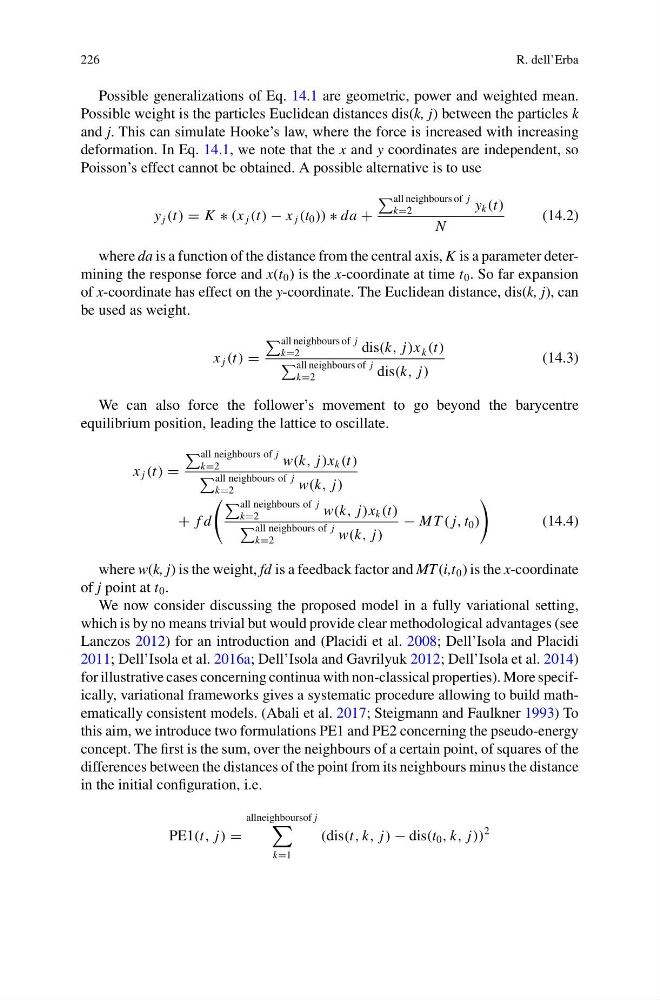
Possible generalizations of Eq. 14.1 are geometric, power and weighted mean.
Possible weight is the particles Euclidean distances dis(k, j) between the particles k
and j. This can simulate Hooke’s law, where the force is increased with increasing
deformation. In Eq. 14.1, we note that the x and y coordinates are independent, so
Poisson’s effect cannot be obtained. A possible alternative is to use
y j (t) = K ∗ (x j (t) − x j (t 0 )) ∗ da +
all neighbours of j
k=2
y k (t)
N
(14.2)
where da is a function of the distance from the central axis, K is a parameter determining the response force and x(t 0 ) is the x-coordinate at time t 0 . So far expansion
of x-coordinate has effect on the y-coordinate. The Euclidean distance, dis(k, j), can
be used as weight.
x j (t) =
all neighbours of j
k=2
dis(k, j)x k (t)
all neighbours of j
k=2
dis(k, j)
(14.3)
We can also force the follower’s movement to go beyond the barycentre
equilibrium position, leading the lattice to oscillate.
x j (t) =
all neighbours of j
k=2
w(k, j)x k (t)
all neighbours of j
k=2
w(k, j)
+ f d
all neighbours of j
k=2
w(k, j)x k (t)
all neighbours of j
k=2
w(k, j)
− MT ( j, t 0 )
(14.4)
where w(k, j) is the weight, fd is a feedback factor and MT (i,t 0 ) is the x-coordinate
of j point at t 0 .
We now consider discussing the proposed model in a fully variational setting,
which is by no means trivial but would provide clear methodological advantages (see
Lanczos 2012) for an introduction and (Placidi et al. 2008; Dell’Isola and Placidi
2011; Dell’Isola et al. 2016a; Dell’Isola and Gavrilyuk 2012; Dell’Isola et al. 2014)
for illustrative cases concerning continua with non-classical properties). More specifically, variational frameworks gives a systematic procedure allowing to build mathematically consistent models. (Abali et al. 2017; Steigmann and Faulkner 1993) To
this aim, we introduce two formulations PE1 and PE2 concerning the pseudo-energy
concept. The first is the sum, over the neighbours of a certain point, of squares of the
differences between the distances of the point from its neighbours minus the distance
in the initial configuration, i.e.
PE1(t, j) =
allneighboursof j
k=1
(dis(t, k, j) − dis(t 0 , k, j))
2
R. dell’Erba
Possible generalizations of Eq. 14.1 are geometric, power and weighted mean.
Possible weight is the particles Euclidean distances dis(k, j) between the particles k
and j. This can simulate Hooke’s law, where the force is increased with increasing
deformation. In Eq. 14.1, we note that the x and y coordinates are independent, so
Poisson’s effect cannot be obtained. A possible alternative is to use
y j (t) = K ∗ (x j (t) − x j (t 0 )) ∗ da +
all neighbours of j
k=2
y k (t)
N
(14.2)
where da is a function of the distance from the central axis, K is a parameter determining the response force and x(t 0 ) is the x-coordinate at time t 0 . So far expansion
of x-coordinate has effect on the y-coordinate. The Euclidean distance, dis(k, j), can
be used as weight.
x j (t) =
all neighbours of j
k=2
dis(k, j)x k (t)
all neighbours of j
k=2
dis(k, j)
(14.3)
We can also force the follower’s movement to go beyond the barycentre
equilibrium position, leading the lattice to oscillate.
x j (t) =
all neighbours of j
k=2
w(k, j)x k (t)
all neighbours of j
k=2
w(k, j)
+ f d
all neighbours of j
k=2
w(k, j)x k (t)
all neighbours of j
k=2
w(k, j)
− MT ( j, t 0 )
(14.4)
where w(k, j) is the weight, fd is a feedback factor and MT (i,t 0 ) is the x-coordinate
of j point at t 0 .
We now consider discussing the proposed model in a fully variational setting,
which is by no means trivial but would provide clear methodological advantages (see
Lanczos 2012) for an introduction and (Placidi et al. 2008; Dell’Isola and Placidi
2011; Dell’Isola et al. 2016a; Dell’Isola and Gavrilyuk 2012; Dell’Isola et al. 2014)
for illustrative cases concerning continua with non-classical properties). More specifically, variational frameworks gives a systematic procedure allowing to build mathematically consistent models. (Abali et al. 2017; Steigmann and Faulkner 1993) To
this aim, we introduce two formulations PE1 and PE2 concerning the pseudo-energy
concept. The first is the sum, over the neighbours of a certain point, of squares of the
differences between the distances of the point from its neighbours minus the distance
in the initial configuration, i.e.
PE1(t, j) =
allneighboursof j
k=1
(dis(t, k, j) − dis(t 0 , k, j))
2