

11 Numerical Evaluation of Integrals in Laplace Domain Anisotropic …
155
Overall excellent review of works on three-dimensional dynamic elastic fundamental
solutions is provided by Dineva et al. (2019).
Evaluating highly oscillatory integrals even in one dimension is very expensive with traditional methods and nowadays there are several different approaches
available that are specifically designed to deal with this type of integrals (Iserles
et al. 2006). In this paper we propose a technique for numerical evaluation of onedimensional integrals in Laplace domain anisotropic elastic fundamental solutions
aimed for high frequencies and/or large distances between source and observation
points. Our approach is based on quadrature rule developed by Evans and Webster
(1997), which is a variation of Levin’s method (Levin 1982).
11.2 Fundamental Solutions
Laplace-transformed full-space displacement fundamental solutions for anisotropic
and linearly elastic media can be represented as a sum of static (singular) and dynamic
(regular) terms as
g j p (y, x, s) = g j p (r, s) = g
S
j p (r) + g
R
j p (r, s), j, p = 1, 3,
(11.1)
r = y − x, r = |r|,
(11.2)
where g
S
j p is static (singular) term, g
R
j p is dynamic (regular) term, s is the complex
Laplace transform parameter, x is the position vector of the source point, and y is
the position vector of the observation point.
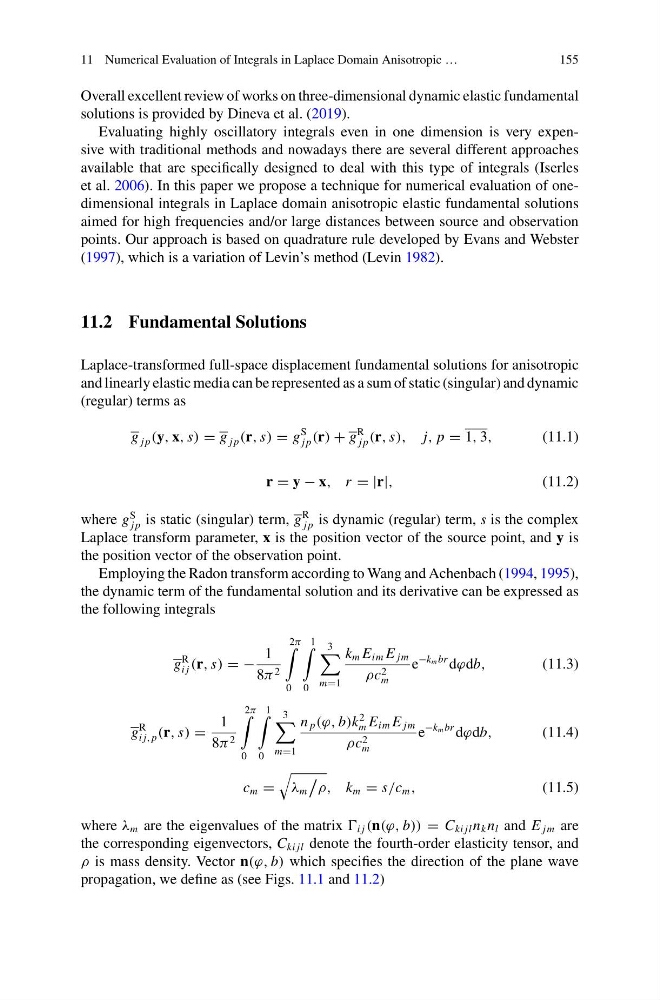
Employing the Radon transform according to Wang and Achenbach (1994, 1995),
the dynamic term of the fundamental solution and its derivative can be expressed as
the following integrals
g
R
i j (r, s) = −
1
8π 2
2π
0
1
0
3
m=1
k m E im E jm
ρc 2
m
e
−k m br dϕdb,
(11.3)
g
R
i j, p (r, s) =
1
8π 2
2π
0
1
0
3
m=1
n p (ϕ, b)k
2
m E im E jm
ρc 2
m
e
−k m br dϕdb,
(11.4)
c m =
λ m
ρ, k m = s/c m ,
(11.5)
where λ m are the eigenvalues of the matrix i j (n(ϕ, b)) = C ki jl n k n l and E jm are
the corresponding eigenvectors, C ki jl denote the fourth-order elasticity tensor, and
ρ is mass density. Vector n(ϕ, b) which specifies the direction of the plane wave
propagation, we define as (see Figs. 11.1 and 11.2)
155
Overall excellent review of works on three-dimensional dynamic elastic fundamental
solutions is provided by Dineva et al. (2019).
Evaluating highly oscillatory integrals even in one dimension is very expensive with traditional methods and nowadays there are several different approaches
available that are specifically designed to deal with this type of integrals (Iserles
et al. 2006). In this paper we propose a technique for numerical evaluation of onedimensional integrals in Laplace domain anisotropic elastic fundamental solutions
aimed for high frequencies and/or large distances between source and observation
points. Our approach is based on quadrature rule developed by Evans and Webster
(1997), which is a variation of Levin’s method (Levin 1982).
11.2 Fundamental Solutions
Laplace-transformed full-space displacement fundamental solutions for anisotropic
and linearly elastic media can be represented as a sum of static (singular) and dynamic
(regular) terms as
g j p (y, x, s) = g j p (r, s) = g
S
j p (r) + g
R
j p (r, s), j, p = 1, 3,
(11.1)
r = y − x, r = |r|,
(11.2)
where g
S
j p is static (singular) term, g
R
j p is dynamic (regular) term, s is the complex
Laplace transform parameter, x is the position vector of the source point, and y is
the position vector of the observation point.
Employing the Radon transform according to Wang and Achenbach (1994, 1995),
the dynamic term of the fundamental solution and its derivative can be expressed as
the following integrals
g
R
i j (r, s) = −
1
8π 2
2π
0
1
0
3
m=1
k m E im E jm
ρc 2
m
e
−k m br dϕdb,
(11.3)
g
R
i j, p (r, s) =
1
8π 2
2π
0
1
0
3
m=1
n p (ϕ, b)k
2
m E im E jm
ρc 2
m
e
−k m br dϕdb,
(11.4)
c m =
λ m
ρ, k m = s/c m ,
(11.5)
where λ m are the eigenvalues of the matrix i j (n(ϕ, b)) = C ki jl n k n l and E jm are
the corresponding eigenvectors, C ki jl denote the fourth-order elasticity tensor, and
ρ is mass density. Vector n(ϕ, b) which specifies the direction of the plane wave
propagation, we define as (see Figs. 11.1 and 11.2)