

148
G. Yu. Levi et al.
thermoelastic bodies is that the elements of function (10.25)–(10.26) have a countable set of complex zeros and poles, some of which have a small imaginary part
(Belyankova et al. 2012). The analysis showed that, along with the complex poles
with a small imaginary part, the function K has many significantly complex poles
with a large imaginary part.
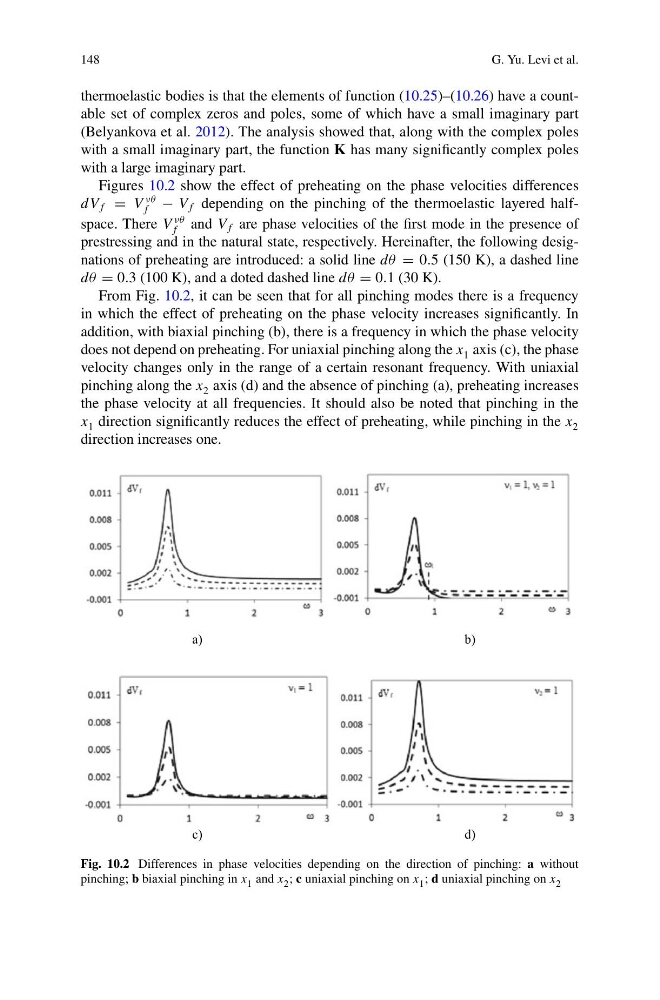
Figures 10.2 show the effect of preheating on the phase velocities differences
dV f = V
νθ
f − V f depending on the pinching of the thermoelastic layered halfspace. There V
νθ
f and V f are phase velocities of the first mode in the presence of
prestressing and in the natural state, respectively. Hereinafter, the following designations of preheating are introduced: a solid line dθ = 0.5 (150 K), a dashed line
dθ = 0.3 (100 K), and a doted dashed line dθ = 0.1 (30 K).
From Fig. 10.2, it can be seen that for all pinching modes there is a frequency
in which the effect of preheating on the phase velocity increases significantly. In
addition, with biaxial pinching (b), there is a frequency in which the phase velocity
does not depend on preheating. For uniaxial pinching along the x 1 axis (c), the phase
velocity changes only in the range of a certain resonant frequency. With uniaxial
pinching along the x 2 axis (d) and the absence of pinching (a), preheating increases
the phase velocity at all frequencies. It should also be noted that pinching in the
x 1 direction significantly reduces the effect of preheating, while pinching in the x 2
direction increases one.
Fig. 10.2 Differences in phase velocities depending on the direction of pinching: a without
pinching; b biaxial pinching in x 1 and x 2 ; c uniaxial pinching on x 1 ; d uniaxial pinching on x 2
G. Yu. Levi et al.
thermoelastic bodies is that the elements of function (10.25)–(10.26) have a countable set of complex zeros and poles, some of which have a small imaginary part
(Belyankova et al. 2012). The analysis showed that, along with the complex poles
with a small imaginary part, the function K has many significantly complex poles
with a large imaginary part.
Figures 10.2 show the effect of preheating on the phase velocities differences
dV f = V
νθ
f − V f depending on the pinching of the thermoelastic layered halfspace. There V
νθ
f and V f are phase velocities of the first mode in the presence of
prestressing and in the natural state, respectively. Hereinafter, the following designations of preheating are introduced: a solid line dθ = 0.5 (150 K), a dashed line
dθ = 0.3 (100 K), and a doted dashed line dθ = 0.1 (30 K).
From Fig. 10.2, it can be seen that for all pinching modes there is a frequency
in which the effect of preheating on the phase velocity increases significantly. In
addition, with biaxial pinching (b), there is a frequency in which the phase velocity
does not depend on preheating. For uniaxial pinching along the x 1 axis (c), the phase
velocity changes only in the range of a certain resonant frequency. With uniaxial
pinching along the x 2 axis (d) and the absence of pinching (a), preheating increases
the phase velocity at all frequencies. It should also be noted that pinching in the
x 1 direction significantly reduces the effect of preheating, while pinching in the x 2
direction increases one.
Fig. 10.2 Differences in phase velocities depending on the direction of pinching: a without
pinching; b biaxial pinching in x 1 and x 2 ; c uniaxial pinching on x 1 ; d uniaxial pinching on x 2