

142
G. Yu. Levi et al.
∂σ
∗(n)
31
∂ x 1
+
∂σ
∗(n)
32
∂ x 2
+
∂σ
∗(n)
3
∂ x 3
= ρ
(n)
0
∂
2 u
(n)
3
∂t 2
λ
(n)
1
∂
2 u
(n)
4
∂ x
2
1
+ λ
(n)
2
∂
2 u
(n)
4
∂ x
2
2
+ λ
(n)
3
∂
2 u
(n)
4
∂ x
2
3
=
θ
(n)
1
θ 0
c
(n)
ε ρ
(n)
0
∂u
(n)
4
∂ t
+θ
(n)
1 β
(n)∗
1
∂
2 u
(n)
1
∂ t∂ x 1
+ θ
(n)
1 β
(n)∗
2
∂
2 u
(n)
2
∂ t∂ x 2
+ θ
(n)
1 β
(n)∗
3
∂
2 u
(n)
3
∂ t∂ x 3
,
(10.3)
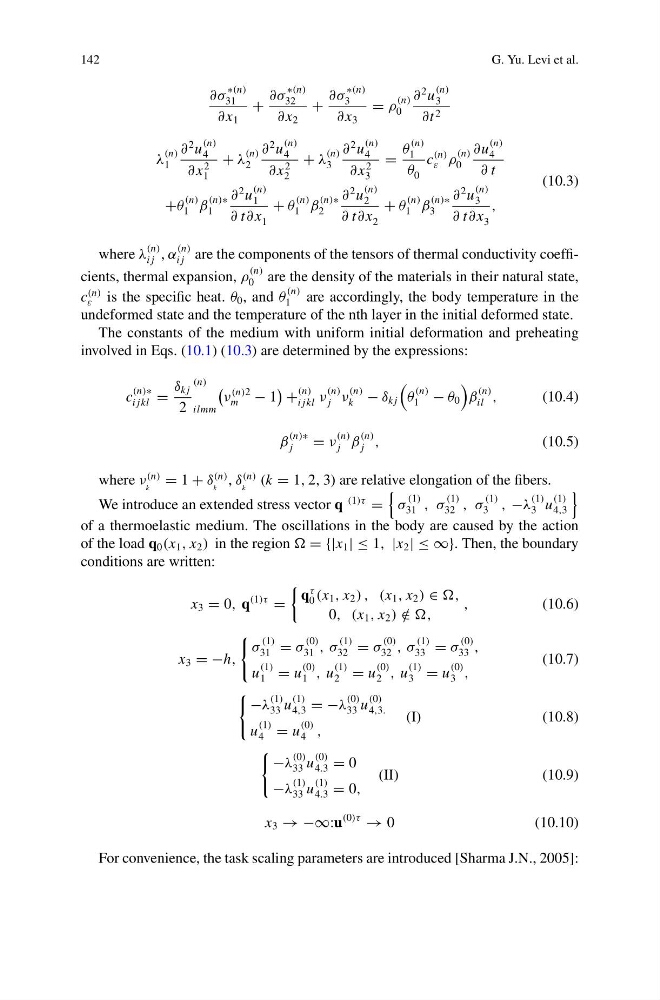
where λ
(n)
i j , α
(n)
i j are the components of the tensors of thermal conductivity coefficients, thermal expansion, ρ
(n)
0 are the density of the materials in their natural state,
c
(n)
ε is the specific heat. θ 0 , and θ
(n)
1
are accordingly, the body temperature in the
undeformed state and the temperature of the nth layer in the initial deformed state.
The constants of the medium with uniform initial deformation and preheating
involved in Eqs. (10.1) (10.3) are determined by the expressions:
c
(n)∗
i jkl =
δ k j
2
(n)
ilmm
ν
(n)2
m
− 1
+
(n)
i jkl ν
(n)
j ν
(n)
k − δ k j
θ
(n)
1 − θ 0
β
(n)
il ,
(10.4)
β
(n)∗
j
= ν
(n)
j β
(n)
j ,
(10.5)
where ν
(n)
k
= 1 + δ
(n)
k
, δ
(n)
k
(k = 1, 2, 3) are relative elongation of the fibers.
We introduce an extended stress vector q
(1)τ
=
σ
(1)
31 , σ
(1)
32 , σ
(1)
3 , −λ
(1)
3 u
(1)
4,3
of a thermoelastic medium. The oscillations in the body are caused by the action
of the load q 0 (x 1 , x 2 ) in the region = {|x 1 | ≤ 1, |x 2 | ≤ ∞}. Then, the boundary
conditions are written:
x 3 = 0, q
(1)τ
=
q
τ
0 (x 1 , x 2 ) , (x 1 , x 2 ) ∈ ,
0, (x 1 , x 2 ) /
∈ ,
,
(10.6)
x 3 = −h,
σ
(1)
31 = σ
(0)
31 , σ
(1)
32 = σ
(0)
32 , σ
(1)
33 = σ
(0)
33 ,
u
(1)
1 = u
(0)
1 , u
(1)
2 = u
(0)
2 , u
(1)
3 = u
(0)
3 ,
(10.7)
−λ
(1)
33 u
(1)
4,3 = −λ
(0)
33 u
(0)
4,3.
u
(1)
4 = u
(0)
4 ,
(I)
(10.8)
−λ
(0)
33 u
(0)
4.3 = 0
−λ
(1)
33 u
(1)
4.3 = 0,
(II)
(10.9)
x 3 → −∞:u
(0)τ
→ 0
(10.10)
For convenience, the task scaling parameters are introduced [Sharma J.N., 2005]:
G. Yu. Levi et al.
∂σ
∗(n)
31
∂ x 1
+
∂σ
∗(n)
32
∂ x 2
+
∂σ
∗(n)
3
∂ x 3
= ρ
(n)
0
∂
2 u
(n)
3
∂t 2
λ
(n)
1
∂
2 u
(n)
4
∂ x
2
1
+ λ
(n)
2
∂
2 u
(n)
4
∂ x
2
2
+ λ
(n)
3
∂
2 u
(n)
4
∂ x
2
3
=
θ
(n)
1
θ 0
c
(n)
ε ρ
(n)
0
∂u
(n)
4
∂ t
+θ
(n)
1 β
(n)∗
1
∂
2 u
(n)
1
∂ t∂ x 1
+ θ
(n)
1 β
(n)∗
2
∂
2 u
(n)
2
∂ t∂ x 2
+ θ
(n)
1 β
(n)∗
3
∂
2 u
(n)
3
∂ t∂ x 3
,
(10.3)
where λ
(n)
i j , α
(n)
i j are the components of the tensors of thermal conductivity coefficients, thermal expansion, ρ
(n)
0 are the density of the materials in their natural state,
c
(n)
ε is the specific heat. θ 0 , and θ
(n)
1
are accordingly, the body temperature in the
undeformed state and the temperature of the nth layer in the initial deformed state.
The constants of the medium with uniform initial deformation and preheating
involved in Eqs. (10.1) (10.3) are determined by the expressions:
c
(n)∗
i jkl =
δ k j
2
(n)
ilmm
ν
(n)2
m
− 1
+
(n)
i jkl ν
(n)
j ν
(n)
k − δ k j
θ
(n)
1 − θ 0
β
(n)
il ,
(10.4)
β
(n)∗
j
= ν
(n)
j β
(n)
j ,
(10.5)
where ν
(n)
k
= 1 + δ
(n)
k
, δ
(n)
k
(k = 1, 2, 3) are relative elongation of the fibers.
We introduce an extended stress vector q
(1)τ
=
σ
(1)
31 , σ
(1)
32 , σ
(1)
3 , −λ
(1)
3 u
(1)
4,3
of a thermoelastic medium. The oscillations in the body are caused by the action
of the load q 0 (x 1 , x 2 ) in the region = {|x 1 | ≤ 1, |x 2 | ≤ ∞}. Then, the boundary
conditions are written:
x 3 = 0, q
(1)τ
=
q
τ
0 (x 1 , x 2 ) , (x 1 , x 2 ) ∈ ,
0, (x 1 , x 2 ) /
∈ ,
,
(10.6)
x 3 = −h,
σ
(1)
31 = σ
(0)
31 , σ
(1)
32 = σ
(0)
32 , σ
(1)
33 = σ
(0)
33 ,
u
(1)
1 = u
(0)
1 , u
(1)
2 = u
(0)
2 , u
(1)
3 = u
(0)
3 ,
(10.7)
−λ
(1)
33 u
(1)
4,3 = −λ
(0)
33 u
(0)
4,3.
u
(1)
4 = u
(0)
4 ,
(I)
(10.8)
−λ
(0)
33 u
(0)
4.3 = 0
−λ
(1)
33 u
(1)
4.3 = 0,
(II)
(10.9)
x 3 → −∞:u
(0)τ
→ 0
(10.10)
For convenience, the task scaling parameters are introduced [Sharma J.N., 2005]: