

94
L. Igumnov et al.
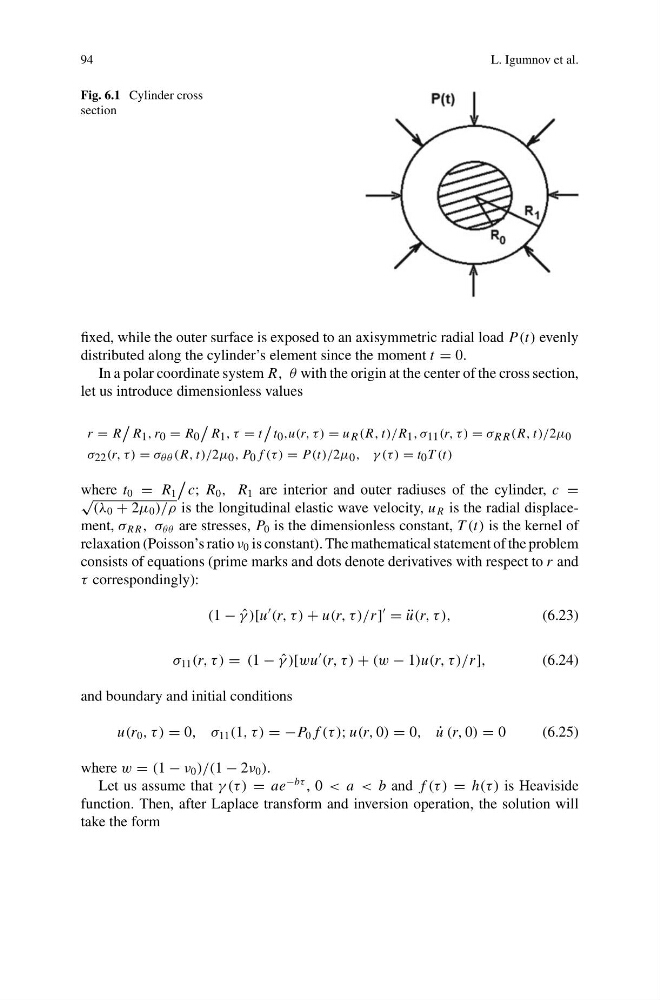
Fig. 6.1 Cylinder cross
section
fixed, while the outer surface is exposed to an axisymmetric radial load P(t) evenly
distributed along the cylinder’s element since the moment t = 0.
In a polar coordinate system R, θ with the origin at the center of the cross section,
let us introduce dimensionless values
r = R
R 1 , r 0 = R 0
R 1 , τ = t
t 0 ,u(r, τ ) = u R (R, t)/R 1 , σ 11 (r, τ ) = σ R R (R, t)/2μ 0
σ 22 (r, τ ) = σ θθ (R, t)/2μ 0 , P 0 f (τ ) = P(t)/2μ 0 , γ(τ) = t 0 T (t)
where t 0 = R 1
c; R 0 , R 1 are interior and outer radiuses of the cylinder, c =
√
(λ 0 + 2μ 0 )/ρ is the longitudinal elastic wave velocity, u R is the radial displacement, σ R R , σ θθ are stresses, P 0 is the dimensionless constant, T (t) is the kernel of
relaxation (Poisson’s ratio ν 0 is constant). The mathematical statement of the problem
consists of equations (prime marks and dots denote derivatives with respect to r and
τ correspondingly):
(1 − ˆ
γ )[u
(r, τ ) + u(r, τ )/r ]
= ¨
u(r, τ ),
(6.23)
σ 11 (r, τ ) = (1 − ˆ
γ )[wu
(r, τ ) + (w − 1)u(r, τ )/r ],
(6.24)
and boundary and initial conditions
u(r 0 , τ ) = 0, σ 11 (1, τ ) = −P 0 f (τ ); u(r, 0) = 0, ˙
u (r, 0) = 0
(6.25)
where w = (1 − ν 0 )/(1 − 2ν 0 ).
Let us assume that γ (τ ) = ae
−bτ , 0 < a < b and f (τ ) = h(τ ) is Heaviside
function. Then, after Laplace transform and inversion operation, the solution will
take the form
L. Igumnov et al.
Fig. 6.1 Cylinder cross
section
fixed, while the outer surface is exposed to an axisymmetric radial load P(t) evenly
distributed along the cylinder’s element since the moment t = 0.
In a polar coordinate system R, θ with the origin at the center of the cross section,
let us introduce dimensionless values
r = R
R 1 , r 0 = R 0
R 1 , τ = t
t 0 ,u(r, τ ) = u R (R, t)/R 1 , σ 11 (r, τ ) = σ R R (R, t)/2μ 0
σ 22 (r, τ ) = σ θθ (R, t)/2μ 0 , P 0 f (τ ) = P(t)/2μ 0 , γ(τ) = t 0 T (t)
where t 0 = R 1
c; R 0 , R 1 are interior and outer radiuses of the cylinder, c =
√
(λ 0 + 2μ 0 )/ρ is the longitudinal elastic wave velocity, u R is the radial displacement, σ R R , σ θθ are stresses, P 0 is the dimensionless constant, T (t) is the kernel of
relaxation (Poisson’s ratio ν 0 is constant). The mathematical statement of the problem
consists of equations (prime marks and dots denote derivatives with respect to r and
τ correspondingly):
(1 − ˆ
γ )[u
(r, τ ) + u(r, τ )/r ]
= ¨
u(r, τ ),
(6.23)
σ 11 (r, τ ) = (1 − ˆ
γ )[wu
(r, τ ) + (w − 1)u(r, τ )/r ],
(6.24)
and boundary and initial conditions
u(r 0 , τ ) = 0, σ 11 (1, τ ) = −P 0 f (τ ); u(r, 0) = 0, ˙
u (r, 0) = 0
(6.25)
where w = (1 − ν 0 )/(1 − 2ν 0 ).
Let us assume that γ (τ ) = ae
−bτ , 0 < a < b and f (τ ) = h(τ ) is Heaviside
function. Then, after Laplace transform and inversion operation, the solution will
take the form