

The Internal Structure of Materials 89
function. Biomaterials should be compatible with the human body
and not induce rejection. This class of materials is rather broad and
can comprise metals, ceramics, polymers, and composites. Typically these materials are used in prostheses, implants, and surgical
instruments. Biomaterials should not be confused with bio-based
materials, which are the material parts of our body, such as bone.
Nanomaterials
The nanomaterial class of materials is extremely broad because
it can include all the previous classes of materials, provided they
are composed of a structural component at the nanoscale or they
exhibit one of the dimensions at the nanoscale. The prefix nano
represents a billionth of a unit, so the nanoscale is normally considered to span from 1 to 100 nanometers. Nanomaterials are typically
categorized as 0-D (nanoparticles), 1-D (nanowires, nanotubes,
and nanorods), 2-D (nanofilms and nanocoatings), or 3-D (bulk),
which represent the number of dimensions that are not at the nanoscale (see Chapter 6).
4.2 the iNterNal struCture
of Materials
atomic structure
What are things made of? Everything is made of atoms. How do we
know? It is a hypothesis that has been confirmed in several ways.
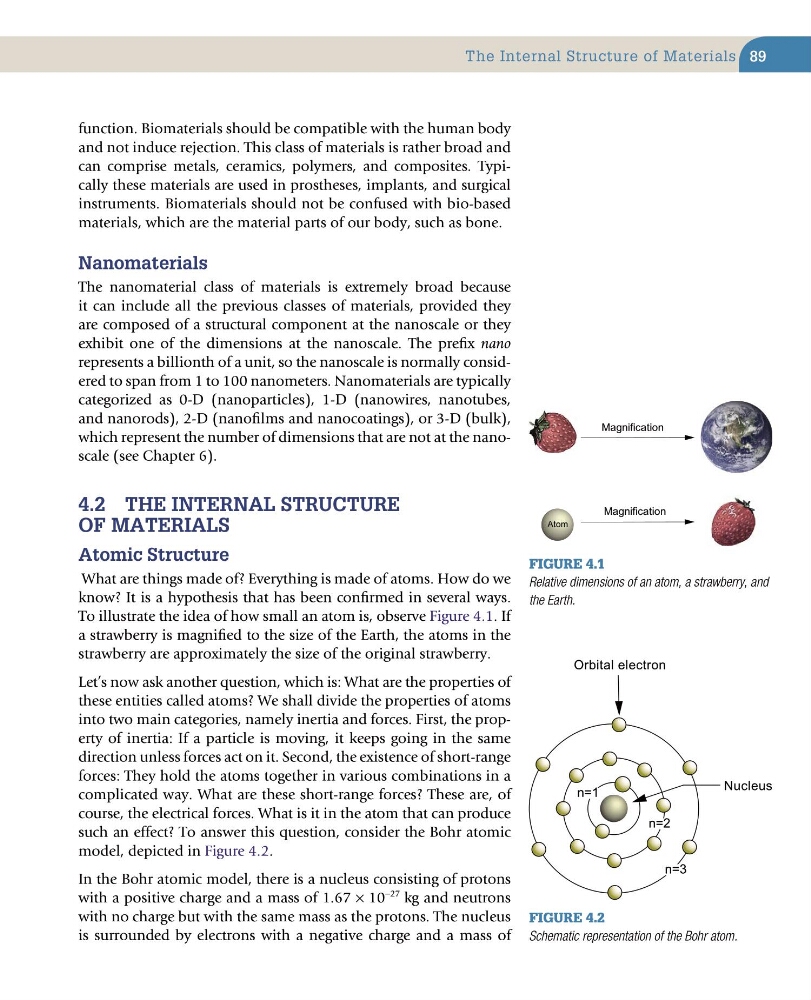
To illustrate the idea of how small an atom is, observe Figure 4.1. If
a strawberry is magnified to the size of the Earth, the atoms in the
strawberry are approximately the size of the original strawberry.
Let’s now ask another question, which is: What are the properties of
these entities called atoms? We shall divide the properties of atoms
into two main categories, namely inertia and forces. First, the property of inertia: If a particle is moving, it keeps going in the same
direction unless forces act on it. Second, the existence of short-range
forces: They hold the atoms together in various combinations in a
complicated way. What are these short-range forces? These are, of
course, the electrical forces. What is it in the atom that can produce
such an effect? To answer this question, consider the Bohr atomic
model, depicted in Figure 4.2.
In the Bohr atomic model, there is a nucleus consisting of protons
with a positive charge and a mass of 1.67 × 10
−27 kg and neutrons
with no charge but with the same mass as the protons. The nucleus
is surrounded by electrons with a negative charge and a mass of
Figure 4.1
Relative dimensions of an atom, a strawberry, and
the Earth.
Magnification
Magnification
Atom
Figure 4.2
Schematic representation of the Bohr atom.
Orbital electron
Nucleus
n=1
n=2
n=3
function. Biomaterials should be compatible with the human body
and not induce rejection. This class of materials is rather broad and
can comprise metals, ceramics, polymers, and composites. Typically these materials are used in prostheses, implants, and surgical
instruments. Biomaterials should not be confused with bio-based
materials, which are the material parts of our body, such as bone.
Nanomaterials
The nanomaterial class of materials is extremely broad because
it can include all the previous classes of materials, provided they
are composed of a structural component at the nanoscale or they
exhibit one of the dimensions at the nanoscale. The prefix nano
represents a billionth of a unit, so the nanoscale is normally considered to span from 1 to 100 nanometers. Nanomaterials are typically
categorized as 0-D (nanoparticles), 1-D (nanowires, nanotubes,
and nanorods), 2-D (nanofilms and nanocoatings), or 3-D (bulk),
which represent the number of dimensions that are not at the nanoscale (see Chapter 6).
4.2 the iNterNal struCture
of Materials
atomic structure
What are things made of? Everything is made of atoms. How do we
know? It is a hypothesis that has been confirmed in several ways.
To illustrate the idea of how small an atom is, observe Figure 4.1. If
a strawberry is magnified to the size of the Earth, the atoms in the
strawberry are approximately the size of the original strawberry.
Let’s now ask another question, which is: What are the properties of
these entities called atoms? We shall divide the properties of atoms
into two main categories, namely inertia and forces. First, the property of inertia: If a particle is moving, it keeps going in the same
direction unless forces act on it. Second, the existence of short-range
forces: They hold the atoms together in various combinations in a
complicated way. What are these short-range forces? These are, of
course, the electrical forces. What is it in the atom that can produce
such an effect? To answer this question, consider the Bohr atomic
model, depicted in Figure 4.2.
In the Bohr atomic model, there is a nucleus consisting of protons
with a positive charge and a mass of 1.67 × 10
−27 kg and neutrons
with no charge but with the same mass as the protons. The nucleus
is surrounded by electrons with a negative charge and a mass of
Figure 4.1
Relative dimensions of an atom, a strawberry, and
the Earth.
Magnification
Magnification
Atom
Figure 4.2
Schematic representation of the Bohr atom.
Orbital electron
Nucleus
n=1
n=2
n=3