

81
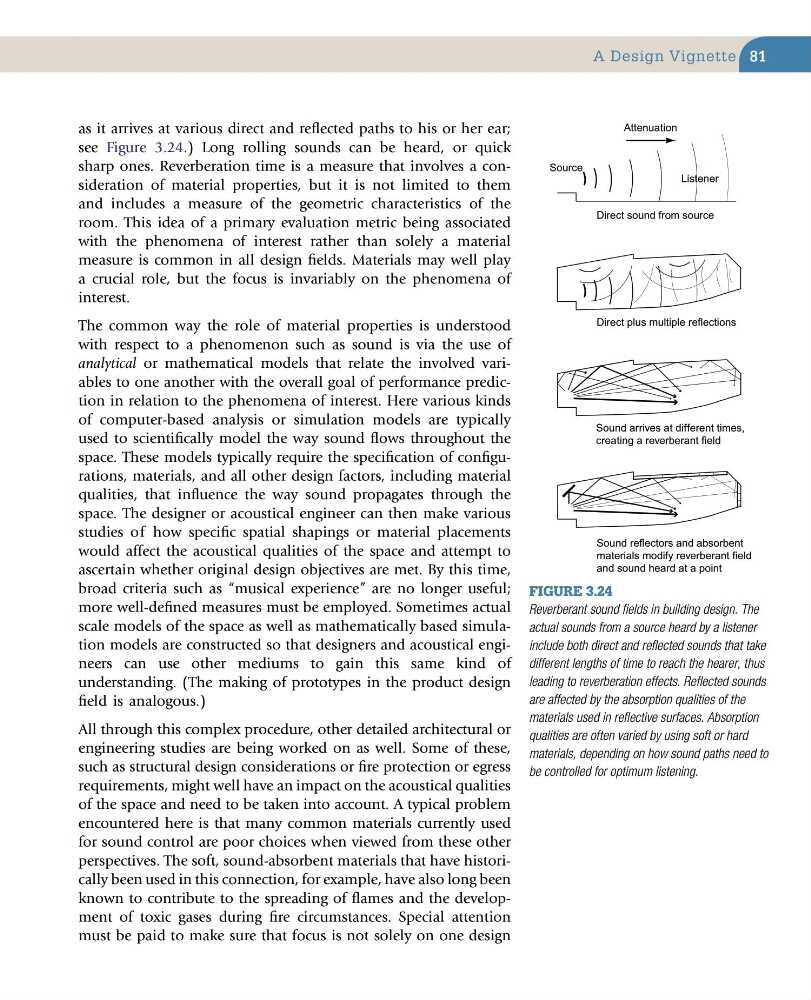
as it arrives at various direct and reflected paths to his or her ear;
see Figure 3.24.) Long rolling sounds can be heard, or quick
sharp ones. Reverberation time is a measure that involves a consideration of material properties, but it is not limited to them
and includes a measure of the geometric characteristics of the
room. This idea of a primary evaluation metric being associated
with the phenomena of interest rather than solely a material
measure is common in all design fields. Materials may well play
a crucial role, but the focus is invariably on the phenomena of
interest.
The common way the role of material properties is understood
with respect to a phenomenon such as sound is via the use of
analytical or mathematical models that relate the involved variables to one another with the overall goal of performance prediction in relation to the phenomena of interest. Here various kinds
of computer-based analysis or simulation models are typically
used to scientifically model the way sound flows throughout the
space. These models typically require the specification of configurations, materials, and all other design factors, including material
qualities, that influence the way sound propagates through the
space. The designer or acoustical engineer can then make various
studies of how specific spatial shapings or material placements
would affect the acoustical qualities of the space and attempt to
ascertain whether original design objectives are met. By this time,
broad criteria such as “musical experience” are no longer useful;
more well-defined measures must be employed. Sometimes actual
scale models of the space as well as mathematically based simulation models are constructed so that designers and acoustical engineers can use other mediums to gain this same kind of
understanding. (The making of prototypes in the product design
field is analogous.)
All through this complex procedure, other detailed architectural or
engineering studies are being worked on as well. Some of these,
such as structural design considerations or fire protection or egress
requirements, might well have an impact on the acoustical qualities
of the space and need to be taken into account. A typical problem
encountered here is that many common materials currently used
for sound control are poor choices when viewed from these other
perspectives. The soft, sound-absorbent materials that have historically been used in this connection, for example, have also long been
known to contribute to the spreading of flames and the development of toxic gases during fire circumstances. Special attention
must be paid to make sure that focus is not solely on one design
Figure 3.24
Reverberant sound fields in building design. The
actual sounds from a source heard by a listener
include both direct and reflected sounds that take
different lengths of time to reach the hearer, thus
leading to reverberation effects. Reflected sounds
are affected by the absorption qualities of the
materials used in reflective surfaces. Absorption
qualities are often varied by using soft or hard
materials, depending on how sound paths need to
be controlled for optimum listening.
Attenuation
Source
Listener
Direct sound from source
Direct plus multiple reflections
Sound arrives at different times,
creating a reverberant field
Sound reflectors and absorbent
materials modify reverberant field
and sound heard at a point
A Design Vignette
as it arrives at various direct and reflected paths to his or her ear;
see Figure 3.24.) Long rolling sounds can be heard, or quick
sharp ones. Reverberation time is a measure that involves a consideration of material properties, but it is not limited to them
and includes a measure of the geometric characteristics of the
room. This idea of a primary evaluation metric being associated
with the phenomena of interest rather than solely a material
measure is common in all design fields. Materials may well play
a crucial role, but the focus is invariably on the phenomena of
interest.
The common way the role of material properties is understood
with respect to a phenomenon such as sound is via the use of
analytical or mathematical models that relate the involved variables to one another with the overall goal of performance prediction in relation to the phenomena of interest. Here various kinds
of computer-based analysis or simulation models are typically
used to scientifically model the way sound flows throughout the
space. These models typically require the specification of configurations, materials, and all other design factors, including material
qualities, that influence the way sound propagates through the
space. The designer or acoustical engineer can then make various
studies of how specific spatial shapings or material placements
would affect the acoustical qualities of the space and attempt to
ascertain whether original design objectives are met. By this time,
broad criteria such as “musical experience” are no longer useful;
more well-defined measures must be employed. Sometimes actual
scale models of the space as well as mathematically based simulation models are constructed so that designers and acoustical engineers can use other mediums to gain this same kind of
understanding. (The making of prototypes in the product design
field is analogous.)
All through this complex procedure, other detailed architectural or
engineering studies are being worked on as well. Some of these,
such as structural design considerations or fire protection or egress
requirements, might well have an impact on the acoustical qualities
of the space and need to be taken into account. A typical problem
encountered here is that many common materials currently used
for sound control are poor choices when viewed from these other
perspectives. The soft, sound-absorbent materials that have historically been used in this connection, for example, have also long been
known to contribute to the spreading of flames and the development of toxic gases during fire circumstances. Special attention
must be paid to make sure that focus is not solely on one design
Figure 3.24
Reverberant sound fields in building design. The
actual sounds from a source heard by a listener
include both direct and reflected sounds that take
different lengths of time to reach the hearer, thus
leading to reverberation effects. Reflected sounds
are affected by the absorption qualities of the
materials used in reflective surfaces. Absorption
qualities are often varied by using soft or hard
materials, depending on how sound paths need to
be controlled for optimum listening.
Attenuation
Source
Listener
Direct sound from source
Direct plus multiple reflections
Sound arrives at different times,
creating a reverberant field
Sound reflectors and absorbent
materials modify reverberant field
and sound heard at a point
A Design Vignette