

C hapter 3 the Design Context
78
problematical). The design value of “strong and light,” however,
might remain as an initial generative factor for a design, perhaps
because the idea is symbolically associated with other designed
objects that have captured our societal imaginations, such as aircraft. Why were many objects that were designed in the 1930s—
including not only locomotives but vacuum cleaners and other
common household goods—given “streamlined” appearances? It
is, after all, rather hard to argue that the wind resistance provided
by a floor vacuum cleaner is a particularly important functional
generator of design form. The associative design value of “streamlining” and its related material suggestions of “sleek metallic,”
however, have long been with us and remain widespread as symbolic of newness and innovation. This is particularly true in many
consumer-oriented products in which the ideas of “associative”
properties, briefly discussed earlier, can be highly important.
3.5 a Design Vignette
As a way of entering into a discussion of design issues in relation
to materials in architecture, let’s first look at a highly particularized
vignette: the design of a concert hall for listening to music. Here
the material issues would seem to immediately devolve into
classical technical problems of choosing materials with the right
acoustical properties in relation to sound absorption or reflection.
We, however, poke at this assertion here. This same vignette is used
as a brief introduction to the way design processes occur.
Any music aficionado knows that there are great halls—Vienna’s
Grosser Musikvereinssaal, Amsterdam’s Concertgebouw, Boston’s
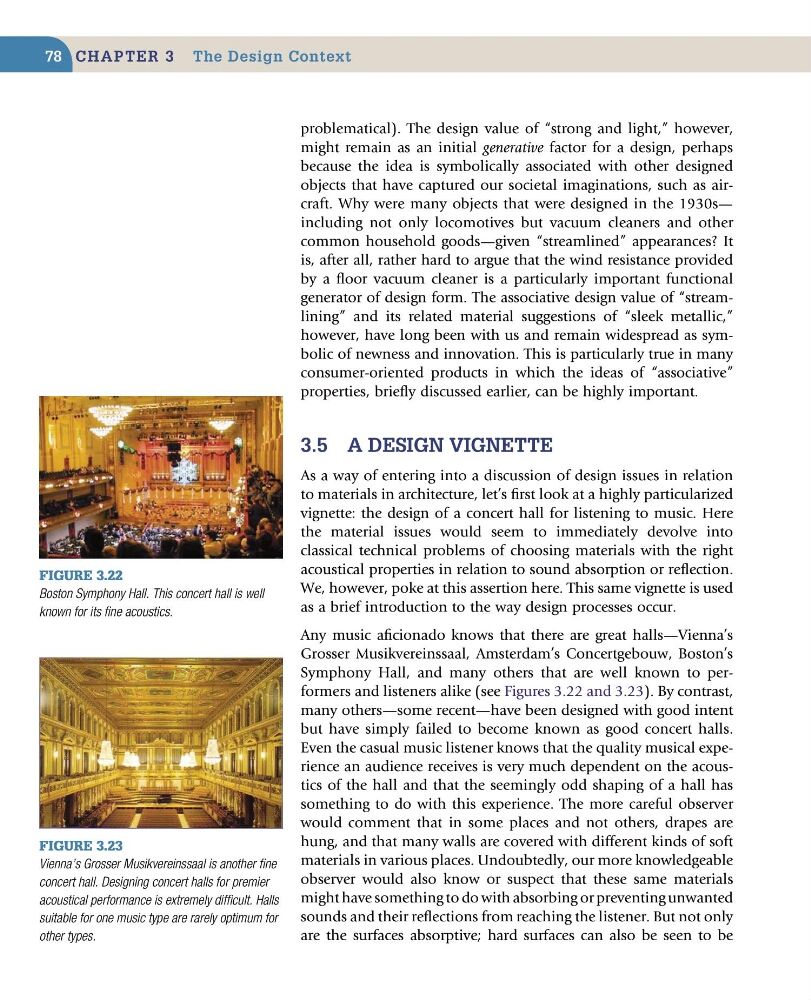
Symphony Hall, and many others that are well known to performers and listeners alike (see Figures 3.22 and 3.23). By contrast,
many others—some recent—have been designed with good intent
but have simply failed to become known as good concert halls.
Even the casual music listener knows that the quality musical experience an audience receives is very much dependent on the acoustics of the hall and that the seemingly odd shaping of a hall has
something to do with this experience. The more careful observer
would comment that in some places and not others, drapes are
hung, and that many walls are covered with different kinds of soft
materials in various places. Undoubtedly, our more knowledgeable
observer would also know or suspect that these same materials
might have something to do with absorbing or preventing unwanted
sounds and their reflections from reaching the listener. But not only
are the surfaces absorptive; hard surfaces can also be seen to be
Figure 3.22
Boston Symphony Hall. This concert hall is well
known for its fine acoustics.
Figure 3.23
Vienna’s Grosser Musikvereinssaal is another fine
concert hall. Designing concert halls for premier
acoustical performance is extremely difficult. Halls
suitable for one music type are rarely optimum for
other types.
78
problematical). The design value of “strong and light,” however,
might remain as an initial generative factor for a design, perhaps
because the idea is symbolically associated with other designed
objects that have captured our societal imaginations, such as aircraft. Why were many objects that were designed in the 1930s—
including not only locomotives but vacuum cleaners and other
common household goods—given “streamlined” appearances? It
is, after all, rather hard to argue that the wind resistance provided
by a floor vacuum cleaner is a particularly important functional
generator of design form. The associative design value of “streamlining” and its related material suggestions of “sleek metallic,”
however, have long been with us and remain widespread as symbolic of newness and innovation. This is particularly true in many
consumer-oriented products in which the ideas of “associative”
properties, briefly discussed earlier, can be highly important.
3.5 a Design Vignette
As a way of entering into a discussion of design issues in relation
to materials in architecture, let’s first look at a highly particularized
vignette: the design of a concert hall for listening to music. Here
the material issues would seem to immediately devolve into
classical technical problems of choosing materials with the right
acoustical properties in relation to sound absorption or reflection.
We, however, poke at this assertion here. This same vignette is used
as a brief introduction to the way design processes occur.
Any music aficionado knows that there are great halls—Vienna’s
Grosser Musikvereinssaal, Amsterdam’s Concertgebouw, Boston’s
Symphony Hall, and many others that are well known to performers and listeners alike (see Figures 3.22 and 3.23). By contrast,
many others—some recent—have been designed with good intent
but have simply failed to become known as good concert halls.
Even the casual music listener knows that the quality musical experience an audience receives is very much dependent on the acoustics of the hall and that the seemingly odd shaping of a hall has
something to do with this experience. The more careful observer
would comment that in some places and not others, drapes are
hung, and that many walls are covered with different kinds of soft
materials in various places. Undoubtedly, our more knowledgeable
observer would also know or suspect that these same materials
might have something to do with absorbing or preventing unwanted
sounds and their reflections from reaching the listener. But not only
are the surfaces absorptive; hard surfaces can also be seen to be
Figure 3.22
Boston Symphony Hall. This concert hall is well
known for its fine acoustics.
Figure 3.23
Vienna’s Grosser Musikvereinssaal is another fine
concert hall. Designing concert halls for premier
acoustical performance is extremely difficult. Halls
suitable for one music type are rarely optimum for
other types.