

75
influence material choices, and there can be little or no determinism based solely on singular technical factors. The latter often also
include multiple design objectives involving material choices that
might even be in conflict with one another.
In many situations involving well-defined design problems, design
processes including materials can be relatively straightforward and
consist of a series of sequential steps. A structural engineer designing a beam that is part of a flooring system for a building, for
example, typically assesses the external loads acting on the member
and determines the forces and bending moments using welldeveloped structural analysis algorithms that relate the geometrical
and material properties of a beam to the kinds of internal stresses
and deformations that are developed. Cost functions could also be
constructed. Depending on the design objective, such as minimum
weight or minimum depth, the process can then be structured so
that by specifying design criteria related to strength and stiffness,
variables such as specific required material properties (minimum
yield stress levels or needed modulus of elasticity) can be determined
explicitly for the material to be used in a specified beam crosssection. (Alternatively, material properties could be specified and
geometric properties of the cross-section determined.) Subsequently,
different kinds of screening processes can be used to select real materials with the needed properties from existing databases of material
properties. Design processes of this general type occur in many engineering fields literally by the thousands each day and form the
working basis for many common design development activities.
In the scenario just illustrated, we clearly defined the function
of the object to be designed. Clear design objectives, such as
minimum weight or minimum cost, could also be easily specified.
Constraints—for example, how much load the member has to
support—could be specified as well. Design variables or parameters
might then be either the geometric and dimensional characteristics
of the beam for a given material or material properties themselves
for a given beam geometry. Material selection procedures directly
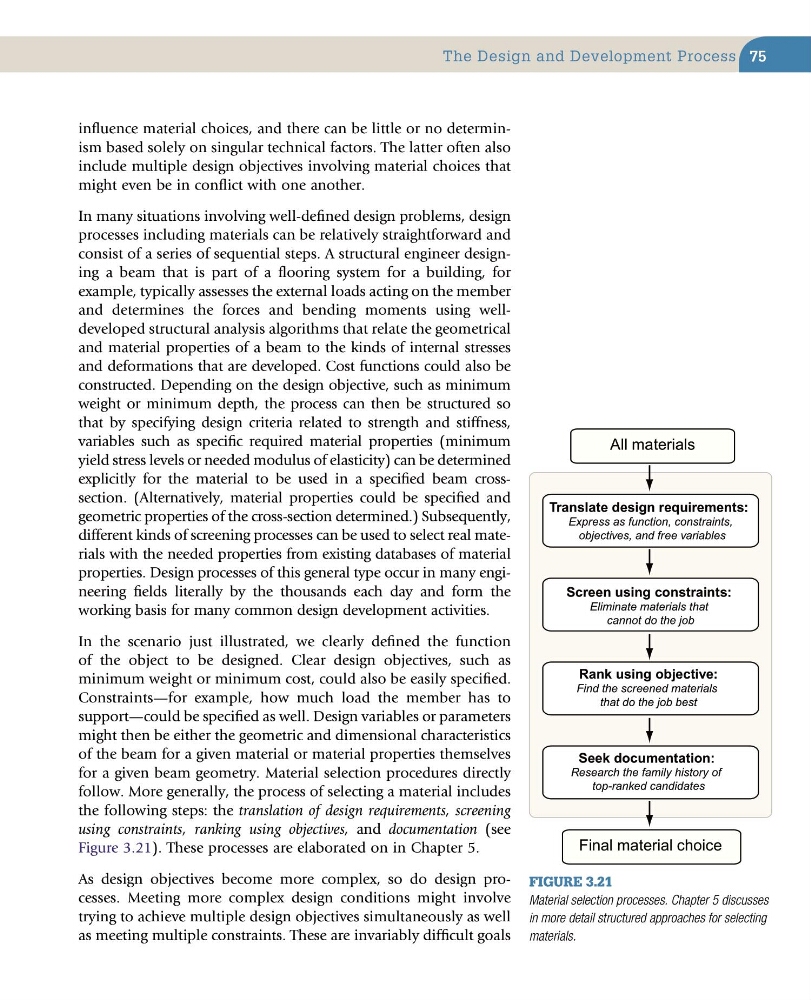
follow. More generally, the process of selecting a material includes
the following steps: the translation of design requirements, screening
using constraints, ranking using objectives, and documentation (see
Figure 3.21). These processes are elaborated on in Chapter 5.
As design objectives become more complex, so do design processes. Meeting more complex design conditions might involve
trying to achieve multiple design objectives simultaneously as well
as meeting multiple constraints. These are invariably difficult goals
Figure 3.21
Material selection processes. Chapter 5 discusses
in more detail structured approaches for selecting
materials.
Translate design requirements:
Express as function, constraints,
objectives, and free variables
All materials
Final material choice
Screen using constraints:
Eliminate materials that
cannot do the job
Rank using objective:
Find the screened materials
that do the job best
Seek documentation:
Research the family history of
top-ranked candidates
The Design and Development Process
influence material choices, and there can be little or no determinism based solely on singular technical factors. The latter often also
include multiple design objectives involving material choices that
might even be in conflict with one another.
In many situations involving well-defined design problems, design
processes including materials can be relatively straightforward and
consist of a series of sequential steps. A structural engineer designing a beam that is part of a flooring system for a building, for
example, typically assesses the external loads acting on the member
and determines the forces and bending moments using welldeveloped structural analysis algorithms that relate the geometrical
and material properties of a beam to the kinds of internal stresses
and deformations that are developed. Cost functions could also be
constructed. Depending on the design objective, such as minimum
weight or minimum depth, the process can then be structured so
that by specifying design criteria related to strength and stiffness,
variables such as specific required material properties (minimum
yield stress levels or needed modulus of elasticity) can be determined
explicitly for the material to be used in a specified beam crosssection. (Alternatively, material properties could be specified and
geometric properties of the cross-section determined.) Subsequently,
different kinds of screening processes can be used to select real materials with the needed properties from existing databases of material
properties. Design processes of this general type occur in many engineering fields literally by the thousands each day and form the
working basis for many common design development activities.
In the scenario just illustrated, we clearly defined the function
of the object to be designed. Clear design objectives, such as
minimum weight or minimum cost, could also be easily specified.
Constraints—for example, how much load the member has to
support—could be specified as well. Design variables or parameters
might then be either the geometric and dimensional characteristics
of the beam for a given material or material properties themselves
for a given beam geometry. Material selection procedures directly
follow. More generally, the process of selecting a material includes
the following steps: the translation of design requirements, screening
using constraints, ranking using objectives, and documentation (see
Figure 3.21). These processes are elaborated on in Chapter 5.
As design objectives become more complex, so do design processes. Meeting more complex design conditions might involve
trying to achieve multiple design objectives simultaneously as well
as meeting multiple constraints. These are invariably difficult goals
Figure 3.21
Material selection processes. Chapter 5 discusses
in more detail structured approaches for selecting
materials.
Translate design requirements:
Express as function, constraints,
objectives, and free variables
All materials
Final material choice
Screen using constraints:
Eliminate materials that
cannot do the job
Rank using objective:
Find the screened materials
that do the job best
Seek documentation:
Research the family history of
top-ranked candidates
The Design and Development Process