

73
builds explicit material solutions and/or physical devices. Specialized design and engineering teams usually undertake this process.
Final material selections are determined at this point. Numerical
simulation analyses (e.g., functional, structural, thermal, or other)
are normally used to verify that an anticipated product meets original design requirements.
Once all systems and subsystems have been physically and functionally defined, the design team again addresses the overall design
form that has been evolving in parallel. A major objective here is
to make sure that there are no physical or functional system “conflicts.” Quite often a system might simply not be able to fit in the
intended space. There may be spatial conflicts between elements of
different systems. (In building design, structural and mechanical
system components often seem to have affinities for occupying the
exact same physical spaces.) Or, in other situations, the proximity
of one electronic system to another might require special shielding.
The list goes on and on. All these events would require design
alterations, either to the whole assembly or within its systems. The
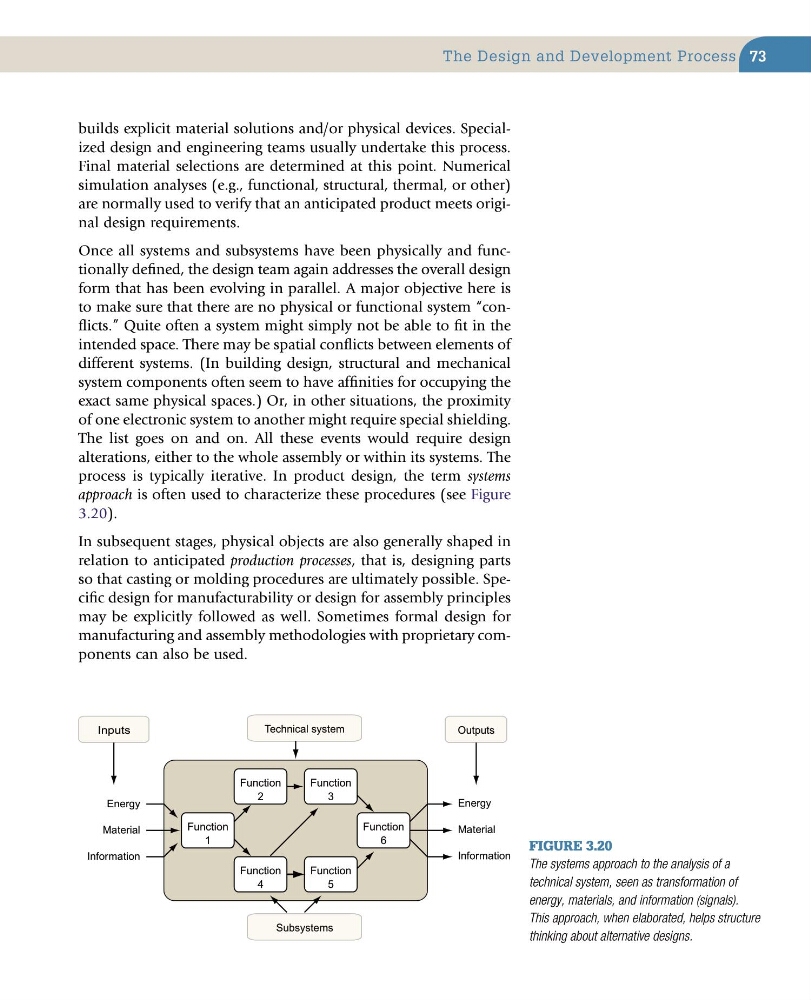
process is typically iterative. In product design, the term systems
approach is often used to characterize these procedures (see Figure
3.20).
In subsequent stages, physical objects are also generally shaped in
relation to anticipated production processes, that is, designing parts
so that casting or molding procedures are ultimately possible. Specific design for manufacturability or design for assembly principles
may be explicitly followed as well. Sometimes formal design for
manufacturing and assembly methodologies with proprietary components can also be used.
Figure 3.20
The systems approach to the analysis of a
technical system, seen as transformation of
energy, materials, and information (signals).
This approach, when elaborated, helps structure
thinking about alternative designs.
Energy
Material
Information
Function
1
Inputs
Function
3
Function
5
Function
6
Technical system
Outputs
Subsystems
Function
2
Function
4
Energy
Material
Information
The Design and Development Process
builds explicit material solutions and/or physical devices. Specialized design and engineering teams usually undertake this process.
Final material selections are determined at this point. Numerical
simulation analyses (e.g., functional, structural, thermal, or other)
are normally used to verify that an anticipated product meets original design requirements.
Once all systems and subsystems have been physically and functionally defined, the design team again addresses the overall design
form that has been evolving in parallel. A major objective here is
to make sure that there are no physical or functional system “conflicts.” Quite often a system might simply not be able to fit in the
intended space. There may be spatial conflicts between elements of
different systems. (In building design, structural and mechanical
system components often seem to have affinities for occupying the
exact same physical spaces.) Or, in other situations, the proximity
of one electronic system to another might require special shielding.
The list goes on and on. All these events would require design
alterations, either to the whole assembly or within its systems. The
process is typically iterative. In product design, the term systems
approach is often used to characterize these procedures (see Figure
3.20).
In subsequent stages, physical objects are also generally shaped in
relation to anticipated production processes, that is, designing parts
so that casting or molding procedures are ultimately possible. Specific design for manufacturability or design for assembly principles
may be explicitly followed as well. Sometimes formal design for
manufacturing and assembly methodologies with proprietary components can also be used.
Figure 3.20
The systems approach to the analysis of a
technical system, seen as transformation of
energy, materials, and information (signals).
This approach, when elaborated, helps structure
thinking about alternative designs.
Energy
Material
Information
Function
1
Inputs
Function
3
Function
5
Function
6
Technical system
Outputs
Subsystems
Function
2
Function
4
Energy
Material
Information
The Design and Development Process