

61
the bottle, that are not directly material dependent. The use of these
kinds of computational models that play out the role of material
properties in relation to other design parameters is intrinsically
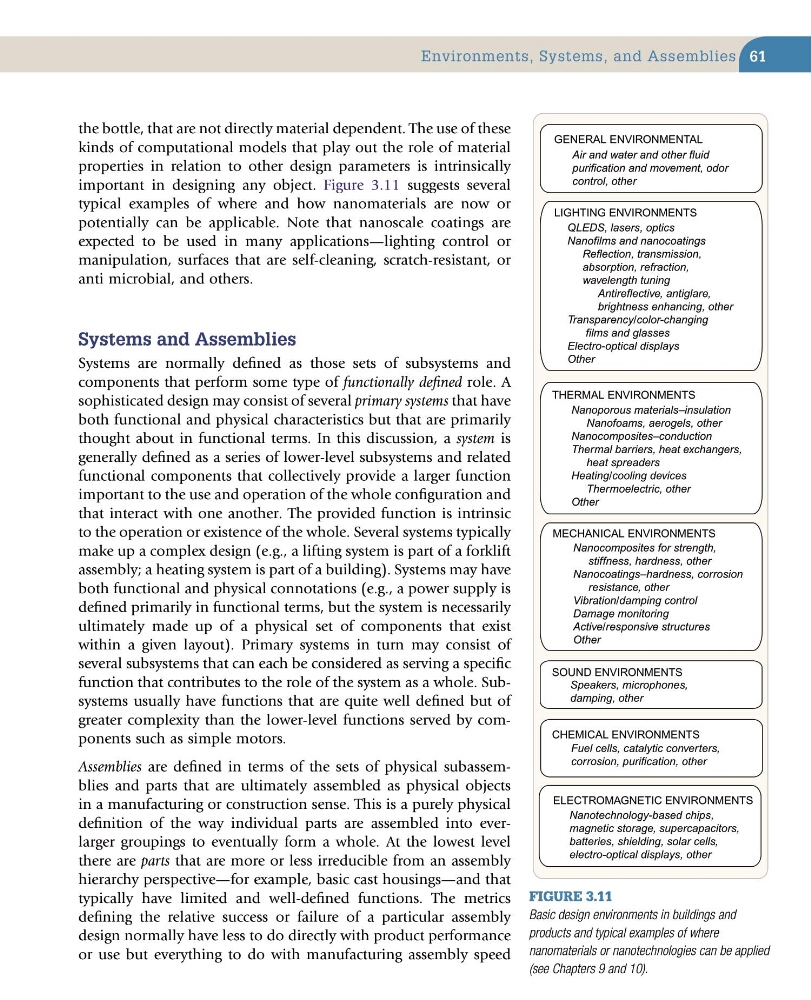
important in designing any object. Figure 3.11 suggests several
typical examples of where and how nanomaterials are now or
potentially can be applicable. Note that nanoscale coatings are
expected to be used in many applications—lighting control or
manipulation, surfaces that are self-cleaning, scratch-resistant, or
anti microbial, and others.
systems and assemblies
Systems are normally defined as those sets of subsystems and
components that perform some type of functionally defined role. A
sophisticated design may consist of several primary systems that have
both functional and physical characteristics but that are primarily
thought about in functional terms. In this discussion, a system is
generally defined as a series of lower-level subsystems and related
functional components that collectively provide a larger function
important to the use and operation of the whole configuration and
that interact with one another. The provided function is intrinsic
to the operation or existence of the whole. Several systems typically
make up a complex design (e.g., a lifting system is part of a forklift
assembly; a heating system is part of a building). Systems may have
both functional and physical connotations (e.g., a power supply is
defined primarily in functional terms, but the system is necessarily
ultimately made up of a physical set of components that exist
within a given layout). Primary systems in turn may consist of
several subsystems that can each be considered as serving a specific
function that contributes to the role of the system as a whole. Subsystems usually have functions that are quite well defined but of
greater complexity than the lower-level functions served by components such as simple motors.
Assemblies are defined in terms of the sets of physical subassemblies and parts that are ultimately assembled as physical objects
in a manufacturing or construction sense. This is a purely physical
definition of the way individual parts are assembled into everlarger groupings to eventually form a whole. At the lowest level
there are parts that are more or less irreducible from an assembly
hierarchy perspective—for example, basic cast housings—and that
typically have limited and well-defined functions. The metrics
defining the relative success or failure of a particular assembly
design normally have less to do directly with product performance
or use but everything to do with manufacturing assembly speed
Figure 3.11
Basic design environments in buildings and
products and typical examples of where
nanomaterials or nanotechnologies can be applied
(see Chapters 9 and 10).
THERMAL ENVIRONMENTS
Nanocomposites for strength,
stiffness, hardness, other
Nanocoatings–hardness, corrosion
resistance, other
Vibration/damping control
Damage monitoring
Active/responsive structures
Other
Nanoporous materials–insulation
Nanofoams, aerogels, other
Nanocomposites–conduction
Thermal barriers, heat exchangers,
heat spreaders
Heating/cooling devices
Thermoelectric, other
Other
Nanotechnology-based chips,
magnetic storage, supercapacitors,
batteries, shielding, solar cells,
electro-optical displays, other
QLEDS, lasers, optics
Nanofilms and nanocoatings
Reflection, transmission,
absorption, refraction,
wavelength tuning
Antireflective, antiglare,
brightness enhancing, other
Transparency/color-changing
films and glasses
Electro-optical displays
Other
Speakers, microphones,
damping, other
LIGHTING ENVIRONMENTS
Air and water and other fluid
purification and movement, odor
control, other
GENERAL ENVIRONMENTAL
MECHANICAL ENVIRONMENTS
SOUND ENVIRONMENTS
CHEMICAL ENVIRONMENTS
Fuel cells, catalytic converters,
corrosion, purification, other
ELECTROMAGNETIC ENVIRONMENTS
Environments, Systems, and Assemblies
the bottle, that are not directly material dependent. The use of these
kinds of computational models that play out the role of material
properties in relation to other design parameters is intrinsically
important in designing any object. Figure 3.11 suggests several
typical examples of where and how nanomaterials are now or
potentially can be applicable. Note that nanoscale coatings are
expected to be used in many applications—lighting control or
manipulation, surfaces that are self-cleaning, scratch-resistant, or
anti microbial, and others.
systems and assemblies
Systems are normally defined as those sets of subsystems and
components that perform some type of functionally defined role. A
sophisticated design may consist of several primary systems that have
both functional and physical characteristics but that are primarily
thought about in functional terms. In this discussion, a system is
generally defined as a series of lower-level subsystems and related
functional components that collectively provide a larger function
important to the use and operation of the whole configuration and
that interact with one another. The provided function is intrinsic
to the operation or existence of the whole. Several systems typically
make up a complex design (e.g., a lifting system is part of a forklift
assembly; a heating system is part of a building). Systems may have
both functional and physical connotations (e.g., a power supply is
defined primarily in functional terms, but the system is necessarily
ultimately made up of a physical set of components that exist
within a given layout). Primary systems in turn may consist of
several subsystems that can each be considered as serving a specific
function that contributes to the role of the system as a whole. Subsystems usually have functions that are quite well defined but of
greater complexity than the lower-level functions served by components such as simple motors.
Assemblies are defined in terms of the sets of physical subassemblies and parts that are ultimately assembled as physical objects
in a manufacturing or construction sense. This is a purely physical
definition of the way individual parts are assembled into everlarger groupings to eventually form a whole. At the lowest level
there are parts that are more or less irreducible from an assembly
hierarchy perspective—for example, basic cast housings—and that
typically have limited and well-defined functions. The metrics
defining the relative success or failure of a particular assembly
design normally have less to do directly with product performance
or use but everything to do with manufacturing assembly speed
Figure 3.11
Basic design environments in buildings and
products and typical examples of where
nanomaterials or nanotechnologies can be applied
(see Chapters 9 and 10).
THERMAL ENVIRONMENTS
Nanocomposites for strength,
stiffness, hardness, other
Nanocoatings–hardness, corrosion
resistance, other
Vibration/damping control
Damage monitoring
Active/responsive structures
Other
Nanoporous materials–insulation
Nanofoams, aerogels, other
Nanocomposites–conduction
Thermal barriers, heat exchangers,
heat spreaders
Heating/cooling devices
Thermoelectric, other
Other
Nanotechnology-based chips,
magnetic storage, supercapacitors,
batteries, shielding, solar cells,
electro-optical displays, other
QLEDS, lasers, optics
Nanofilms and nanocoatings
Reflection, transmission,
absorption, refraction,
wavelength tuning
Antireflective, antiglare,
brightness enhancing, other
Transparency/color-changing
films and glasses
Electro-optical displays
Other
Speakers, microphones,
damping, other
LIGHTING ENVIRONMENTS
Air and water and other fluid
purification and movement, odor
control, other
GENERAL ENVIRONMENTAL
MECHANICAL ENVIRONMENTS
SOUND ENVIRONMENTS
CHEMICAL ENVIRONMENTS
Fuel cells, catalytic converters,
corrosion, purification, other
ELECTROMAGNETIC ENVIRONMENTS
Environments, Systems, and Assemblies