

59
3.3 enVironMents, systeMs,
anD asseMBlies
The design of any product or building is a complex undertaking. It
requires both understanding and manipulating the whole form as
well as orchestrating the many components and systems that make
up the form and give it usability or functionality. As a way of understanding the design tasks at hand, it is useful to take a moment to
first look at products and buildings via the nature of the involved
physical environments, systems, and assemblies. Environments may
be alternatively considered as either an integral part of a design,
such as spaces within a building, or as defining the external context
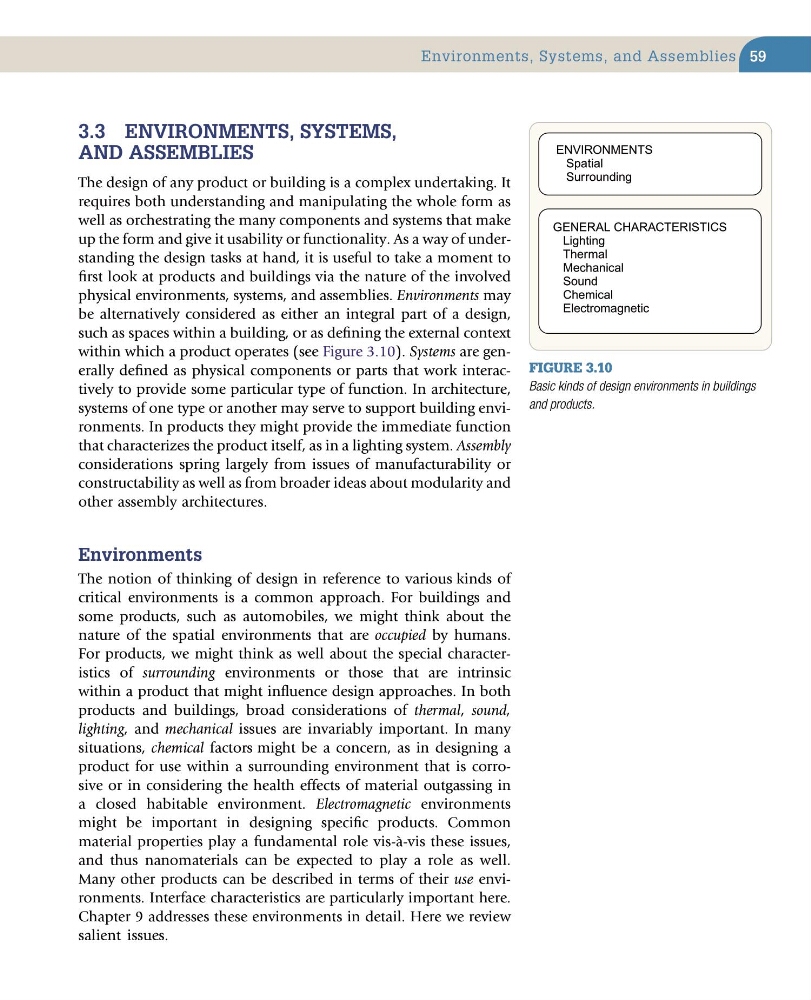
within which a product operates (see Figure 3.10). Systems are generally defined as physical components or parts that work interactively to provide some particular type of function. In architecture,
systems of one type or another may serve to support building environments. In products they might provide the immediate function
that characterizes the product itself, as in a lighting system. Assembly
considerations spring largely from issues of manufacturability or
constructability as well as from broader ideas about modularity and
other assembly architectures.
environments
The notion of thinking of design in reference to various kinds of
critical environments is a common approach. For buildings and
some products, such as automobiles, we might think about the
nature of the spatial environments that are occupied by humans.
For products, we might think as well about the special characteristics of surrounding environments or those that are intrinsic
within a product that might influence design approaches. In both
products and buildings, broad considerations of thermal, sound,
lighting, and mechanical issues are invariably important. In many
situations, chemical factors might be a concern, as in designing a
product for use within a surrounding environment that is corrosive or in considering the health effects of material outgassing in
a closed habitable environment. Electromagnetic environments
might be important in designing specific products. Common
material properties play a fundamental role vis-à-vis these issues,
and thus nanomaterials can be expected to play a role as well.
Many other products can be described in terms of their use environments. Interface characteristics are particularly important here.
Chapter 9 addresses these environments in detail. Here we review
salient issues.
Figure 3.10
Basic kinds of design environments in buildings
and products.
ENVIRONMENTS
Spatial
Surrounding
GENERAL CHARACTERISTICS
Lighting
Thermal
Mechanical
Sound
Chemical
Electromagnetic
Environments, Systems, and Assemblies
3.3 enVironMents, systeMs,
anD asseMBlies
The design of any product or building is a complex undertaking. It
requires both understanding and manipulating the whole form as
well as orchestrating the many components and systems that make
up the form and give it usability or functionality. As a way of understanding the design tasks at hand, it is useful to take a moment to
first look at products and buildings via the nature of the involved
physical environments, systems, and assemblies. Environments may
be alternatively considered as either an integral part of a design,
such as spaces within a building, or as defining the external context
within which a product operates (see Figure 3.10). Systems are generally defined as physical components or parts that work interactively to provide some particular type of function. In architecture,
systems of one type or another may serve to support building environments. In products they might provide the immediate function
that characterizes the product itself, as in a lighting system. Assembly
considerations spring largely from issues of manufacturability or
constructability as well as from broader ideas about modularity and
other assembly architectures.
environments
The notion of thinking of design in reference to various kinds of
critical environments is a common approach. For buildings and
some products, such as automobiles, we might think about the
nature of the spatial environments that are occupied by humans.
For products, we might think as well about the special characteristics of surrounding environments or those that are intrinsic
within a product that might influence design approaches. In both
products and buildings, broad considerations of thermal, sound,
lighting, and mechanical issues are invariably important. In many
situations, chemical factors might be a concern, as in designing a
product for use within a surrounding environment that is corrosive or in considering the health effects of material outgassing in
a closed habitable environment. Electromagnetic environments
might be important in designing specific products. Common
material properties play a fundamental role vis-à-vis these issues,
and thus nanomaterials can be expected to play a role as well.
Many other products can be described in terms of their use environments. Interface characteristics are particularly important here.
Chapter 9 addresses these environments in detail. Here we review
salient issues.
Figure 3.10
Basic kinds of design environments in buildings
and products.
ENVIRONMENTS
Spatial
Surrounding
GENERAL CHARACTERISTICS
Lighting
Thermal
Mechanical
Sound
Chemical
Electromagnetic
Environments, Systems, and Assemblies