

C hapter 3 the Design Context
54
Where might nanomaterial technologies fit into this broad view
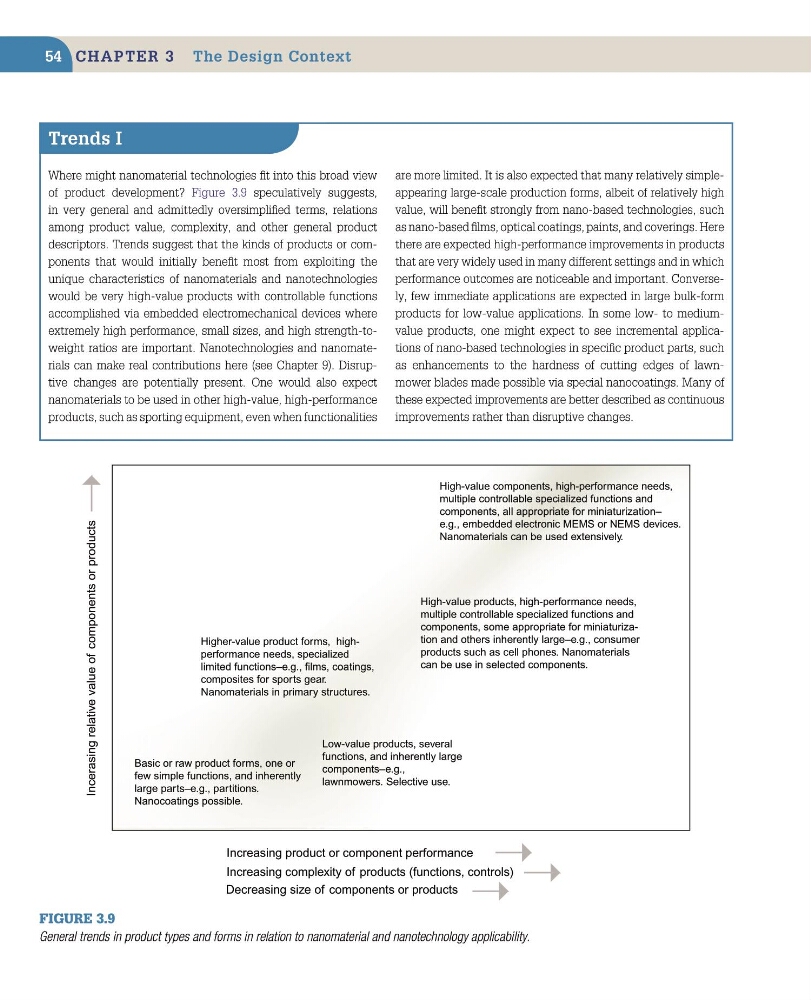
of product development? Figure 3.9 speculatively suggests,
in very general and admittedly oversimplified terms, relations
among product value, complexity, and other general product
descriptors. Trends suggest that the kinds of products or components that would initially benefit most from exploiting the
unique characteristics of nanomaterials and nanotechnologies
would be very high-value products with controllable functions
accomplished via embedded electromechanical devices where
extremely high performance, small sizes, and high strength-toweight ratios are important. Nanotechnologies and nanomaterials can make real contributions here (see Chapter 9). Disruptive changes are potentially present. One would also expect
nanomaterials to be used in other high-value, high-performance
products, such as sporting equipment, even when functionalities
are more limited. It is also expected that many relatively simpleappearing large-scale production forms, albeit of relatively high
value, will benefit strongly from nano-based technologies, such
as nano-based films, optical coatings, paints, and coverings. Here
there are expected high-performance improvements in products
that are very widely used in many different settings and in which
performance outcomes are noticeable and important. Conversely, few immediate applications are expected in large bulk-form
products for low-value applications. In some low- to mediumvalue products, one might expect to see incremental applications of nano-based technologies in specific product parts, such
as enhancements to the hardness of cutting edges of lawnmower blades made possible via special nanocoatings. Many of
these expected improvements are better described as continuous
improvements rather than disruptive changes.
trends i
Figure 3.9
General trends in product types and forms in relation to nanomaterial and nanotechnology applicability.
Basic or raw product forms, one or
few simple functions, and inherently
large parts–e.g., partitions.
Nanocoatings possible.
Low-value products, several
functions, and inherently large
components–e.g.,
lawnmowers. Selective use.
High-value components, high-performance needs,
multiple controllable specialized functions and
components, all appropriate for miniaturization–
e.g., embedded electronic MEMS or NEMS devices.
Nanomaterials can be used extensively.
Higher-value product forms, highperformance needs, specialized
limited functions–e.g., films, coatings,
composites for sports gear.
Nanomaterials in primary structures.
High-value products, high-performance needs,
multiple controllable specialized functions and
components, some appropriate for miniaturization and others inherently large–e.g., consumer
products such as cell phones. Nanomaterials
can be use in selected components.
Incerasing relative value of components or products
Decreasing size of components or products
Increasing complexity of products (functions, controls)
Increasing product or component performance
54
Where might nanomaterial technologies fit into this broad view
of product development? Figure 3.9 speculatively suggests,
in very general and admittedly oversimplified terms, relations
among product value, complexity, and other general product
descriptors. Trends suggest that the kinds of products or components that would initially benefit most from exploiting the
unique characteristics of nanomaterials and nanotechnologies
would be very high-value products with controllable functions
accomplished via embedded electromechanical devices where
extremely high performance, small sizes, and high strength-toweight ratios are important. Nanotechnologies and nanomaterials can make real contributions here (see Chapter 9). Disruptive changes are potentially present. One would also expect
nanomaterials to be used in other high-value, high-performance
products, such as sporting equipment, even when functionalities
are more limited. It is also expected that many relatively simpleappearing large-scale production forms, albeit of relatively high
value, will benefit strongly from nano-based technologies, such
as nano-based films, optical coatings, paints, and coverings. Here
there are expected high-performance improvements in products
that are very widely used in many different settings and in which
performance outcomes are noticeable and important. Conversely, few immediate applications are expected in large bulk-form
products for low-value applications. In some low- to mediumvalue products, one might expect to see incremental applications of nano-based technologies in specific product parts, such
as enhancements to the hardness of cutting edges of lawnmower blades made possible via special nanocoatings. Many of
these expected improvements are better described as continuous
improvements rather than disruptive changes.
trends i
Figure 3.9
General trends in product types and forms in relation to nanomaterial and nanotechnology applicability.
Basic or raw product forms, one or
few simple functions, and inherently
large parts–e.g., partitions.
Nanocoatings possible.
Low-value products, several
functions, and inherently large
components–e.g.,
lawnmowers. Selective use.
High-value components, high-performance needs,
multiple controllable specialized functions and
components, all appropriate for miniaturization–
e.g., embedded electronic MEMS or NEMS devices.
Nanomaterials can be used extensively.
Higher-value product forms, highperformance needs, specialized
limited functions–e.g., films, coatings,
composites for sports gear.
Nanomaterials in primary structures.
High-value products, high-performance needs,
multiple controllable specialized functions and
components, some appropriate for miniaturization and others inherently large–e.g., consumer
products such as cell phones. Nanomaterials
can be use in selected components.
Incerasing relative value of components or products
Decreasing size of components or products
Increasing complexity of products (functions, controls)
Increasing product or component performance