

chaPter 12 the Broader context
514
users and designers associate with the “architecture” of the building; hence appearances, textures, finishes, and the like are highly
important as well. Products produced for these systems vary widely
in technological sophistication. Glasses and many kinds of panels
can be extremely sophisticated, whereas other buildings might use
walls made of very lowtech products.
Nonetheless, the huge surface areas associated with enclosure
systems make them a natural target for sophisticated products that
are surface oriented. If there is one thing that buildings have in comparison with other artifacts, it is surface area. Hence, many applications can be expected in the “surface” or “enclosure” category, such
as glasses, paints, and coatings, and have either functional or useful
visual properties. As we saw in Chapter 10, many very interesting
and useful innovations based on the use of nanomaterials are taking
place here, such as various thin films, coatings, and others. Products with selfcleaning, easycleaning, antimold, or other behaviors
of this type are particularly attractive and can be expected to find
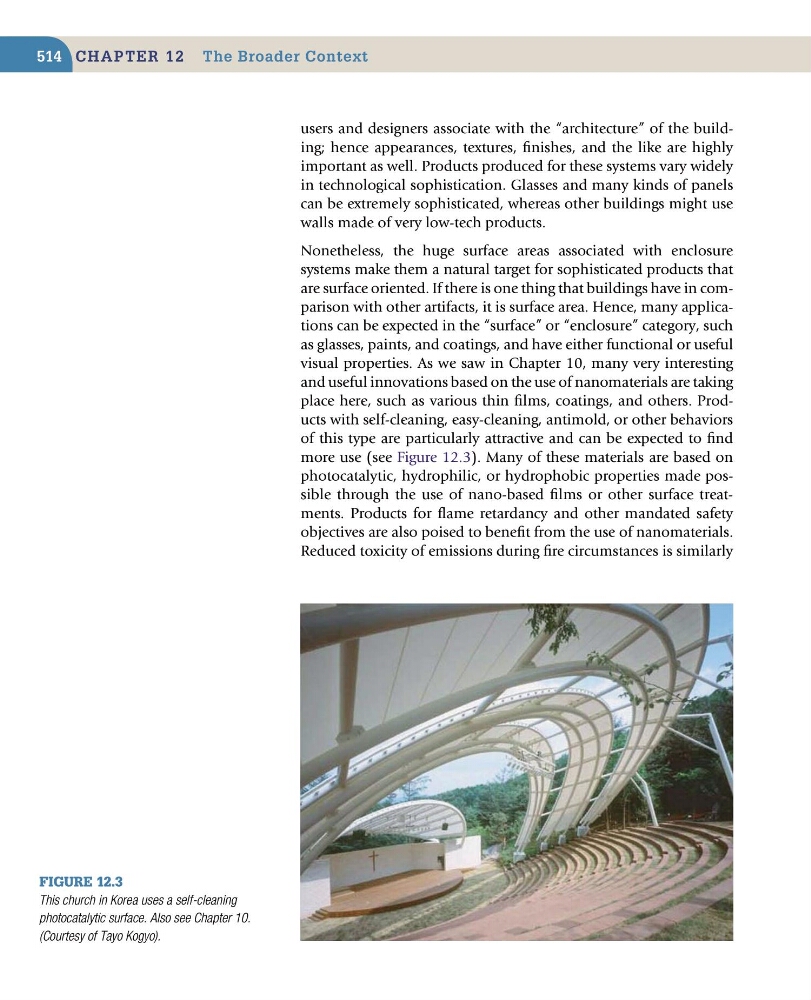
more use (see Figure 12.3). Many of these materials are based on
photocatalytic, hydrophilic, or hydrophobic properties made possible through the use of nanobased films or other surface treatments. Products for flame retardancy and other mandated safety
objectives are also poised to benefit from the use of nanomaterials.
Reduced toxicity of emissions during fire circumstances is similarly
Figure 12.3
This church in Korea uses a self-cleaning
photocatalytic surface. Also see Chapter 10.
(Courtesy of Tayo Kogyo).
514
users and designers associate with the “architecture” of the building; hence appearances, textures, finishes, and the like are highly
important as well. Products produced for these systems vary widely
in technological sophistication. Glasses and many kinds of panels
can be extremely sophisticated, whereas other buildings might use
walls made of very lowtech products.
Nonetheless, the huge surface areas associated with enclosure
systems make them a natural target for sophisticated products that
are surface oriented. If there is one thing that buildings have in comparison with other artifacts, it is surface area. Hence, many applications can be expected in the “surface” or “enclosure” category, such
as glasses, paints, and coatings, and have either functional or useful
visual properties. As we saw in Chapter 10, many very interesting
and useful innovations based on the use of nanomaterials are taking
place here, such as various thin films, coatings, and others. Products with selfcleaning, easycleaning, antimold, or other behaviors
of this type are particularly attractive and can be expected to find
more use (see Figure 12.3). Many of these materials are based on
photocatalytic, hydrophilic, or hydrophobic properties made possible through the use of nanobased films or other surface treatments. Products for flame retardancy and other mandated safety
objectives are also poised to benefit from the use of nanomaterials.
Reduced toxicity of emissions during fire circumstances is similarly
Figure 12.3
This church in Korea uses a self-cleaning
photocatalytic surface. Also see Chapter 10.
(Courtesy of Tayo Kogyo).