

chaPter 12 the Broader context
508
Polymerbased nanocomposites are finding use in many body
components. Both thermoplastics and thermosets are in use. Thermoplastic materials can be shaped quite easily. The early use of
thermoplastic olefin (TPO) has proven successful for use in certain
interior and exterior elements (stepassists, panels). Lightweight
nanocomposites of this type use relatively inexpensive nanoclays
and nanotalcs. The TPO normally used employs natural smectite
clay. It is treated so that exfoliation occurs and molecular sheets
are formed. Yet issues of cost, quality, and strength remain. Exfoliation methods normally need high quantities of additives that
can be a drawback, although several approaches are alleviating this
problem. Several explorations are in progress in relation to thermosets, which can be quite strong, that involve the use of various
kinds of nanomaterials in the resins. Carbon nanotubes have been
explored for use here.
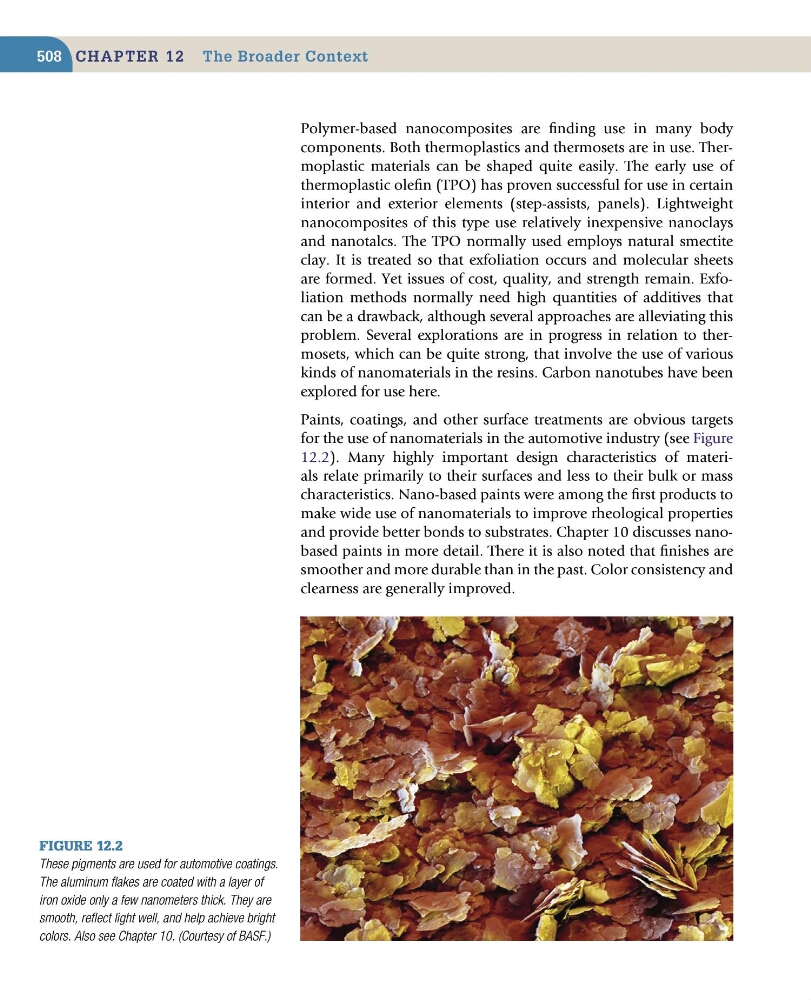
Paints, coatings, and other surface treatments are obvious targets
for the use of nanomaterials in the automotive industry (see Figure
12.2). Many highly important design characteristics of materials relate primarily to their surfaces and less to their bulk or mass
characteristics. Nanobased paints were among the first products to
make wide use of nanomaterials to improve rheological properties
and provide better bonds to substrates. Chapter 10 discusses nanobased paints in more detail. There it is also noted that finishes are
smoother and more durable than in the past. Color consistency and
clearness are generally improved.
Figure 12.2
These pigments are used for automotive coatings.
The aluminum flakes are coated with a layer of
iron oxide only a few nanometers thick. They are
smooth, reflect light well, and help achieve bright
colors. Also see Chapter 10. (Courtesy of BASF.)
508
Polymerbased nanocomposites are finding use in many body
components. Both thermoplastics and thermosets are in use. Thermoplastic materials can be shaped quite easily. The early use of
thermoplastic olefin (TPO) has proven successful for use in certain
interior and exterior elements (stepassists, panels). Lightweight
nanocomposites of this type use relatively inexpensive nanoclays
and nanotalcs. The TPO normally used employs natural smectite
clay. It is treated so that exfoliation occurs and molecular sheets
are formed. Yet issues of cost, quality, and strength remain. Exfoliation methods normally need high quantities of additives that
can be a drawback, although several approaches are alleviating this
problem. Several explorations are in progress in relation to thermosets, which can be quite strong, that involve the use of various
kinds of nanomaterials in the resins. Carbon nanotubes have been
explored for use here.
Paints, coatings, and other surface treatments are obvious targets
for the use of nanomaterials in the automotive industry (see Figure
12.2). Many highly important design characteristics of materials relate primarily to their surfaces and less to their bulk or mass
characteristics. Nanobased paints were among the first products to
make wide use of nanomaterials to improve rheological properties
and provide better bonds to substrates. Chapter 10 discusses nanobased paints in more detail. There it is also noted that finishes are
smoother and more durable than in the past. Color consistency and
clearness are generally improved.
Figure 12.2
These pigments are used for automotive coatings.
The aluminum flakes are coated with a layer of
iron oxide only a few nanometers thick. They are
smooth, reflect light well, and help achieve bright
colors. Also see Chapter 10. (Courtesy of BASF.)