

chaPter 12 the Broader context
504
sources. The “battery barrier” still remains a powerful limitation in
the move toward fully electric vehicles or more efficient hybrids.
Nonetheless, improvements in lithium batteries are anticipated
in both capacity and recharge rates. Attention for automobiles
remains primarily focused on the further development of fuelcell technologies and the role that nanomaterials could play in
improving efficiencies. The potential for significant improvements
in fuel cells over current technologies is extremely high. A variety
of nanobased materials and technologies can contribute here,
including new nanomembrane technologies. Various other fuelcell
approaches are also being explored, including solidstate systems.
Not all fuelcell approaches will prove useful for automobiles.
Magnetorheological shock
absorbers, electrorheological tires
QLED
lights
Many electronic and mechanical components: emission controls, fuel
cells, batteries, supercapacitors, tribological applications (wear,
lubricants), nanocoolants, other
Self-cleaning glasses, antifogging
Control, communication, navigation systems,
car-in-context guidance systems
Emergency medical and personal health
monitoring systems, entertainment
Biothreat sensors and alerts,
air purification
Antiscratch paints
Self-healing paints
Self-cleaning clear
coats
Self-cleaning,
antimicrobial textiles
Nanocomposites—
frames and shells
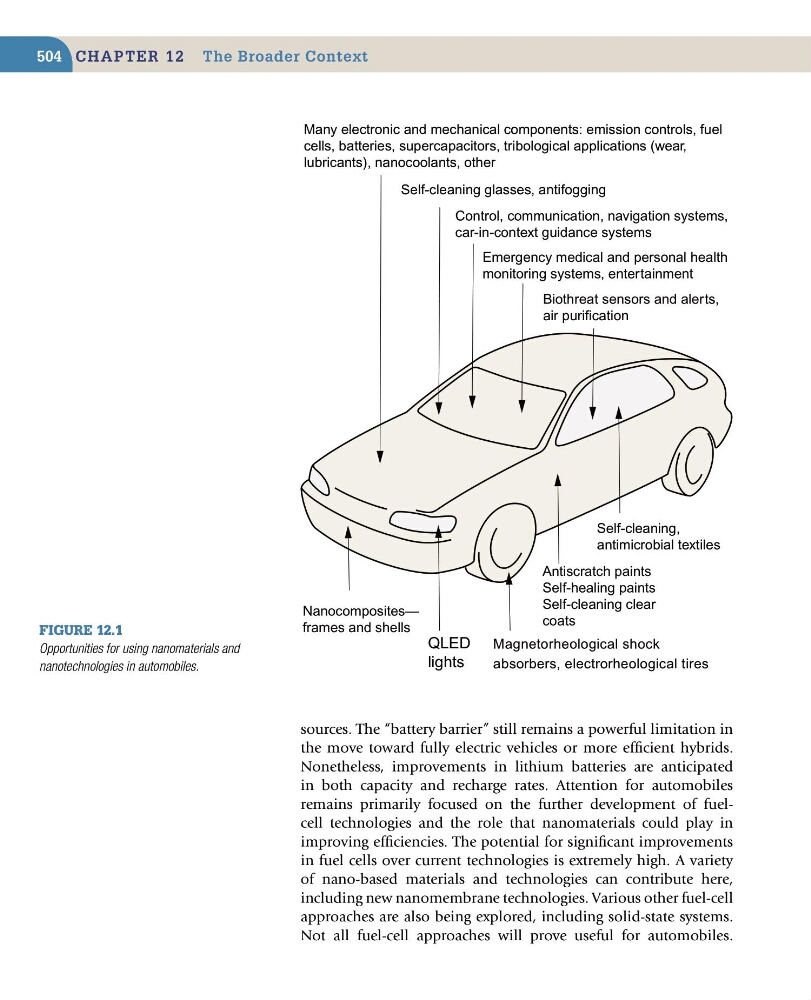
Figure 12.1
Opportunities for using nanomaterials and
nanotechnologies in automobiles.
504
sources. The “battery barrier” still remains a powerful limitation in
the move toward fully electric vehicles or more efficient hybrids.
Nonetheless, improvements in lithium batteries are anticipated
in both capacity and recharge rates. Attention for automobiles
remains primarily focused on the further development of fuelcell technologies and the role that nanomaterials could play in
improving efficiencies. The potential for significant improvements
in fuel cells over current technologies is extremely high. A variety
of nanobased materials and technologies can contribute here,
including new nanomembrane technologies. Various other fuelcell
approaches are also being explored, including solidstate systems.
Not all fuelcell approaches will prove useful for automobiles.
Magnetorheological shock
absorbers, electrorheological tires
QLED
lights
Many electronic and mechanical components: emission controls, fuel
cells, batteries, supercapacitors, tribological applications (wear,
lubricants), nanocoolants, other
Self-cleaning glasses, antifogging
Control, communication, navigation systems,
car-in-context guidance systems
Emergency medical and personal health
monitoring systems, entertainment
Biothreat sensors and alerts,
air purification
Antiscratch paints
Self-healing paints
Self-cleaning clear
coats
Self-cleaning,
antimicrobial textiles
Nanocomposites—
frames and shells
Figure 12.1
Opportunities for using nanomaterials and
nanotechnologies in automobiles.