

C hapTer 11 nanomaterials and nanotechnologies
494
released from the amine as nearly pure gas. Other kinds of scrubbers are designed for specific application targets. Nanomaterials
have been explored as paths to improving these kinds of processes
because of their high surface areas and processing ability to obtain
a variety of shapes.
In electrostatic precipitators, static electricity is used to charge pollutant particles in the air, which are then attracted and bound to
a collection plate of the opposite charge. These systems have been
typically seen on the scale of centralized HVAC for a single building and at a portable size meant for an individual indoor space.
The size of collection plates, air flow rate, debris accumulation,
and the charge delivery characteristics influence efficiency and efficacy. Electrostatic systems require maintenance, which consists of
wiping accumulated debris from the collection plates, to maintain
efficiency. These systems have been used to remove dust particles,
fumes, odors, and gases and have also been used in tandem with
membrane filtration.
Other approaches are based on ultraviolet exposure. Simple UV light
is capable of denaturing the DNA of many kinds of viruses, bacteria, and fungi. This technology is common in water filtration as well
for the removal of a variety of microorganisms. This technology is
often used as part of a hybrid system that employs a mechanical
filter and is increasingly being used at the largest scale in building
HVAC systems.
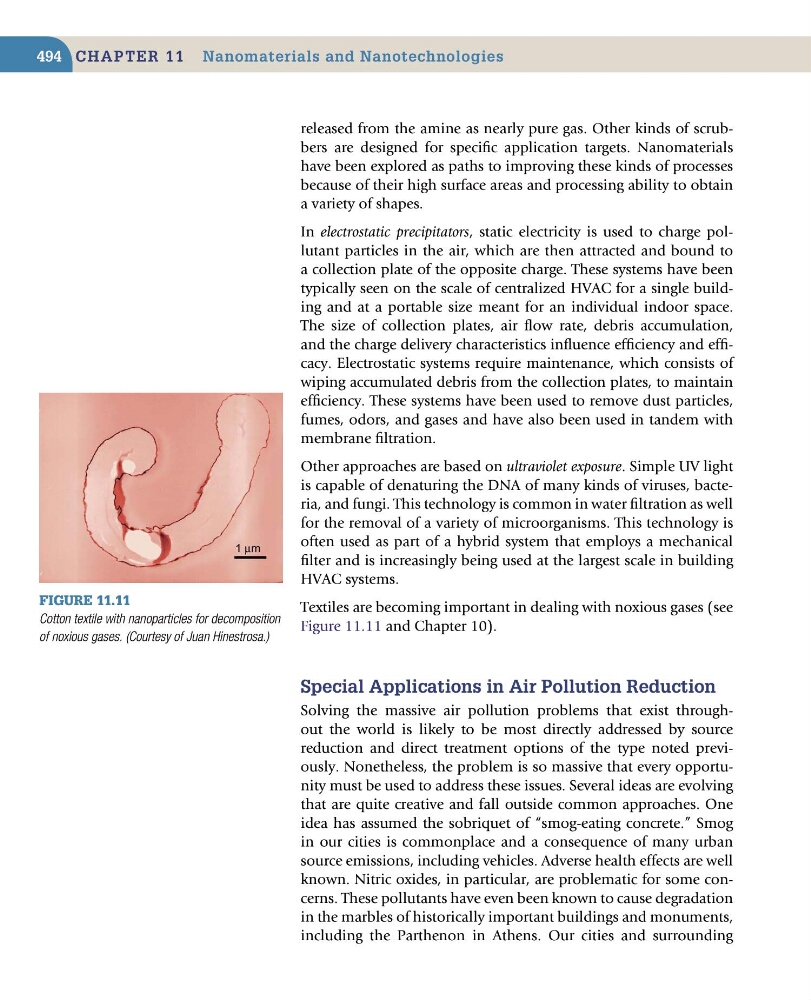
Textiles are becoming important in dealing with noxious gases (see
Figure 11.11 and Chapter 10).
special applications in air pollution reduction
Solving the massive air pollution problems that exist throughout the world is likely to be most directly addressed by source
reduction and direct treatment options of the type noted previously. Nonetheless, the problem is so massive that every opportunity must be used to address these issues. Several ideas are evolving
that are quite creative and fall outside common approaches. One
idea has assumed the sobriquet of “smog-eating concrete.” Smog
in our cities is commonplace and a consequence of many urban
source emissions, including vehicles. Adverse health effects are well
known. Nitric oxides, in particular, are problematic for some concerns. These pollutants have even been known to cause degradation
in the marbles of historically important buildings and monuments,
including the Parthenon in Athens. Our cities and surrounding
Figure 11.11
Cotton textile with nanoparticles for decomposition
of noxious gases. (Courtesy of Juan Hinestrosa.)
494
released from the amine as nearly pure gas. Other kinds of scrubbers are designed for specific application targets. Nanomaterials
have been explored as paths to improving these kinds of processes
because of their high surface areas and processing ability to obtain
a variety of shapes.
In electrostatic precipitators, static electricity is used to charge pollutant particles in the air, which are then attracted and bound to
a collection plate of the opposite charge. These systems have been
typically seen on the scale of centralized HVAC for a single building and at a portable size meant for an individual indoor space.
The size of collection plates, air flow rate, debris accumulation,
and the charge delivery characteristics influence efficiency and efficacy. Electrostatic systems require maintenance, which consists of
wiping accumulated debris from the collection plates, to maintain
efficiency. These systems have been used to remove dust particles,
fumes, odors, and gases and have also been used in tandem with
membrane filtration.
Other approaches are based on ultraviolet exposure. Simple UV light
is capable of denaturing the DNA of many kinds of viruses, bacteria, and fungi. This technology is common in water filtration as well
for the removal of a variety of microorganisms. This technology is
often used as part of a hybrid system that employs a mechanical
filter and is increasingly being used at the largest scale in building
HVAC systems.
Textiles are becoming important in dealing with noxious gases (see
Figure 11.11 and Chapter 10).
special applications in air pollution reduction
Solving the massive air pollution problems that exist throughout the world is likely to be most directly addressed by source
reduction and direct treatment options of the type noted previously. Nonetheless, the problem is so massive that every opportunity must be used to address these issues. Several ideas are evolving
that are quite creative and fall outside common approaches. One
idea has assumed the sobriquet of “smog-eating concrete.” Smog
in our cities is commonplace and a consequence of many urban
source emissions, including vehicles. Adverse health effects are well
known. Nitric oxides, in particular, are problematic for some concerns. These pollutants have even been known to cause degradation
in the marbles of historically important buildings and monuments,
including the Parthenon in Athens. Our cities and surrounding
Figure 11.11
Cotton textile with nanoparticles for decomposition
of noxious gases. (Courtesy of Juan Hinestrosa.)