

481
lesser risks, but some risks might still be present because of lifecycle concerns with products. The workforce in facilties that make
nanomaterials should exercise special precautions. Nanomaterials
in relation to agricultural products can surely be expected to engender controversies. There are, however, potentially great societal
benefits to using nanomaterials in many settings—so risk/benefit
questions invariably remain.
11.4 environMenTal BenefiTs
and iMpaCTs
Our environment has long suffered from harmful effects produced
by myriad pollutant-generating sources. Industrialized processes,
oil or chemical spills, pesticides, fertilizers, and emissions from
vehicles have caused pollution in our air, water, and earth environments. The need to achieve clean air, water, and soil environments
is a challenge facing societies throughout the world. It is well known
that human health can be directly affected by these issues, as can
the health of whole ecological systems. The role of nanomaterials in
relation to these environmental issues has been reasonably raised
many times—by the scientific research community, by concerned
public groups, and by regulatory agencies. A surprisingly large body
of literature already exists on the subject, perhaps because it is so
controversial.
On one hand, there is every reason to believe that nano-based technologies offer real opportunities for helping to achieve positive environmental objectives through improvements in technologies that
might help reduce our dependency on fossil fuels, such as fuel cells
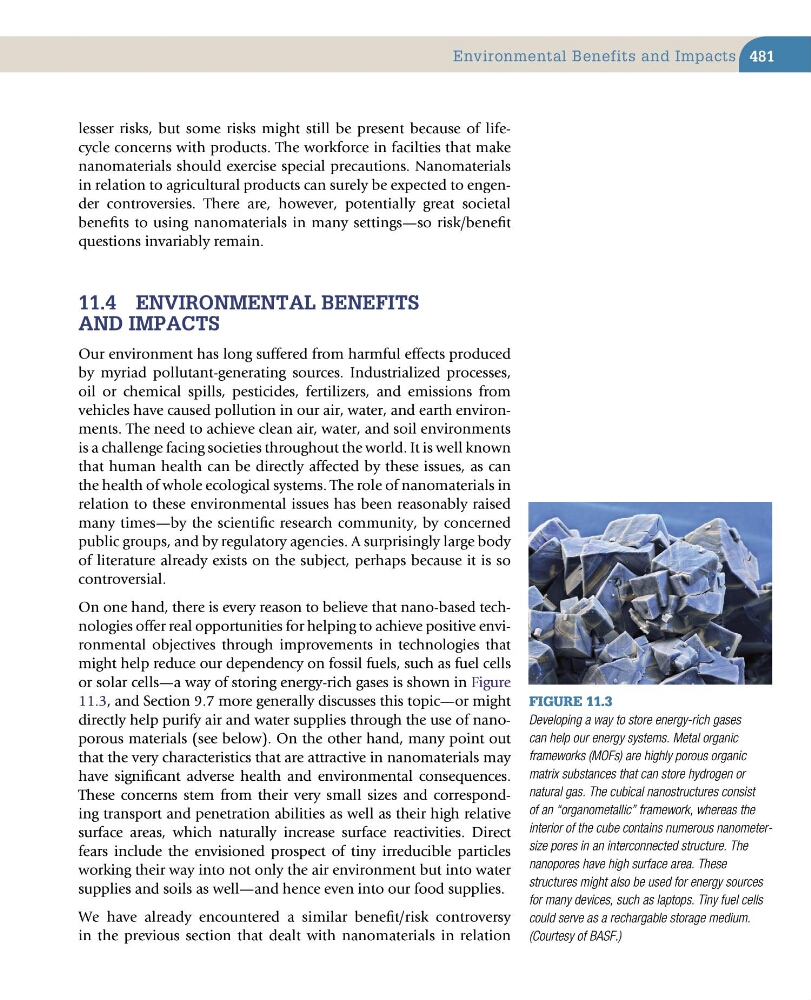
or solar cells—a way of storing energy-rich gases is shown in Figure
11.3, and Section 9.7 more generally discusses this topic—or might
directly help purify air and water supplies through the use of nanoporous materials (see below). On the other hand, many point out
that the very characteristics that are attractive in nanomaterials may
have significant adverse health and environmental consequences.
These concerns stem from their very small sizes and corresponding transport and penetration abilities as well as their high relative
surface areas, which naturally increase surface reactivities. Direct
fears include the envisioned prospect of tiny irreducible particles
working their way into not only the air environment but into water
supplies and soils as well—and hence even into our food supplies.
We have already encountered a similar benefit/risk controversy
in the previous section that dealt with nanomaterials in relation
Figure 11.3
Developing a way to store energy-rich gases
can help our energy systems. Metal organic
frameworks (MOFs) are highly porous organic
matrix substances that can store hydrogen or
natural gas. The cubical nanostructures consist
of an “organometallic” framework, whereas the
interior of the cube contains numerous nanometersize pores in an interconnected structure. The
nanopores have high surface area. These
structures might also be used for energy sources
for many devices, such as laptops. Tiny fuel cells
could serve as a rechargable storage medium.
(Courtesy of BASF.)
Environmental Benefits and Impacts
lesser risks, but some risks might still be present because of lifecycle concerns with products. The workforce in facilties that make
nanomaterials should exercise special precautions. Nanomaterials
in relation to agricultural products can surely be expected to engender controversies. There are, however, potentially great societal
benefits to using nanomaterials in many settings—so risk/benefit
questions invariably remain.
11.4 environMenTal BenefiTs
and iMpaCTs
Our environment has long suffered from harmful effects produced
by myriad pollutant-generating sources. Industrialized processes,
oil or chemical spills, pesticides, fertilizers, and emissions from
vehicles have caused pollution in our air, water, and earth environments. The need to achieve clean air, water, and soil environments
is a challenge facing societies throughout the world. It is well known
that human health can be directly affected by these issues, as can
the health of whole ecological systems. The role of nanomaterials in
relation to these environmental issues has been reasonably raised
many times—by the scientific research community, by concerned
public groups, and by regulatory agencies. A surprisingly large body
of literature already exists on the subject, perhaps because it is so
controversial.
On one hand, there is every reason to believe that nano-based technologies offer real opportunities for helping to achieve positive environmental objectives through improvements in technologies that
might help reduce our dependency on fossil fuels, such as fuel cells
or solar cells—a way of storing energy-rich gases is shown in Figure
11.3, and Section 9.7 more generally discusses this topic—or might
directly help purify air and water supplies through the use of nanoporous materials (see below). On the other hand, many point out
that the very characteristics that are attractive in nanomaterials may
have significant adverse health and environmental consequences.
These concerns stem from their very small sizes and corresponding transport and penetration abilities as well as their high relative
surface areas, which naturally increase surface reactivities. Direct
fears include the envisioned prospect of tiny irreducible particles
working their way into not only the air environment but into water
supplies and soils as well—and hence even into our food supplies.
We have already encountered a similar benefit/risk controversy
in the previous section that dealt with nanomaterials in relation
Figure 11.3
Developing a way to store energy-rich gases
can help our energy systems. Metal organic
frameworks (MOFs) are highly porous organic
matrix substances that can store hydrogen or
natural gas. The cubical nanostructures consist
of an “organometallic” framework, whereas the
interior of the cube contains numerous nanometersize pores in an interconnected structure. The
nanopores have high surface area. These
structures might also be used for energy sources
for many devices, such as laptops. Tiny fuel cells
could serve as a rechargable storage medium.
(Courtesy of BASF.)
Environmental Benefits and Impacts