

479
positions on both sides of the debate, and many hinge around
the issue of whether nanoparticles do or do not penetrate the skin
barrier. If they do, a primary concern among others is that some
common nanoparticles (e.g., titanium dioxide) are known to emit
photoelectrons when exposed to UV light, which then might cause
formation of peroxides, free radicals, and other reactive oxygen
species that might interact with lipids and DNA and cause damage.
If they never penetrate the skin barrier or light never reaches them,
concerns such as this are lessened.
The question of whether or not particles actually do penetrate
the skin and enter the bloodstream has been addressed only to a
certain extent. Skin is a wonderfully complex and versatile material
that serves many functions—a barrier, a device for controlling internal body temperatures, a device for manufacturing vitamins, and
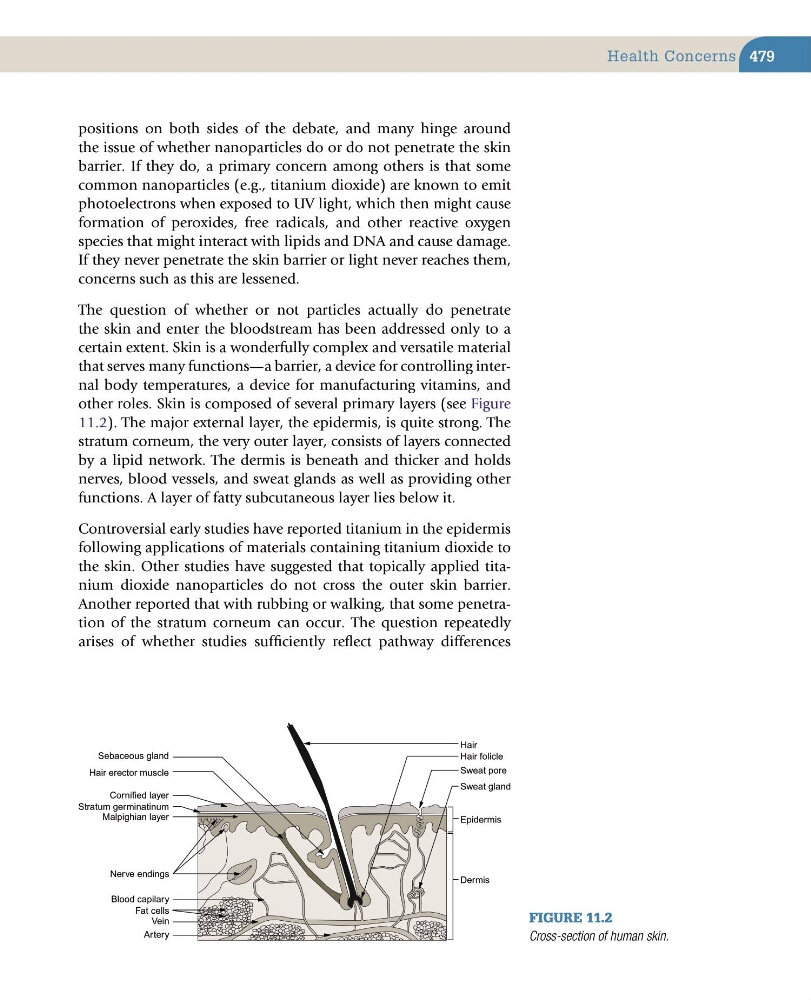
other roles. Skin is composed of several primary layers (see Figure
11.2). The major external layer, the epidermis, is quite strong. The
stratum corneum, the very outer layer, consists of layers connected
by a lipid network. The dermis is beneath and thicker and holds
nerves, blood vessels, and sweat glands as well as providing other
functions. A layer of fatty subcutaneous layer lies below it.
Controversial early studies have reported titanium in the epidermis
following applications of materials containing titanium dioxide to
the skin. Other studies have suggested that topically applied titanium dioxide nanoparticles do not cross the outer skin barrier.
Another reported that with rubbing or walking, that some penetration of the stratum corneum can occur. The question repeatedly
arises of whether studies sufficiently reflect pathway differences
Figure 11.2
Cross-section of human skin.
Hair
Sebaceous gland
Hair erector muscle
Cornified layer
Stratum germinatinum
Malpighian layer
Nerve endings
Blood capilary
Fat cells
Vein
Artery
Hair folicle
Sweat pore
Sweat gland
Epidermis
Dermis
Health Concerns
positions on both sides of the debate, and many hinge around
the issue of whether nanoparticles do or do not penetrate the skin
barrier. If they do, a primary concern among others is that some
common nanoparticles (e.g., titanium dioxide) are known to emit
photoelectrons when exposed to UV light, which then might cause
formation of peroxides, free radicals, and other reactive oxygen
species that might interact with lipids and DNA and cause damage.
If they never penetrate the skin barrier or light never reaches them,
concerns such as this are lessened.
The question of whether or not particles actually do penetrate
the skin and enter the bloodstream has been addressed only to a
certain extent. Skin is a wonderfully complex and versatile material
that serves many functions—a barrier, a device for controlling internal body temperatures, a device for manufacturing vitamins, and
other roles. Skin is composed of several primary layers (see Figure
11.2). The major external layer, the epidermis, is quite strong. The
stratum corneum, the very outer layer, consists of layers connected
by a lipid network. The dermis is beneath and thicker and holds
nerves, blood vessels, and sweat glands as well as providing other
functions. A layer of fatty subcutaneous layer lies below it.
Controversial early studies have reported titanium in the epidermis
following applications of materials containing titanium dioxide to
the skin. Other studies have suggested that topically applied titanium dioxide nanoparticles do not cross the outer skin barrier.
Another reported that with rubbing or walking, that some penetration of the stratum corneum can occur. The question repeatedly
arises of whether studies sufficiently reflect pathway differences
Figure 11.2
Cross-section of human skin.
Hair
Sebaceous gland
Hair erector muscle
Cornified layer
Stratum germinatinum
Malpighian layer
Nerve endings
Blood capilary
Fat cells
Vein
Artery
Hair folicle
Sweat pore
Sweat gland
Epidermis
Dermis
Health Concerns