

469
rials are being explored for use as both biosensors and biolabels.
Biosensors respond to biological molecules. Nanoparticles that are
conjugated with various biological ligands can be designed to bind
with particular cellular targets. Nanowires, for example, have been
coated with substances that only bind to particular proteins that are
to be measured. When the proteins bind to the nanowires, their conductivities are changed sufficiently for detection and measurement.
As previously discussed, nanoparticles exhibit many extremely
interesting properties in relation to light (see Section 8.7), including fluorescence. The use of fluorescent nanoparticles can allow
biocolor labelling and subsequent tracking of cells. Other kinds of
nanomaterial properties, such as magnetism, are explored for similar
pathway tracking. Monitoring techniques such as spectroscopy or
magnetic resonance imaging (MRI) can potentially be improved as
well. In spectroscopy, certain nanoparticles such as gold can cause
chemical signal magnifications. In MRI monitoring, superparamagnetic iron particles are explored for inducting specific signals. Other
approaches are used for enzyme and protein analyses.
Diagnostic techniques rely heavily on detection and sensing in relation to various disease markers. Nanoparticles have been explored
for use in detecting specific viruses and precancerous cells as well as
others. Nanoscale dendrimers are important here. Dendrimers are
synthetic, three-dimensional branching molecules that can be of
great complexity. Various biomolecules have been explored to functionalize nanosized dendrimers, with the objective of detecting
particular kinds of proteins or other substances that characterize
certain diseases. They can be useful in diagnostic imaging as well.
Dendrimers can also carry fluorescent markers for tracking. Similar
approaches use superparamagnetic iron oxides to recognize target
molecular markers inside particular kinds of diseased cells, which
then can be detected by MRI systems.
The whole realm of diagnostic devices and the role of nanomaterials are clearly beyond the scope of this book, but the exploration
of nanosized “laboratories” cannot be passed without notice. The
value of smaller and smaller devices with diagnostic capabilities
has long been recognized. As noted in Chapter 3, an early targeted
exploration of microelectromechanical systems (MEMS) was the
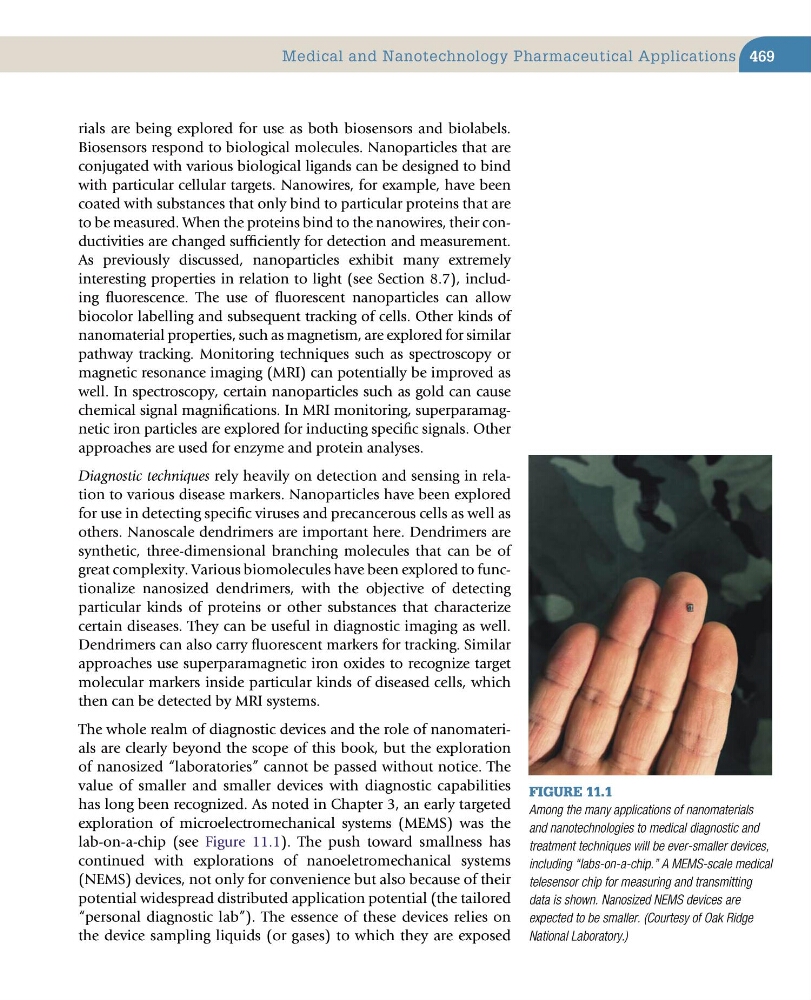
lab-on-a-chip (see Figure 11.1). The push toward smallness has
continued with explorations of nanoeletromechanical systems
(NEMS) devices, not only for convenience but also because of their
potential widespread distributed application potential (the tailored
“personal diagnostic lab”). The essence of these devices relies on
the device sampling liquids (or gases) to which they are exposed
Figure 11.1
Among the many applications of nanomaterials
and nanotechnologies to medical diagnostic and
treatment techniques will be ever-smaller devices,
including “labs-on-a-chip.” A MEMS-scale medical
telesensor chip for measuring and transmitting
data is shown. Nanosized NEMS devices are
expected to be smaller. (Courtesy of Oak Ridge
National Laboratory.)
Medical and Nanotechnology Pharmaceutical Applications
rials are being explored for use as both biosensors and biolabels.
Biosensors respond to biological molecules. Nanoparticles that are
conjugated with various biological ligands can be designed to bind
with particular cellular targets. Nanowires, for example, have been
coated with substances that only bind to particular proteins that are
to be measured. When the proteins bind to the nanowires, their conductivities are changed sufficiently for detection and measurement.
As previously discussed, nanoparticles exhibit many extremely
interesting properties in relation to light (see Section 8.7), including fluorescence. The use of fluorescent nanoparticles can allow
biocolor labelling and subsequent tracking of cells. Other kinds of
nanomaterial properties, such as magnetism, are explored for similar
pathway tracking. Monitoring techniques such as spectroscopy or
magnetic resonance imaging (MRI) can potentially be improved as
well. In spectroscopy, certain nanoparticles such as gold can cause
chemical signal magnifications. In MRI monitoring, superparamagnetic iron particles are explored for inducting specific signals. Other
approaches are used for enzyme and protein analyses.
Diagnostic techniques rely heavily on detection and sensing in relation to various disease markers. Nanoparticles have been explored
for use in detecting specific viruses and precancerous cells as well as
others. Nanoscale dendrimers are important here. Dendrimers are
synthetic, three-dimensional branching molecules that can be of
great complexity. Various biomolecules have been explored to functionalize nanosized dendrimers, with the objective of detecting
particular kinds of proteins or other substances that characterize
certain diseases. They can be useful in diagnostic imaging as well.
Dendrimers can also carry fluorescent markers for tracking. Similar
approaches use superparamagnetic iron oxides to recognize target
molecular markers inside particular kinds of diseased cells, which
then can be detected by MRI systems.
The whole realm of diagnostic devices and the role of nanomaterials are clearly beyond the scope of this book, but the exploration
of nanosized “laboratories” cannot be passed without notice. The
value of smaller and smaller devices with diagnostic capabilities
has long been recognized. As noted in Chapter 3, an early targeted
exploration of microelectromechanical systems (MEMS) was the
lab-on-a-chip (see Figure 11.1). The push toward smallness has
continued with explorations of nanoeletromechanical systems
(NEMS) devices, not only for convenience but also because of their
potential widespread distributed application potential (the tailored
“personal diagnostic lab”). The essence of these devices relies on
the device sampling liquids (or gases) to which they are exposed
Figure 11.1
Among the many applications of nanomaterials
and nanotechnologies to medical diagnostic and
treatment techniques will be ever-smaller devices,
including “labs-on-a-chip.” A MEMS-scale medical
telesensor chip for measuring and transmitting
data is shown. Nanosized NEMS devices are
expected to be smaller. (Courtesy of Oak Ridge
National Laboratory.)
Medical and Nanotechnology Pharmaceutical Applications