

451
their macro-level organization. Various nanocoatings are already
being used to impart many new desirable properties to textiles,
and nanocomposite materials are being widely explored as a way
of improving the overall properties of various kinds of fibers and
hence the overall product itself.
In many product applications, desirable characteristics of textiles
range widely according to the intended application. Some level of
strength, durability, and tear resistance is important in virtually all
applications, albeit specific requirements may vary radically. Needs
in apparel, for example, are obviously different from those in a
mountaineering tent but are nonetheless still present. In specific
applications such as apparel, traditional needs also include flexibility, thinness, softness, breathability, optical properties, stain resistance, heat resistance and flame retardancy, antistatic action, wrinkle
resistance, ability to receive different surface treatments (including
printing), and many factors related to material workability and
ability to incorporate other nontextile inclusions. Recent material
advances have made possible new desirable properties. Antibacterial fabrics are a good example here, as are self-cleaning fabrics.
Fabrics that slowly release different substances have a wide variety
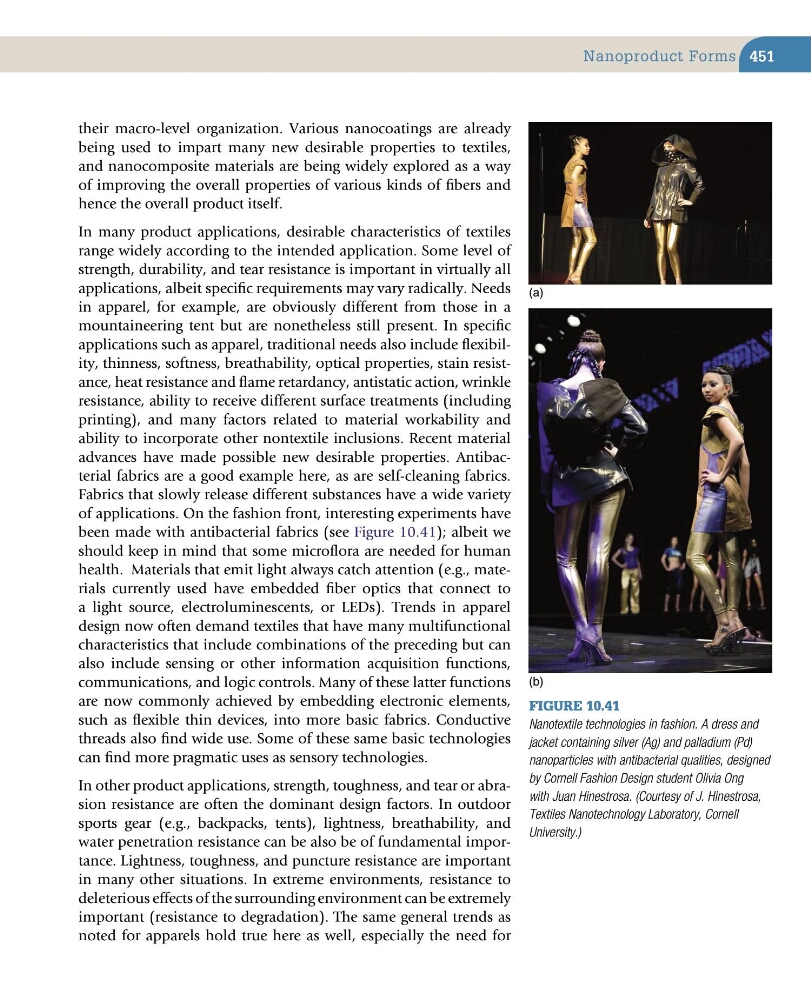
of applications. On the fashion front, interesting experiments have
been made with antibacterial fabrics (see Figure 10.41); albeit we
should keep in mind that some microflora are needed for human
health. Materials that emit light always catch attention (e.g., materials currently used have embedded fiber optics that connect to
a light source, electroluminescents, or LEDs). Trends in apparel
design now often demand textiles that have many multifunctional
characteristics that include combinations of the preceding but can
also include sensing or other information acquisition functions,
communications, and logic controls. Many of these latter functions
are now commonly achieved by embedding electronic elements,
such as flexible thin devices, into more basic fabrics. Conductive
threads also find wide use. Some of these same basic technologies
can find more pragmatic uses as sensory technologies.
In other product applications, strength, toughness, and tear or abrasion resistance are often the dominant design factors. In outdoor
sports gear (e.g., backpacks, tents), lightness, breathability, and
water penetration resistance can be also be of fundamental importance. Lightness, toughness, and puncture resistance are important
in many other situations. In extreme environments, resistance to
deleterious effects of the surrounding environment can be extremely
important (resistance to degradation). The same general trends as
noted for apparels hold true here as well, especially the need for
Figure 10.41
Nanotextile technologies in fashion. A dress and
jacket containing silver (Ag) and palladium (Pd)
nanoparticles with antibacterial qualities, designed
by Cornell Fashion Design student Olivia Ong
with Juan Hinestrosa. (Courtesy of J. Hinestrosa,
Textiles Nanotechnology Laboratory, Cornell
University.)
(a)
(b)
Nanoproduct Forms
their macro-level organization. Various nanocoatings are already
being used to impart many new desirable properties to textiles,
and nanocomposite materials are being widely explored as a way
of improving the overall properties of various kinds of fibers and
hence the overall product itself.
In many product applications, desirable characteristics of textiles
range widely according to the intended application. Some level of
strength, durability, and tear resistance is important in virtually all
applications, albeit specific requirements may vary radically. Needs
in apparel, for example, are obviously different from those in a
mountaineering tent but are nonetheless still present. In specific
applications such as apparel, traditional needs also include flexibility, thinness, softness, breathability, optical properties, stain resistance, heat resistance and flame retardancy, antistatic action, wrinkle
resistance, ability to receive different surface treatments (including
printing), and many factors related to material workability and
ability to incorporate other nontextile inclusions. Recent material
advances have made possible new desirable properties. Antibacterial fabrics are a good example here, as are self-cleaning fabrics.
Fabrics that slowly release different substances have a wide variety
of applications. On the fashion front, interesting experiments have
been made with antibacterial fabrics (see Figure 10.41); albeit we
should keep in mind that some microflora are needed for human
health. Materials that emit light always catch attention (e.g., materials currently used have embedded fiber optics that connect to
a light source, electroluminescents, or LEDs). Trends in apparel
design now often demand textiles that have many multifunctional
characteristics that include combinations of the preceding but can
also include sensing or other information acquisition functions,
communications, and logic controls. Many of these latter functions
are now commonly achieved by embedding electronic elements,
such as flexible thin devices, into more basic fabrics. Conductive
threads also find wide use. Some of these same basic technologies
can find more pragmatic uses as sensory technologies.
In other product applications, strength, toughness, and tear or abrasion resistance are often the dominant design factors. In outdoor
sports gear (e.g., backpacks, tents), lightness, breathability, and
water penetration resistance can be also be of fundamental importance. Lightness, toughness, and puncture resistance are important
in many other situations. In extreme environments, resistance to
deleterious effects of the surrounding environment can be extremely
important (resistance to degradation). The same general trends as
noted for apparels hold true here as well, especially the need for
Figure 10.41
Nanotextile technologies in fashion. A dress and
jacket containing silver (Ag) and palladium (Pd)
nanoparticles with antibacterial qualities, designed
by Cornell Fashion Design student Olivia Ong
with Juan Hinestrosa. (Courtesy of J. Hinestrosa,
Textiles Nanotechnology Laboratory, Cornell
University.)
(a)
(b)
Nanoproduct Forms