

449
nected cell walls of solid materials but also through the gas molecules that occupy the pores. Radiative transport through the pores
also occurs. Convective heat transfer is minimal. In polymer foams,
significant contribution to the thermal conductivity results from
intermolecular collisions between gas molecules and pore walls.
Reducing the pore sizes to nano level increases the collisions
between the gas molecules and the pore walls and tends to decrease
the total thermal conductivity present. The combination of high
porosity to reduce heat conduction through the solids, the long
path through the solids, and the small pore size thus all contribute
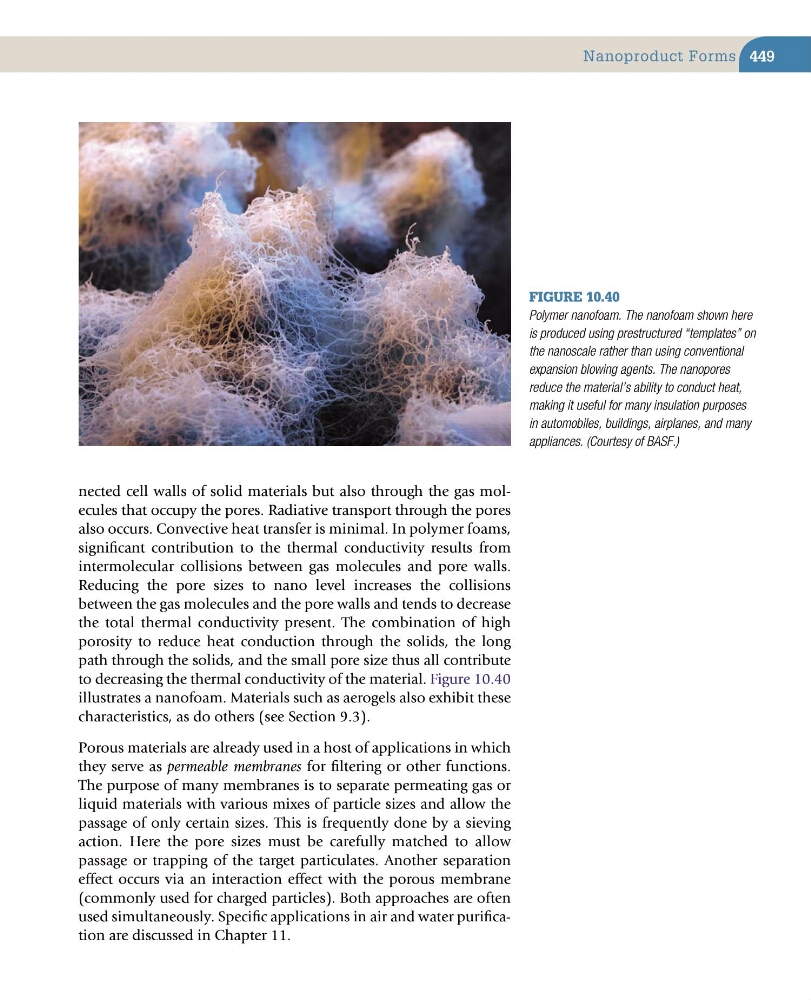
to decreasing the thermal conductivity of the material. Figure 10.40
illustrates a nanofoam. Materials such as aerogels also exhibit these
characteristics, as do others (see Section 9.3).
Porous materials are already used in a host of applications in which
they serve as permeable membranes for filtering or other functions.
The purpose of many membranes is to separate permeating gas or
liquid materials with various mixes of particle sizes and allow the
passage of only certain sizes. This is frequently done by a sieving
action. Here the pore sizes must be carefully matched to allow
passage or trapping of the target particulates. Another separation
effect occurs via an interaction effect with the porous membrane
(commonly used for charged particles). Both approaches are often
used simultaneously. Specific applications in air and water purification are discussed in Chapter 11.
Nanoproduct Forms
Figure 10.40
Polymer nanofoam. The nanofoam shown here
is produced using prestructured “templates” on
the nanoscale rather than using conventional
expansion blowing agents. The nanopores
reduce the material’s ability to conduct heat,
making it useful for many insulation purposes
in automobiles, buildings, airplanes, and many
appliances. (Courtesy of BASF.)
nected cell walls of solid materials but also through the gas molecules that occupy the pores. Radiative transport through the pores
also occurs. Convective heat transfer is minimal. In polymer foams,
significant contribution to the thermal conductivity results from
intermolecular collisions between gas molecules and pore walls.
Reducing the pore sizes to nano level increases the collisions
between the gas molecules and the pore walls and tends to decrease
the total thermal conductivity present. The combination of high
porosity to reduce heat conduction through the solids, the long
path through the solids, and the small pore size thus all contribute
to decreasing the thermal conductivity of the material. Figure 10.40
illustrates a nanofoam. Materials such as aerogels also exhibit these
characteristics, as do others (see Section 9.3).
Porous materials are already used in a host of applications in which
they serve as permeable membranes for filtering or other functions.
The purpose of many membranes is to separate permeating gas or
liquid materials with various mixes of particle sizes and allow the
passage of only certain sizes. This is frequently done by a sieving
action. Here the pore sizes must be carefully matched to allow
passage or trapping of the target particulates. Another separation
effect occurs via an interaction effect with the porous membrane
(commonly used for charged particles). Both approaches are often
used simultaneously. Specific applications in air and water purification are discussed in Chapter 11.
Nanoproduct Forms
Figure 10.40
Polymer nanofoam. The nanofoam shown here
is produced using prestructured “templates” on
the nanoscale rather than using conventional
expansion blowing agents. The nanopores
reduce the material’s ability to conduct heat,
making it useful for many insulation purposes
in automobiles, buildings, airplanes, and many
appliances. (Courtesy of BASF.)